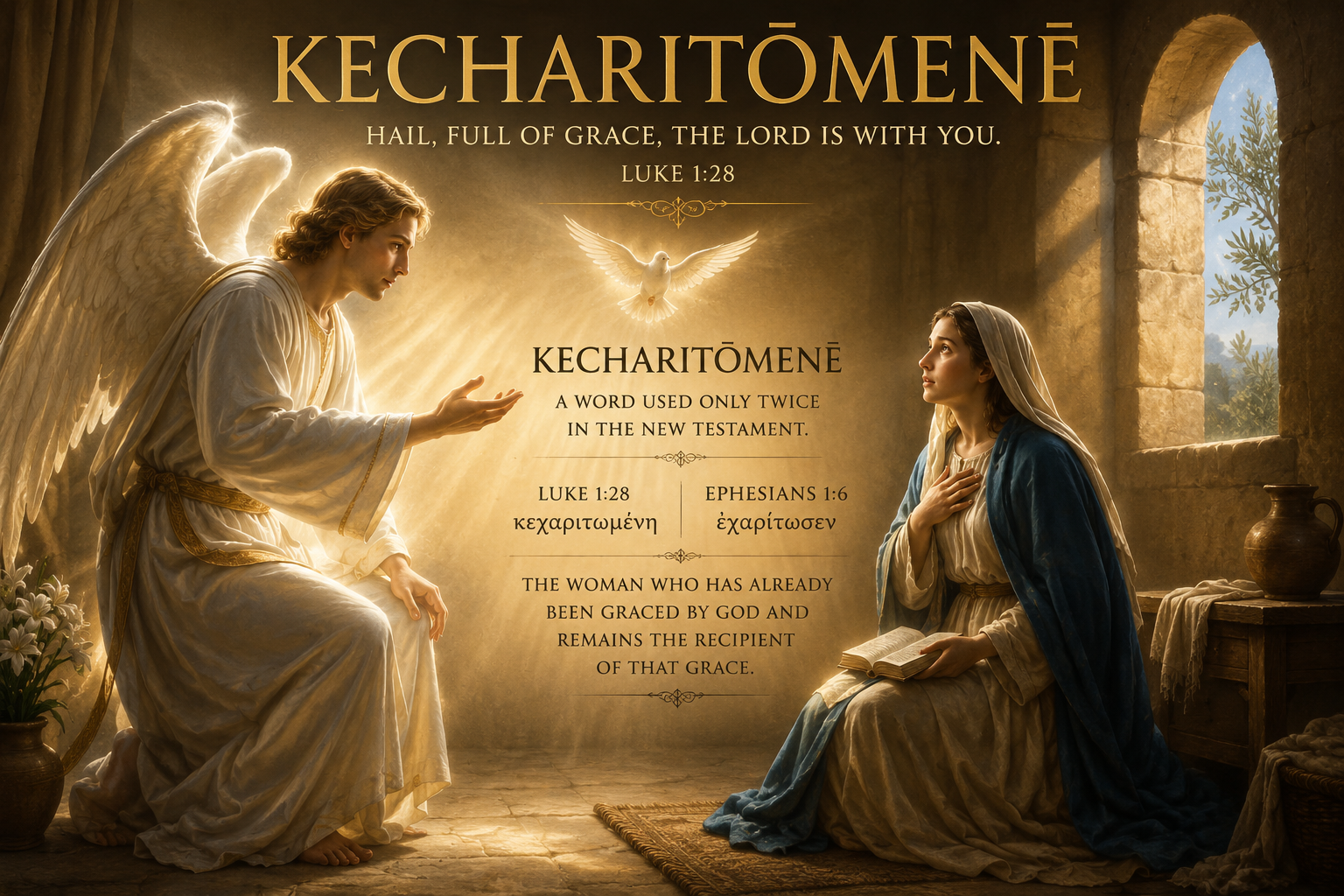
Kecharitōmenē — What Did the Angel Gabriel Really Call Mary?
When the angel Gabriel appears to Mary in Luke’s Gospel, something extraordinary happens that is easy to miss in an English translation.
Gabriel does not begin by addressing her simply as “Mary.”
Instead, he addresses her with a remarkable Greek word:
Χαῖρε, κεχαριτωμένη, ὁ κύριος μετὰ σοῦ.
Chaire, kecharitōmenē, ho Kyrios meta sou.— Luke 1:28
Traditionally translated:
“Hail, full of grace, the Lord is with thee.”
The crucial word is:
κεχαριτωμένη — kecharitōmenē
Understanding this word opens up one of the most important biblical foundations for the Catholic understanding of Mary.
Gabriel Gives Mary a Unique Greeting
Notice first what Gabriel does not say.
He does not say:
“Hail, Mary.”
Instead, Gabriel addresses her as:
Kecharitōmenē
The word functions almost like a title:
“Hail, Kecharitōmenē.”
Only afterward, in Luke 1:30, does Gabriel actually use her name:
“Do not be afraid, Mary, for you have found favor with God.”
Why would an angel sent directly from God greet this young woman with such an unusual expression?
To understand that, we have to look at the Greek.
What Does Kecharitōmenē Mean?
The word comes from the Greek verb:
χαριτόω — charitoō
It means to grace, bestow grace upon, or endow with grace or favour.
But Gabriel does not simply use the ordinary form of the verb.
Kecharitōmenē is a:
Perfect Passive Participle
Each part matters.
A Word Used Only Twice in the New Testament
What makes Gabriel’s greeting even more remarkable is how unusual the underlying verb actually is.
The Greek verb behind kecharitōmenē is charitoō (χαριτόω) — to bestow grace or favour upon someone.
Although the New Testament speaks about grace (charis) many times, this particular verb, charitoō, occurs only twice in the entire New Testament.
The first is Gabriel’s greeting to Mary:
“Hail, kecharitōmenē, the Lord is with you.”
— Luke 1:28
The second occurs in St. Paul’s Letter to the Ephesians:
“To the praise of his glorious grace, which he has bestowed upon us in the Beloved.”
— Ephesians 1:6
The Greek verb translated here as “bestowed” is charitoō — the same underlying verb used of Mary.
This comparison is important because it prevents us from exaggerating the argument.
Christians are indeed graced by God. Ephesians makes that clear.
But Luke uses a particularly striking grammatical form when Gabriel addresses Mary:
Ke-charitō-menē
The prefix and grammatical form matter because kecharitōmenē is a perfect passive participle.
Gabriel is addressing Mary as someone upon whom God’s gracious action has already taken place, with the resulting condition continuing into the present.
Perfect — Something Has Already Happened
The Greek perfect tense normally describes an action that has been completed with a resulting state that remains relevant.
In other words, Gabriel is not merely describing something beginning at the instant he appears.
Mary has already been graced, and she stands before Gabriel in the resulting state of that divine action.
That is important.
Gabriel does not arrive and say, in effect:
“God is going to begin giving you grace.”
He encounters a woman who has already been the recipient of God’s grace.
Before Mary has conceived Christ, before she has performed any great work, Gabriel encounters her as:
Kecharitōmenē
The woman whom God has already graced and who stands before him in that graced condition.
Passive — God Has Done This to Mary
The word is also passive.
Mary did not produce this grace herself.
It was done to her.
God is the source.
Therefore, whatever privilege Mary possesses is not something she accomplished independently of God.
It is entirely the work of divine grace.
This immediately answers a common misunderstanding of Catholic teaching.
Catholics do not believe Mary made herself sinless.
Catholics believe that God acted upon Mary by His grace.
Even the grammar points toward God as the one responsible for Mary’s privileged state.
Mary Still Needed a Saviour
This point is essential.
The Immaculate Conception does not mean that Mary had no need of Jesus Christ as her Saviour.
Mary herself declares:
“My spirit rejoices in God my Savior.”
— Luke 1:47
Mary absolutely needed a Saviour.
The question is not whether Christ saved Mary.
The question is how Christ saved her.
Think of a Fence
Imagine two people approaching a deep pit.
One person falls into the pit and is pulled out.
The other is stopped by a fence before falling in.
Both have been saved from the pit.
The first is saved by being rescued after falling.
The second is saved by being preserved from falling in the first place.
Catholic teaching understands Mary’s redemption in this second sense.
She did not save herself, nor did she exist apart from Christ’s saving work.
Rather, by a unique act of God’s grace, the merits of Jesus Christ were applied to her preventively, preserving her from original sin from the first moment of her existence.
The fence did not mean she did not need saving.
The fence was the way she was saved.
This is why Mary’s words in Luke 1:47 fit perfectly with the doctrine of the Immaculate Conception.
She truly needed a Saviour.
And her Saviour was Jesus Christ.
Her preservation from sin was not an exception to Christ’s redemption.
It was an extraordinary result of Christ’s redemption.
The Catechism describes Mary as being redeemed “in a more exalted fashion” by reason of the merits of Christ.
Mary’s Immaculate Conception therefore does not compete with Christ’s saving work.
It is entirely the result of Christ’s saving work.
“Full of Grace”
This explains why the traditional Catholic translation “full of grace” is so significant.
It is important, however, to be precise in apologetics.
Kecharitōmenē does not literally consist of separate Greek words meaning “full” + “of” + “grace.”
Rather, it describes Mary as a woman who has been endowed with grace and remains in that graced condition.
So when Catholics point to Luke 1:28, the argument should not be:
“The Greek literally says Mary was immaculately conceived.”
It doesn’t.
The argument is more sophisticated.
Luke presents Mary as someone upon whom God has already acted with grace before Gabriel announces the conception of Christ.
The question then becomes:
Why has Mary already been so extraordinarily graced?
And this is where Luke 1:28 begins to connect with the rest of Scripture.
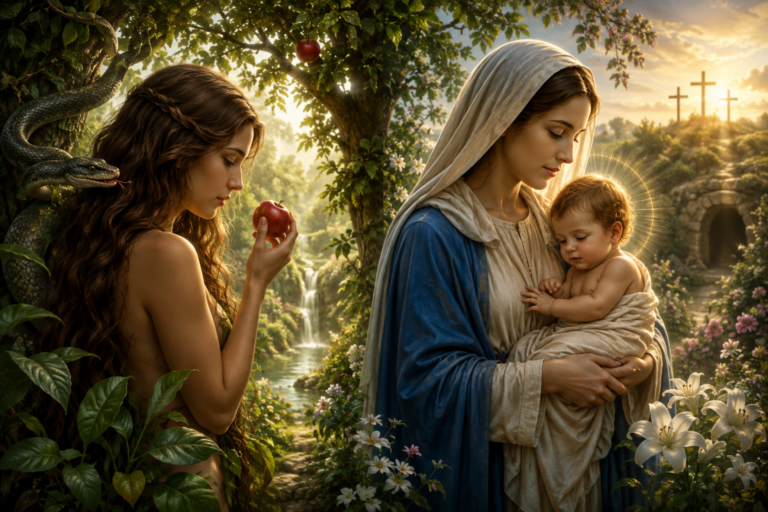
The New Eve
We have already seen the extraordinary parallel between Eve and Mary.
Eve begins her existence without sin.
She encounters a fallen spiritual creature — the serpent.
She believes his word.
She disobeys God.
Through that disobedience comes death.
Mary encounters a holy spiritual creature — Gabriel.
She believes God’s message.
And she responds:
“Behold, I am the handmaid of the Lord; let it be to me according to your word.”
— Luke 1:38
Through Mary’s obedience comes Jesus Christ — the One who defeats death.
The early Church recognized this reversal.
Eve’s disobedience is answered by Mary’s obedience.
If Mary is truly the New Eve, another question naturally follows:
Would the New Eve begin in a condition inferior to the first Eve?
The first Eve was created without sin.
The Catholic understanding is that the New Eve was likewise prepared by God in holiness — but unlike Eve, Mary remained obedient.
Now Luke’s description becomes even more significant:
Kecharitōmenē
The woman whom God has already graced.
The Woman and the Serpent
Now return to the first prophecy after the Fall:
“I will put enmity between you and the woman, and between your seed and her seed.”
— Genesis 3:15
God establishes enmity between the serpent and the woman.
Then at Calvary, Jesus looks at Mary and calls her:
“Woman.”
— John 19:26
This is the same Gospel in which Jesus also calls Mary “Woman” at Cana.
Mary appears within the biblical pattern of the Woman whose offspring defeats the serpent.
And this gives further meaning to her extraordinary preparation by grace.
The woman destined to bring forth the victorious Seed belongs not to the serpent but to God.
The Ark of the New Covenant
Then another biblical pattern strengthens the picture.
The Old Testament Ark was made holy because it carried the signs of God’s covenant and was overshadowed by God’s presence.
Luke deliberately describes Mary using language that recalls the Ark.
Gabriel tells her:
“The Holy Spirit will come upon you, and the power of the Most High will overshadow you.”
— Luke 1:35
Mary is going to carry not merely symbols of God’s presence.
She will carry God the Son made flesh.
If the Old Covenant Ark was consecrated because of what it carried, how fitting would it be for the woman who carried Christ Himself to be uniquely sanctified by God?
Again, no single parallel by itself proves the entire doctrine.
But the pieces are beginning to converge.
Scripture Builds a Picture
This is where the Catholic argument becomes much stronger than simply quoting one verse.
Consider the whole picture.
Mary is the New Eve.
The first Eve was originally created without sin.
Mary is the Woman associated with the victorious Seed of Genesis 3:15.
Mary is the Ark of the New Covenant, overshadowed by the power of God and carrying God incarnate.
And when Gabriel finally appears to her, he addresses her not first by her personal name but as:
Kecharitōmenē
The one who has been graced and remains in that graced state.
These biblical themes converge remarkably well with what the Catholic Church would later define as the Immaculate Conception.
But Doesn’t Romans Say “All Have Sinned”?
One of the most common objections is Romans 3:23:
“For all have sinned and fall short of the glory of God.”
If “all” must mean absolutely every individual human being without exception, however, there is an immediate problem:
Jesus was truly human.
Yet Scripture explicitly teaches:
“He committed no sin.”
— 1 Peter 2:22
So Romans 3:23 is describing the universal human condition and humanity’s need for salvation.
It is not intended as a technical statement ruling out every possible exception created by God’s grace.
Mary does not escape the need for redemption.
She is redeemed by Christ.
The Catholic claim is simply that Christ’s redemption reached Mary preventively, preserving her from original sin.
What the Immaculate Conception Actually Means
The doctrine is often misunderstood.
The Immaculate Conception is not the Virgin Birth of Jesus.
It concerns Mary’s own conception.
The Catholic Church teaches that:
From the first moment of her conception, Mary was preserved from original sin by a singular grace of Almighty God, through the merits of Jesus Christ.
Notice who does everything:
God.
Mary does not save herself.
Mary does not make herself immaculate.
Mary does not exist independently of Christ’s redemption.
God gives the grace.
Christ provides the redemption.
Mary receives it.
Which brings us straight back to Gabriel’s greeting:
Kecharitōmenē
The passive form is beautifully appropriate.
God acted.
Mary received.
The New Eve Prepared by God
The Immaculate Conception therefore should not be viewed as an isolated Catholic belief invented centuries after Scripture.
It belongs within a much larger biblical pattern.
The first creation began with an Adam and an Eve.
The new creation begins with the New Adam and New Eve.
The first Eve was created without sin but freely chose disobedience.
The New Eve is prepared by God’s grace and freely responds:
“Let it be to me according to your word.”
Eve listens to the serpent.
Mary listens to God.
Eve’s disobedience participates in bringing death.
Mary’s obedience participates in bringing forth the One who conquers death.
And before Mary ever speaks her great yes, Scripture introduces her with an extraordinary title:
Kecharitōmenē
The woman whom God has graced.
Mary’s greatness therefore does not take glory away from God.
It reveals what the grace of God can accomplish.