The Didache — A Window Into the Earliest Christian Church
The Didache — c. AD 70–120
What did Christianity look like immediately after the age of the Apostles?
Did the earliest Christians simply gather together, read Scripture and interpret Christianity individually?
Or was there already a recognisable Christian way of life involving Baptism, Eucharistic worship, fasting, confession, bishops and deacons?
One of the oldest Christian documents outside the New Testament gives us a remarkable glimpse.
It is called:
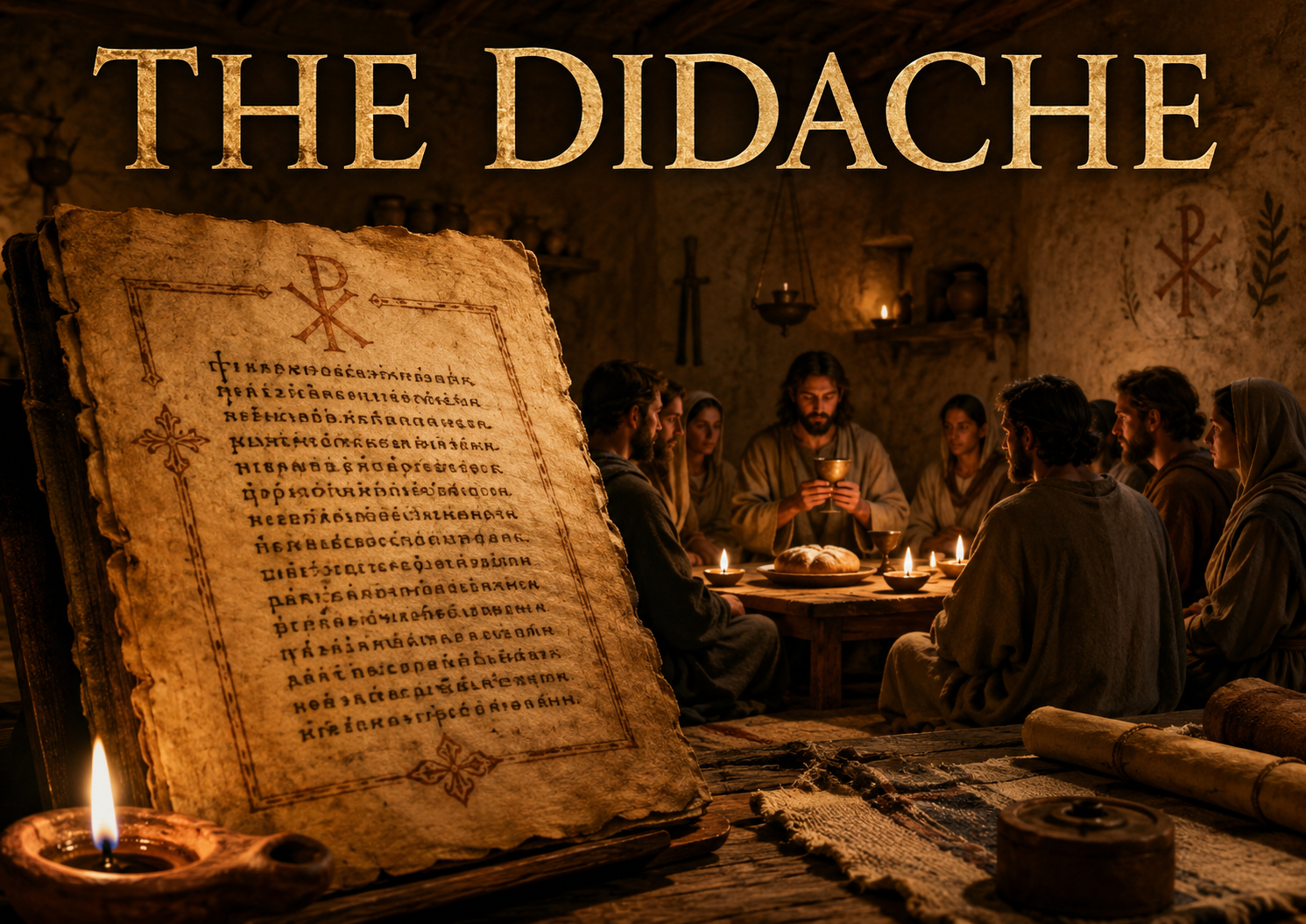
The Didache
The Greek word Didachē simply means:
Teaching
Its fuller ancient title is:
The Teaching of the Lord Through the Twelve Apostles to the Nations
The work is anonymous. It does not claim that one of the Twelve personally sat down and wrote it. Rather, it presents itself as a practical guide to Christian teaching and practice.
And it is extremely ancient.
Modern scholars generally place the Didache somewhere between the latter half of the first century and the first half of the second century, meaning that at least some of the people living when its traditions developed belonged to the generations immediately surrounding the Apostolic Church.
That makes the Didache enormously valuable.
It allows us to ask:
What did very early Christians actually do?
Christianity Was Already a Way of Life
The Didache begins with a striking statement.
There are two ways:
The Way of Life
and:
The Way of Death
The first chapters give moral instruction to Christians preparing to live according to Christ.
The teaching echoes Jesus’ commands to love God, love one’s neighbour, pray for enemies, avoid sexual immorality, reject greed and care for the poor.
This is important because Christianity is presented not merely as accepting certain ideas about Jesus.
It requires a transformed life.
Faith has consequences.
Christians are expected to live differently.
The Didache Condemns Abortion
One passage is particularly remarkable considering how early the document is.
Among a list of serious sins, the Didache explicitly forbids killing an unborn child through abortion and also condemns killing a child after birth.
This matters historically.
Opposition to abortion was not something the Catholic Church invented in the Middle Ages or in modern times.
We find it in one of the earliest surviving Christian documents outside the New Testament.
From very early Christianity, the protection of human life formed part of Christian moral teaching.
Baptism Was Already Trinitarian
Then the Didache turns from morality to Christian worship.
Chapter 7 gives instructions for:
Baptism
The preferred method is baptism in running or “living” water.
But if this is unavailable, other water may be used.
And if sufficient water is unavailable for immersion, the Didache explicitly permits water to be poured over the head three times.
Most importantly, the baptism is performed:
In the name of the Father, and of the Son, and of the Holy Spirit.
That is the same Trinitarian formula Christ gives in Matthew 28:19.
This is fascinating.
At an extremely early stage of Christianity we already find a recognised baptismal practice and a Trinitarian formula.
And the document shows that Christians were concerned primarily with the reality of Baptism rather than insisting that only one physical method could ever be valid.
Immersion was preferred when possible.
Pouring was accepted when necessary.
That sounds remarkably familiar to Catholic sacramental practice.
Christians Fasted on Particular Days
The Didache then gives another glimpse into early Christian discipline.
Christians were instructed to fast regularly.
But rather than fasting on the same days mentioned for others around them, the Didache tells Christians to fast on:
Wednesday
and:
Friday
It also instructs Christians to pray the Our Father three times each day.
Again, notice what we are seeing.
This is not a completely unstructured Christianity in which every Christian independently decides how Christian life should operate.
There are already:
shared prayers
shared fasts
shared moral expectations
and:
shared worship practices.
The Christian community has a recognisable rhythm of life.
Then Comes the Eucharist
Chapters 9 and 10 turn to something especially important:
The Eucharist
The Greek word used is Eucharistia — thanksgiving.
The Didache gives prayers associated with the cup and the broken bread and speaks of the Church being gathered into one just as scattered grain becomes one bread.
But then comes an extremely significant instruction.
Not everybody is permitted to participate.
The Didache says that those who have not been baptised are not to eat or drink of the Eucharist.
Think about what that tells us.
The Eucharist was not treated as an ordinary communal meal open indiscriminately to anyone who happened to attend.
There was already a boundary.
Baptism came first.
Then participation in the Eucharistic life of the Church followed.
That is strikingly similar to the sacramental order still found within the Catholic Church.
The Eucharist Was Something Holy
The reason given for restricting participation is also significant.
The Didache applies Christ’s warning about not giving what is holy indiscriminately when discussing participation in the Eucharist.
Whatever debates Christians may have today about the precise Eucharistic theology reflected in chapters 9–10, one point is difficult to miss:
The Eucharist was treated as sacred.
It was connected with Baptism.
It belonged to the worshipping Christian community.
It was not simply food shared casually among friends.
This is important when comparing the earliest Christian communities with modern forms of Christianity where Communion may be considered largely symbolic or optional.
The Didache shows that Eucharistic worship occupied an established place in Christian community life extremely early.
Christians Gathered on the Lord’s Day
Chapter 14 gives us another extraordinary glimpse into Christian worship.
The Didache instructs believers to gather on:
The Lord’s Day
They are to:
assemble together
break bread
and:
give thanks.
But something is supposed to happen first.
They are instructed to acknowledge their sins so that their offering will be pure.
Already we can see several elements coming together:
Sunday worship
Confession of sins
Breaking of bread
Eucharistic thanksgiving
Sacrificial language
This is Christianity at an extraordinarily early point in its history.
“That Your Sacrifice May Be Pure”
Perhaps the most striking wording in this section is the Didache’s description of the Christian gathering as involving a:
Sacrifice
The author connects the Lord’s Day gathering, confession and breaking of bread with the need for a pure sacrifice.
The Didache then connects this Christian worship with the prophecy of Malachi concerning a pure offering among the nations.
That should immediately interest Catholics.
The Catholic Church has always understood the Eucharist not as another sacrifice replacing Calvary, but as the sacramental making-present of the one sacrifice of Christ.
The Didache by itself does not give us a complete later theological explanation of the Mass.
We should not force later terminology into a document that does not explicitly use it.
But it does give us something extremely significant:
Very early Christians could describe their Lord’s Day Eucharistic assembly using sacrificial language.
That is difficult to reconcile with the idea that sacrificial Eucharistic worship was simply invented centuries later.
Confession Before Worship
Notice something else.
Before this sacrifice is offered, Christians are told to confess their transgressions and to reconcile with anyone with whom they are in conflict.
The concern is clear:
Do not approach Christian worship casually while knowingly remaining unreconciled.
Again, this is not yet a complete description of the later sacrament of Confession.
We should not claim that the Didache describes a medieval confessional.
It does not.
But it absolutely shows that confession of sin belonged to the worshipping life of the early Church.
Bishops and Deacons
Then we come to the organisation of the Church.
Chapter 15 tells Christian communities to appoint:
Bishops
and:
Deacons
They are to be worthy, truthful, tested and not lovers of money.
The Didache also speaks extensively about travelling apostles, prophets and teachers, suggesting that we are looking at Christianity during a period when some very early forms of itinerant ministry still existed alongside increasingly established local leadership. Cambridge’s recent scholarly edition likewise describes the work as containing rules concerning apostles, prophets, teachers and communal leadership.
Once again, Christianity is not presented as isolated individuals reading Christian texts without ecclesial authority.
There is already:
A community
Recognised ministers
Bishops
Deacons
Rules governing worship
Rules governing doctrine and moral conduct
The structure would continue to develop, but its roots are unmistakably early.
False Teachers Were Already a Problem
The Didache also warns Christians about false teachers and false prophets.
A person claiming spiritual authority was not automatically to be trusted.
His teaching and conduct had to correspond with the way of Christ.
Someone exploiting Christians for money could be exposed as false.
That gives us another glimpse of the early Church.
Christian communities already understood that:
Not every person claiming to teach Christianity actually represented the Apostolic faith.
There was a recognised body of teaching that believers were expected to preserve.
The Didache and Sacred Tradition
This is where the Didache becomes particularly interesting for Catholic apologetics.
The New Testament was still taking shape as a recognised collection of books during the period in which the Didache emerged.
Yet Christian communities clearly possessed an established life of:
teaching
Baptism
prayer
fasting
Eucharistic worship
moral discipline
Church leadership
and:
Sunday assembly.
Christianity existed as a living faith within the Church.
The faith was preached.
It was taught.
It was prayed.
It was celebrated sacramentally.
It was handed on.
That is exactly why the earliest Christian writings are so important when discussing Scripture and Tradition.
They show Christianity functioning as a Church.
Does the Didache Prove Catholicism?
We should be careful here.
The Didache is not a twenty-first-century Catholic catechism.
It does not discuss every later theological controversy.
It does not give us developed explanations of every sacrament.
And Catholics should not pretend that every sentence can simply be lifted from the document and placed directly into a modern missal.
That would be poor history.
But neither should we ignore what is actually there.
This extremely early Christian document describes a Church with:
Trinitarian Baptism
Baptism by pouring when necessary
regular fasting
the Our Father prayed repeatedly
a restricted Eucharistic communion
the Eucharist treated as holy
Lord’s Day worship
confession of sins
sacrificial language associated with Christian worship
bishops and deacons
and:
a recognised Christian moral tradition.
That does not settle every Catholic-Protestant debate by itself.
But it raises an important historical question:
Which form of Christianity does this look more like?
Christianity Before the Great Divisions
The Didache comes from a world long before:
Luther
Calvin
the Reformation
modern Evangelicalism
or the thousands of Christian denominations that exist today.
Indeed, its basic written form belongs within the first generations of Christianity itself.
And when we look through this ancient window, we do not find Christianity reduced simply to:
“Read the Bible and decide Christianity for yourself.”
We encounter a worshipping Church.
A baptising Church.
A fasting Church.
A Eucharistic Church.
A Church concerned with repentance and holiness.
A Church possessing bishops and deacons.
A Church determined to preserve the teaching it had received.
Why the Didache Matters
The Didache is valuable because it brings us remarkably close to the world immediately surrounding the Apostles.
It allows Christianity to speak to us from almost two thousand years ago.
And what we hear is important.
The earliest Christians did not see Christianity merely as an intellectual agreement with certain statements about Jesus.
Christianity was something they entered through Baptism.
Something they lived through moral discipline and prayer.
Something they celebrated together on the Lord’s Day.
Something centred upon the breaking of bread and thanksgiving.
Something guarded by an organised Christian community.
And something they believed had been handed down to them.
That is why the Didache remains such a powerful witness.
Not because every Catholic doctrine can be found fully developed within sixteen short chapters.
But because when the curtain is pulled back on some of the earliest generations of Christianity, what appears is already recognisably: