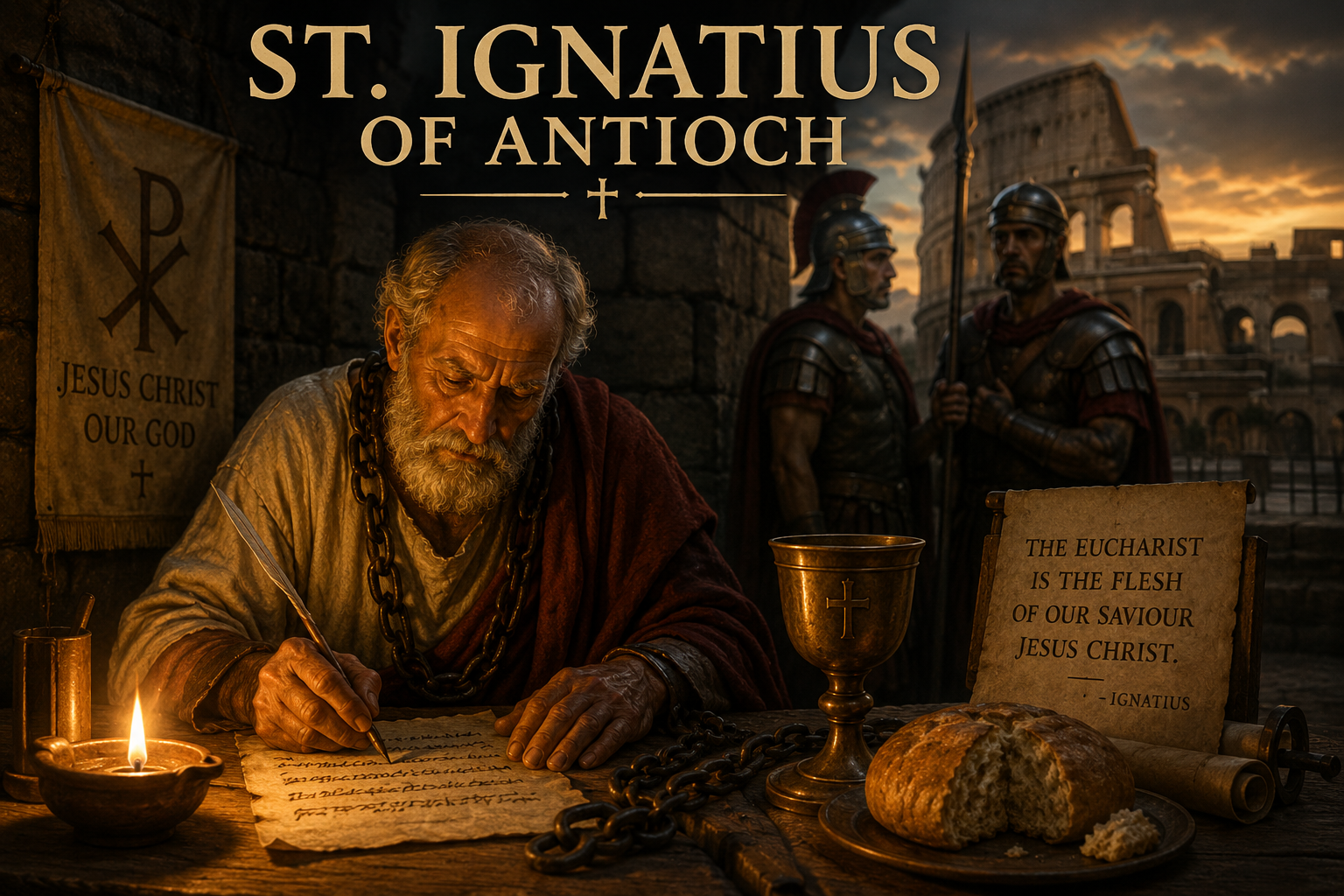
St. Ignatius of Antioch — The Eucharist, the Bishop and the Catholic Church
St. Ignatius of Antioch — c. AD 107
Imagine being able to read the words of a Christian bishop writing only a few generations after the death and Resurrection of Jesus Christ.
Not a medieval theologian.
Not someone writing a thousand years after the Apostles.
But a bishop of one of the great churches of the ancient world, travelling under guard toward Rome where he expected to be executed for his Christian faith.
That man was:
St. Ignatius of Antioch
And the letters he wrote on his final journey give us one of the clearest windows into what Christianity looked like at the beginning of the second century.
What we find is remarkable.
Ignatius speaks openly about:
Jesus Christ as God
the Eucharist as the flesh of Christ
bishops, presbyters and deacons
the authority of the bishop
Christian worship on the Lord’s Day
and even:
The Catholic Church
This is why the letters of Ignatius are so important for anyone trying to understand the beliefs of the earliest Christians.
Who Was Ignatius of Antioch?
Ignatius was Bishop of:
Antioch
Antioch was one of the most important cities in early Christianity.
The Acts of the Apostles tells us:
“And in Antioch the disciples were for the first time called Christians.”
— Acts 11:26
According to the ancient tradition summarized by Pope Benedict XVI, Ignatius was the third Bishop of Antioch and suffered martyrdom around AD 107.
That immediately puts him extraordinarily close to the Apostolic age.
We are not dealing with Christianity after centuries of theological development.
We are looking at Christianity near the beginning.
A Bishop on His Way to Die
Ignatius was arrested and transported from Syria toward Rome under military guard.
He knew where the journey was leading.
Martyrdom.
During the journey he encountered Christian communities and wrote letters to several churches.
According to the ancient account preserved by Eusebius and summarized by Benedict XVI, Ignatius wrote four letters while at Smyrna:
- Ephesians
- Magnesians
- Trallians
- Romans
After leaving Smyrna he wrote another three:
- Philadelphians
- Smyrnaeans
- Polycarp
These seven letters have become some of the most important surviving writings of the Apostolic Fathers.
Ignatius was not sitting comfortably in a theological school discussing Christianity in the abstract.
He was writing while chained and being transported toward his death.
That makes what he says about Christianity particularly powerful.
“Jesus Christ, Our God”
Before looking at Catholic doctrines, there is something even more fundamental.
What did this extremely early Christian bishop believe about Jesus?
Ignatius opens his Letter to the Ephesians referring to:
“Jesus Christ, our God.”
That is extraordinarily important.
Christian belief in the divinity of Jesus was not something invented at the Council of Nicaea in AD 325.
More than two centuries before Nicaea, Ignatius was already openly referring to Jesus Christ as:
God.
He also insists that Christ was genuinely human.
Against teachers who claimed that Jesus only appeared to have a physical body, Ignatius insists that Jesus:
was truly born
truly suffered
was truly crucified
and:
truly died.
This is the Christianity Ignatius inherited.
Jesus Christ is truly God.
And Jesus Christ truly became man.
Then Ignatius Talks About the Eucharist
This is where his writings become especially important for Catholic apologetics.
Some early heretics denied that Christ had truly taken human flesh.
Ignatius explains that these people refused to participate in the Eucharist.
Why?
Because:
“They confess not the Eucharist to be the flesh of our Saviour Jesus Christ.”
Stop for a moment and consider what Ignatius has just said.
This is around the beginning of the second century.
And a Christian bishop is identifying the Eucharist with:
The flesh of Jesus Christ.
Not merely with an image of His flesh.
Not merely with a reminder of His flesh.
Ignatius specifically connects the Eucharist with the same flesh that suffered for our sins and was raised by the Father.
That makes the context particularly powerful.
He is arguing against people who denied the reality of Christ’s physical body.
And one of the reasons they reject the Eucharist is precisely because Christian Eucharistic belief contradicts their theology.
This Is Very Difficult to Explain as “Only Symbolic”
Suppose someone claimed that the earliest Christians believed Communion was merely symbolic bread and wine.
Ignatius becomes difficult to explain.
Why would people who denied Christ’s real flesh refuse the Eucharist because Christians believed it was His flesh?
If the Eucharist simply meant:
“This bread reminds us of Jesus,”
there would be little reason for their denial of Christ’s physical body to create such a problem.
But Ignatius tells us exactly why there was a problem.
The Eucharistic faith of the Church was tied to the reality of Christ’s flesh.
That does not mean Ignatius provides a complete later scholastic explanation of Transubstantiation.
He does not.
That terminology developed much later as the Church explained more precisely how Christ is present.
But the underlying belief is already strikingly clear:
The Eucharist is not ordinary bread.
Ignatius treats it as intimately and objectively connected with the actual flesh of Jesus Christ.
The “Medicine of Immortality”
Ignatius says something equally remarkable in his Letter to the Ephesians.
Speaking of the one bread shared by Christians, he calls it:
“the medicine of immortality”
and describes it as an antidote against death leading to eternal life in Jesus Christ.
Again, this is extremely strong Eucharistic language.
For Ignatius, the Eucharist is not an optional symbolic exercise added onto Christianity.
It belongs to the very life of the Church.
It is connected with:
Christ
unity
eternal life
and:
immortality.
One Eucharist — Under the Bishop
Ignatius then reveals something else about early Christianity.
The Eucharist was not something any Christian could simply decide to celebrate independently.
Ignatius tells the Smyrnaeans that the proper Eucharist is the one celebrated by:
the bishop
or:
someone authorised by the bishop.
This tells us a great deal.
Already at this extraordinarily early period there is a visible structure to Christian worship.
The Eucharist belongs within the Church.
And the bishop has responsibility for the sacramental life of that Church.
This is a very different picture from Christianity as completely independent congregations with self-appointed ministers.
Bishop, Presbyters and Deacons
Throughout his letters, Ignatius repeatedly refers to three identifiable forms of ministry:
Bishop
Presbyters
Deacons
For example, in his Letter to the Magnesians, Ignatius speaks of the bishop presiding, the presbyters forming a council, and the deacons carrying out the ministry of Jesus Christ.
The same structure appears again in his Letter to the Trallians.
The terminology is important.
The Greek presbyteroi means elders or presbyters, and it is from this ministry that our English word priest ultimately developed.
Ignatius therefore gives us an early picture of the threefold ordained structure familiar throughout historic Christianity:
Bishop
Priest / Presbyter
Deacon
This structure is not appearing in a medieval document.
We encounter it at the very beginning of the second century.
Why Was the Bishop So Important?
Ignatius constantly urges Christians to remain united to their bishop.
Why?
Because for Ignatius, Christianity is not simply an invisible relationship between an individual and Jesus.
Christ created:
A Church.
The bishop is a visible focus of unity within the local Christian community.
Ignatius tells the Smyrnaeans to follow their bishop, their presbytery and their deacons, and he specifically connects the bishop with the proper celebration of the Eucharist.
This gives us a Church that is simultaneously:
visible
organised
sacramental
and:
hierarchical.
That does not mean every administrative detail of the modern Catholic Church already existed in precisely its present form.
Christian institutions developed as the Church grew.
But the essential structure is already clearly visible.
Then Ignatius Uses an Extraordinary Expression
In the same Letter to the Smyrnaeans, Ignatius writes:
“Wherever Jesus Christ is, there is the Catholic Church.”
There it is.
Catholic Church
The word katholikē means universal or according to the whole.
We should not pretend that Ignatius was using every later meaning contained in the modern expression Roman Catholic Church.
That would be anachronistic.
But neither should we dismiss what he actually says.
A Christian bishop writing around the beginning of the second century could already speak naturally about:
The Catholic Church.
And look at the context.
Immediately around that statement Ignatius is discussing:
the bishop
the Eucharist
Baptism
and:
the unity of the Christian community.
That context is extremely significant.
The “Catholic Church” for Ignatius is not an invisible collection of Christians who happen to hold similar beliefs.
It has visible communion.
It has bishops.
It celebrates the Eucharist.
And Christians are expected to remain united to it.
Christianity Was Not “Me and My Bible”
Remember when Ignatius is writing.
The New Testament books existed, but Christians did not yet possess a universally settled, bound 27-book New Testament sitting on every believer’s shelf.
Yet Ignatius clearly knows what Christianity is.
He repeatedly appeals to the faith received from Christ and the Apostles and warns Christians against false doctrine. Benedict XVI described Ignatius as urging communities to hold firmly to the tradition of the Apostles.
Christianity is being lived and transmitted through:
the Church
bishops
presbyters
deacons
the Eucharist
the Gospel
and:
the Apostolic faith.
Once again, the earliest Christian evidence presents Christianity as a living Church rather than simply an individually interpreted book.
Christians Were Worshipping on the Lord’s Day
Ignatius also gives us evidence concerning the Christian day of worship.
Writing to the Magnesians, he contrasts observance of the old Sabbath with Christian life centred on:
The Lord’s Day
the day associated with Christ’s Resurrection.
This fits perfectly with what we have already seen in the Didache, where Christians are instructed to gather on the Lord’s Day to break bread and give thanks.
The two documents reinforce one another.
Very early Christianity already has a recognisable weekly rhythm centred upon:
The day of the Resurrection.
Ignatius Was Willing to Die for This Faith
And this is perhaps what gives his testimony its greatest force.
Ignatius was not merely defending theological propositions.
He believed this faith so deeply that he was prepared to die for it.
In his Letter to the Romans he famously describes himself as:
“the wheat of God”
and speaks of being ground by the teeth of wild beasts so that he might become the pure bread of Christ.
His language is intense because he genuinely expects martyrdom.
He asks the Roman Christians not to intervene to save him.
He wants to remain faithful to Christ even unto death.
According to the ancient tradition recorded by Eusebius, Ignatius eventually reached Rome and was killed by wild animals.
Why His Testimony Matters
Ignatius matters because of when he lived.
If these beliefs first appeared in the fourth, fifth or tenth centuries, critics of Catholicism might reasonably argue that Christianity had radically changed.
But Ignatius is writing near the beginning of the second century.
And in his letters we already find:
Jesus explicitly called God
Christ’s true flesh and true suffering
the Eucharist identified with the flesh of Christ
the Eucharist called the medicine of immortality
one Eucharistic communion
bishops
presbyters
deacons
authority connected with the bishop
worship on the Lord’s Day
and:
The Catholic Church
These are not conclusions being imposed upon Ignatius from the Middle Ages.
They are found in his own letters.
Compare This With the Didache
Now place Ignatius beside the Didache.
The Didache showed us:
Trinitarian Baptism
Sunday Eucharistic worship
confession of sins
fasting
bishops and deacons
and:
a sacred Eucharistic community.
Ignatius now brings that early Christian picture into even sharper focus.
He gives us:
bishop, presbyter and deacon
a Eucharist governed by ecclesial authority
the Eucharist as Christ’s flesh
and:
the Catholic Church.
These two witnesses come from extremely early Christianity.
And together they raise an important question.
What did the Church immediately after the Apostles actually look like?
It does not look like Christianity had to wait hundreds of years before becoming sacramental and episcopal.
Those features are already there.
The Eucharist Is the Key
Perhaps the most important passage for Catholic apologetics remains Ignatius’s warning about those who reject Christian teaching:
“They confess not the Eucharist to be the flesh of our Saviour Jesus Christ.”
Those words were not written at the Council of Trent.
They were not written by Thomas Aquinas.
They were not written by a medieval pope.
They were written by:
A bishop of Antioch near the beginning of the second century.
A man belonging to the generation immediately following the Apostolic age.
A man travelling toward martyrdom.
And he expected the Christians receiving his letters to understand exactly what he meant.
That is why Ignatius is such an important witness.
What Kind of Church Do We See?
When we read Ignatius without imposing modern denominational assumptions upon him, a picture emerges.
Christianity has:
doctrine that must be preserved
a visible Church
bishops
presbyters
deacons
sacramental worship
one Eucharistic communion
Sunday worship
and:
a belief that the Eucharist is truly connected with the flesh and blood of Jesus Christ.
And Ignatius has a name for this universal Christian body:
The Catholic Church.
This does not mean that every later Catholic doctrine can be proved from seven letters written by one bishop.
That would be an unreasonable standard.
But it does mean that anyone claiming early Christianity was essentially modern low-church Protestantism has a serious historical problem to address.
Ignatius simply does not describe that kind of Christianity.
What he describes looks remarkably like:
A visible, sacramental, episcopal and Catholic Church.
And he describes it while the memory of the Apostles was still extraordinarily close.