From the Tabernacle to the Altar: How the Catholic Mass Fulfils the Worship of the Old Covenant
From the Tabernacle to the Altar: How the Catholic Mass Fulfils the Worship of the Old Cove
The Old Testament Concealed — the New Testament Revealed
When we read the instructions God gave Moses for the worship of Israel, something remarkable begins to emerge.
There is a sanctuary.
There is an altar.
There are priests set apart for sacred ministry.
They wear sacred vestments.
They wash before approaching the altar.
There are candles and lamps.
There is incense.
There are sacred vessels.
There is bread kept continually before the presence of God.
There are offerings brought by the people to maintain the sanctuary and its worship.
There is sacrificial blood.
There is ritual sprinkling.
And at the centre of Israel’s great feast of deliverance stands an unblemished lamb that is sacrificed — and then eaten.
To a Catholic, much of this sounds strangely familiar.
Yet this is not the Catholic Mass.
This is the worship of the Old Covenant, given by God to Moses centuries before the birth of Christ.
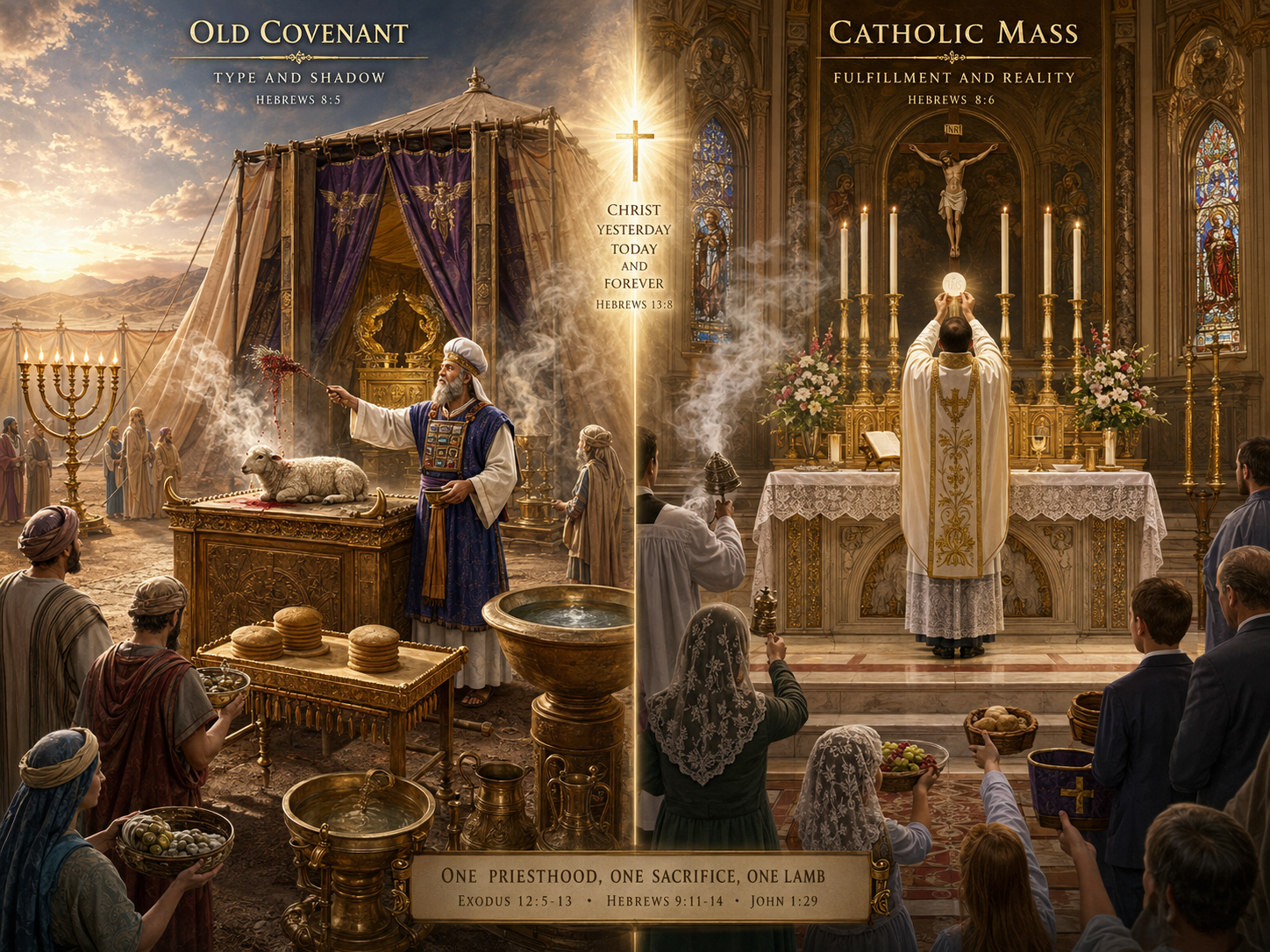
The resemblance matters because Scripture itself tells us that these things were shadows of something greater to come.
Hebrews describes the priests of the Old Covenant as serving in a sanctuary that was a “copy and shadow of the heavenly sanctuary.” Moses was commanded to construct the Tabernacle according to the heavenly pattern God revealed to him.
The Old Covenant sanctuary was therefore not an arbitrary collection of religious ceremonies.
God was teaching his people through signs.
The Tabernacle, priesthood, sacrifices, lamb, blood, bread, incense and sacred worship were preparing the world for Jesus Christ.
And once Christ comes, the shadows begin to reveal their meaning.
—
The Tabernacle: God Dwelling Among His People
After Israel’s deliverance from Egypt, God commands Moses to construct the Tabernacle — the sacred dwelling in which his presence would remain among his people.
When its construction is completed:
«“The glory of the LORD filled the tabernacle.”
— Exodus 40:34»
The cloud of God’s glory covered the Tent of Meeting so powerfully that Moses himself could not enter.
The Tabernacle was therefore more than a meeting hall.
It was sacred space because God dwelt there.
That principle does not disappear in the New Covenant.
Instead, it reaches its fulfilment in Christ.
St John tells us:
“The Word became flesh and made his dwelling among us.”
— John 1:14
The Greek expression carries the imagery of pitching one’s tent or tabernacling among humanity.
What had once been manifested in cloud and glory now appears personally in Jesus Christ, Emmanuel — God with us.
And following Christ’s institution of the Eucharist, Catholic churches again contain a tabernacle — not because Catholics are attempting to reconstruct Judaism, but because the consecrated Eucharist is reserved there.
The Old Tabernacle contained signs of God’s presence.
The Christian tabernacle contains Christ sacramentally present in the Eucharist.
The Church therefore did not abandon the biblical idea of God dwelling in the midst of his people.
Its fulfilment became greater than the shadow.
—
The Priesthood: Set Apart for Sacred Worship
God did not permit anyone simply to enter the sanctuary and perform its sacred rites.
Aaron and his sons were specifically chosen for priestly ministry.
Exodus 28 describes sacred garments made for Aaron because he was to serve God as priest. The priestly vestments included a tunic, robe, ephod, breastpiece, sash and turban.
Before their ministry, the priests were:
– washed with water,
– clothed in sacred vestments,
– anointed,
– consecrated,
– and set apart for service at the altar.
Exodus 29 explicitly commands that Aaron and his sons be washed, vested and anointed before exercising their priestly office.
Again, the Catholic claim is not that a Catholic priest is simply a Levitical priest under another name.
The Letter to the Hebrews makes clear that the Levitical priesthood itself was incomplete.
Its fulfilment is Jesus Christ, the eternal High Priest.
The Catechism states that everything prefigured by the Old Covenant priesthood finds its fulfilment in Christ, the one perfect High Priest whose sacrifice is unique.
The Catholic priest therefore does not replace Christ.
He ministers in Christ’s priesthood.
This helps explain why Catholic worship still possesses a visible ministerial priesthood, sacred vestments, ritual washing, an altar and a sacrificial liturgy.
The shadow has passed.
But the reality to which the shadow pointed has not disappeared.
It has been fulfilled in Christ.
—
The Altar: Because Biblical Worship Is Sacrificial
At the centre of Old Covenant worship stood an altar.
Why?
Because covenant worship involved sacrifice.
That becomes extremely important when examining Christianity.
Many modern Christians are accustomed to worship centred almost entirely upon preaching and singing.
But biblical worship repeatedly revolves around:
priest — altar — offering — sacrifice — covenant meal.
Catholic churches therefore contain an altar for a profoundly biblical reason.
The Mass is not merely a Bible study, prayer meeting or remembrance service.
It is the sacramental celebration of Christ’s one eternal sacrifice.
The General Instruction of the Roman Missal calls the altar the centre of the Eucharistic liturgy and describes the bread and wine being placed upon it during the preparation of the gifts.
The existence of an altar tells us something about what Catholics believe is happening.
There is a sacrifice.
But whose sacrifice?
Christ’s.
—
The Daily Lamb — With Bread and Wine
One of the most striking passages appears in Exodus 29.
After describing the consecration of the priests, God gives instructions for the regular sacrifice offered at the sanctuary.
An unblemished year-old lamb was to be offered in the morning and another in the evening.
The lamb was accompanied by an offering of flour mixed with oil and a libation.
After describing this regular sacrifice, God promises that he will meet Israel there and dwell among his people.
Think about the pattern:
A priest.
An altar.
An unblemished lamb.
Bread or grain.
A libation.
Sacrifice.
God dwelling among his people.
We should not mechanically identify every element with a Catholic rubric.
Biblical typology is deeper than that.
But the pattern prepares the biblical imagination for what is coming.
Because eventually another Lamb appears.
—
“Behold, the Lamb of God”
When John the Baptist sees Jesus approaching, he does not merely say:
“There is the Messiah.”
He proclaims:
“Behold, the Lamb of God.”
The language of sacrifice has entered the story.
St Paul becomes even more explicit:
“For our paschal lamb, Christ, has been sacrificed.”
— 1 Corinthians 5:7
Jesus is not merely compared poetically with a lamb.
He is presented as the fulfilment of the sacrificial Lamb.
And this brings us to one of the most important Eucharistic parallels in the entire Bible.
—
The Passover Lamb Had to Be Eaten
Before Israel escaped from Egypt, every household was commanded to select an unblemished lamb.
The lamb was killed.
Its blood marked the home.
Through that blood the household was spared from death.
But the ritual did not end when the lamb was killed.
They had to eat the lamb.
God specifically commanded Israel to eat the sacrificial victim.
Furthermore, Exodus commands that none of the Passover lamb’s bones were to be broken.
Now look at Christ.
St John deliberately records that when Jesus died on the Cross, his legs were not broken, explicitly connecting what happened to Scripture.
Christ is the true Paschal Lamb.
And what does Jesus command his disciples concerning himself?
In John 6 he says:
“Whoever eats my flesh and drinks my blood has eternal life.”
He goes further:
“My flesh is true food, and my blood is true drink.”
— John 6:54–55
This is where the Eucharistic typology becomes extraordinary.
Old Passover
The lamb is chosen.
The lamb is sacrificed.
Its blood saves.
The lamb is eaten.
New Passover
Christ is the Lamb.
Christ is sacrificed.
His Blood saves.
And Christ commands:
Take and eat. This is my Body.
The Eucharist is therefore not merely a symbol reminding Christians that Jesus was once the Lamb.
The Eucharist is sacramental communion with Jesus Christ himself — the true Paschal Lamb.
St Paul connects these ideas directly.
He calls Christ our sacrificed Paschal Lamb and elsewhere calls the Eucharistic cup a participation in Christ’s Blood and the bread a participation in Christ’s Body.
The New Covenant feast is centred upon receiving the Lamb.
—
The Blood of the Covenant
Another extraordinary parallel appears at Mount Sinai.
Moses offers sacrifice and takes the blood.
Some is placed upon the altar.
Then Moses takes the blood and sprinkles it upon the people, declaring:
“This is the blood of the covenant which the LORD has made with you.”
— Exodus 24:8
Remember those words.
Because centuries later Jesus sits with his Apostles at the Last Supper.
He takes the chalice and identifies it with:
the Blood of the Covenant.
St Mark’s Gospel explicitly places Christ’s words within the transition from Passover to the New Covenant and notes the connection with Exodus 24.
St Paul preserves the same tradition:
“This cup is the new covenant in my blood.”
— 1 Corinthians 11:25
This is not accidental wording.
At Sinai:
sacrifice → blood → covenant.
At the Last Supper and Calvary:
Christ → his Blood → New Covenant.
Jesus is deliberately bringing the Old Covenant imagery to fulfilment in himself.
—
Sprinkling, Hyssop and Holy Water
Here we need to be precise.
It would be too simplistic to say that Old Covenant blood simply became Catholic holy water.
But there is a profound biblical continuity in the imagery of sprinkling, cleansing and consecration.
Old Covenant purification rites used both sacrificial blood and water.
Psalm 51 famously cries:
“Cleanse me with hyssop, that I may be pure.”
The USCCB commentary notes that hyssop was used as a natural sprinkler for sacrificial blood or cleansing water in Mosaic rites.
Numbers 19 describes a clean person taking hyssop, dipping it into water used for purification and sprinkling people, tents and vessels.
Then the prophet Ezekiel looks toward a coming restoration and declares God’s promise:
“I will sprinkle clean water over you to make you clean.”
— Ezekiel 36:25
The imagery therefore develops:
blood — water — hyssop — sprinkling — cleansing — consecration.
Christ brings true purification through his Blood, while water becomes central to New Covenant sacramental life through Baptism.
Catholic use of blessed water stands within this broad biblical language of water, blessing, purification and remembrance of Baptism.
And there is an especially beautiful echo in the older Roman liturgy.
Before the principal Sunday Mass, the traditional Asperges uses blessed water while Psalm 51’s plea for cleansing with hyssop is sung.
The Church is not pretending that holy water is Christ’s Blood.
Rather, the ancient biblical language of sprinkling and purification continues within Christian worship while its ultimate cleansing power comes from Christ.
—
The Bread of the Presence
Inside the Old Covenant sanctuary stood a table bearing sacred bread before God.
Hebrews 9 itself recalls that the Holy Place contained:
– the lampstand,
– the table,
– and the bread of offering or Bread of the Presence.
The bread remained before the Lord in the sanctuary.
Then Jesus comes and declares:
“My Father gives you the true bread from heaven.”
And:
“I am the bread of life.”
— John 6
Again the Old Covenant sign gives way to something immeasurably greater.
Not bread merely standing before God’s presence.
But Christ himself:
the true Bread from Heaven.
The Eucharistic tabernacle therefore produces a remarkable biblical image.
In Israel’s sanctuary there was sacred bread continually before God.
In the Christian sanctuary the consecrated Eucharist is reserved because Catholics believe the Bread has become what Christ said it is:
his Body.
—
Melchizedek: Priest, Bread and Wine
Before there was a Levitical priesthood, Scripture introduces a mysterious figure.
Melchizedek.
Genesis tells us:
Melchizedek was a priest of God Most High, and he brought out bread and wine.
Centuries later Psalm 110 announces a coming priest:
“You are a priest forever according to the order of Melchizedek.”
Hebrews applies this prophecy to Jesus Christ and develops Christ’s eternal priesthood in precisely those terms.
So before Aaron’s priesthood, Scripture already places before us:
priesthood — bread — wine.
Then the eternal Priest according to the order of Melchizedek takes bread and wine at the Last Supper and establishes the Eucharist.
This typology was so important to Christian tradition that the ancient Roman Canon explicitly remembers:
Abel, Abraham and Melchizedek.
The Holy See itself notes that the Roman Canon recalls the sacrifice of Abel, the sacrifice of Abraham and the bread and wine associated with Melchizedek.
The Mass therefore consciously places itself within the entire biblical history of sacrifice.
—
Incense: From the Tabernacle to Heaven
Incense was not an optional decoration in Old Covenant worship.
God commanded an altar of incense to be placed before him.
Aaron was to burn fragrant incense regularly in connection with the sanctuary and its lamps.
One might expect incense to disappear completely once the Old Covenant had been fulfilled.
But then St John is shown heavenly worship.
And incense appears again.
Revelation presents golden bowls of incense associated with the prayers of the saints.
Later an angel stands before the heavenly altar with a golden censer.
This is enormously significant.
Incense is not merely “Jewish ritualism.”
The Book of Revelation presents it in the worship of heaven.
The Catholic Mass therefore uses incense not because Christianity has returned to the Old Covenant, but because biblical worship itself uses physical signs to express spiritual realities.
The Roman Missal even explains the symbolism: the gifts, altar and cross may be incensed to signify the Church’s offering and prayer rising before God.
—
Lamps, Candles and Sacred Vessels
The Tabernacle was filled with sacred objects dedicated exclusively to divine worship.
There were lamps.
There were vessels.
There were censers.
There were bowls.
There was an altar.
There were sacred garments.
And these objects were treated differently because they had been consecrated for the worship of God.
Catholic worship follows the same fundamental biblical principle.
The chalice is not treated like an ordinary drinking glass.
The altar is not treated like an ordinary table.
Priestly vestments are not ordinary clothing.
The sanctuary is not treated like an ordinary room.
Candles burn around sacred worship.
Incense is used.
Sacred vessels are set apart.
Not because matter is unspiritual.
Precisely the opposite.
Because biblical religion understands that material creation can be consecrated to the worship of God.
—
Even the Bells Have an Old Testament Echo
Exodus 28 commands golden bells to be placed around the hem of Aaron’s priestly garment.
Their sound was heard when the High Priest entered and left the sanctuary.
Catholic altar bells are a later development, so we should not claim an unbroken historical chain running directly from Aaron’s bells to bells at Mass.
But the biblical echo is nevertheless striking.
Even St Justin Martyr in the second century saw symbolic significance in the bells of the High Priest’s garment.
The principle is worth noticing:
sound itself can mark a sacred moment in worship.
Catholic bells at the Eucharistic liturgy fit comfortably within that deeply biblical sacramental imagination.
—
The People’s Offerings — Even the Collection Has Biblical Roots
This is one of the most overlooked parallels.
The Tabernacle had to be built.
Its worship had to be maintained.
Where did the material resources come from?
The people.
Moses tells Israel that everyone whose heart prompts him is to bring a contribution for the Lord’s sanctuary:
gold,
silver,
bronze,
fabric,
oil,
spices,
and other materials necessary for sacred worship.
The people contribute materially to the worship of God.
That principle continues into Christianity.
St Paul gives instructions concerning a collection for the saints and tells Christians to set something aside on the first day of every week.
So when a collection is taken at Sunday Mass, the concept is hardly foreign to Scripture.
Of course, the collection at Mass is not itself a sacrament and should not be exaggerated into a direct fulfilment of the Tabernacle collection.
But the continuity is unmistakable:
Old Covenant
The people give from what they possess for sacred worship and God’s people.
New Covenant
Christians give from what they possess for the Church, worship, ministry and those in need.
Even this very practical element of Catholic life has biblical roots.
—
The Presentation of the Gifts
At Mass, bread and wine are brought forward and placed upon the altar.
The Roman Missal explicitly allows other gifts for the Church and the poor to be received while maintaining the central place of the bread and wine that will become the Eucharistic sacrifice.
This gathers together several enormous biblical themes.
Melchizedek — bread and wine.
Israel — grain and libations accompanying sacrifice.
Passover — covenant meal.
Jesus — bread and wine at the Last Supper.
Calvary — the sacrifice made present sacramentally.
What initially looks like the simple action of carrying bread and wine to an altar actually stands at the convergence of thousands of years of biblical history.
—
The Last Supper: The New Covenant Is Established
The Last Supper is not merely Jesus having a final meal with his friends.
It occurs within the world of Passover.
Jesus takes bread.
He gives thanks.
He breaks it.
And declares:
“This is my body.”
He takes the chalice:
“This cup is the new covenant in my blood.”
Then comes the command:
“Do this in remembrance of me.”
The language reaches backward to Sinai.
“Blood of the covenant.”
It reaches backward to Passover.
The Lamb.
And it reaches forward to Calvary.
His Body given and Blood poured out.
The Old Covenant had been ratified in sacrificial blood.
The New Covenant would be ratified in the Blood of Jesus Christ.
—
But Didn’t Jesus Die Once for All?
This is one of the most common objections to the Catholic doctrine of the Mass.
Hebrews clearly teaches that Jesus’ sacrifice occurred once for all.
Catholics completely affirm this.
Jesus is not crucified again every Sunday.
There are not millions of new Calvaries.
There is one Calvary.
One Lamb.
One High Priest.
One perfect sacrifice.
Hebrews contrasts the repeated sacrifices of the Levitical priesthood with Christ’s single, perfect offering.
Catholic teaching is therefore very precise.
The Catechism states that the sacrifice of Christ and the sacrifice of the Eucharist are one single sacrifice.
The Mass does not add another sacrifice beside Calvary.
It sacramentally makes present the sacrifice Christ offered once for all.
This is possible precisely because Christ is not a dead priest whose work ended on Good Friday.
Hebrews tells us that he is the eternal High Priest ministering in the true heavenly sanctuary.
—
From the Earthly Tabernacle to the Heavenly Sanctuary
This is where Hebrews pulls everything together.
The earthly Tabernacle was a shadow.
Christ enters the true sanctuary, not one made by human hands.
And he enters not carrying the blood of goats and calves, but with his own Blood, obtaining eternal redemption.
Notice what Christianity has not abolished:
Priesthood.
Sanctuary.
Sacrifice.
Blood.
Covenant.
Worship.
Instead, each is lifted to its true and eternal reality in Jesus Christ.
The earthly High Priest becomes a shadow of Christ the eternal High Priest.
The earthly sanctuary becomes a shadow of the heavenly sanctuary.
Animal blood gives way to the Blood of Christ.
Repeated sacrifices give way to the one eternal sacrifice.
The Old Covenant gives way to the New Covenant.
—
Revelation: What Does Christian Worship Look Like in Heaven?
If Christianity were intended to become entirely non-liturgical, non-sacrificial and stripped of sacred imagery, we might expect John’s vision of heaven to resemble a simple preaching service.
It does not.
John sees:
a Lamb standing as though slain,
elders,
worship,
sacred hymns,
incense,
golden bowls,
an altar,
angels,
prostration,
and ultimately a wedding feast.
Revelation 5 presents Christ as the Lamb who has been slain while heavenly beings fall down in worship and incense represents the prayers of the saints.
The Book eventually reaches its great climax:
the Wedding Supper of the Lamb.
This is why Catholic worship can simultaneously be described as:
a sacrifice,
a covenant meal,
a Passover,
a participation in heavenly worship,
and a wedding feast.
The one we receive is both:
the Lamb and the Bridegroom.
—
Christ the Bridegroom
This brings us into one of the beautiful themes explored by biblical scholars such as Brant Pitre.
Throughout the Old Testament, the covenant between God and Israel is described using the language of marriage.
God is the Bridegroom.
Israel is his bride.
Then Jesus arrives.
When questioned about fasting, Jesus identifies himself as the Bridegroom.
John the Baptist also refers to Christ in bridal language.
St Paul later describes the mysterious union between Christ and the Church as that of Bridegroom and Bride.
And Revelation completes the story with the Wedding Supper of the Lamb.
Here something astonishing happens.
The Bridegroom is also the Lamb.
The wedding feast is also connected with sacrifice.
And at the Eucharist the Bride — the Church — receives the Bridegroom.
The greatest love story ever told reaches Calvary, where Christ gives himself completely for his Bride.
And the Eucharist is the sacramental banquet of that self-giving love.
—
Malachi’s Prophecy: A Pure Offering Among the Nations
Long before Christianity spread across the earth, the prophet Malachi announced something extraordinary.
God declares that from the rising of the sun to its setting his name will be great among the nations, and that everywhere incense and a pure offering will be made to his name.
This presents a problem if Christian worship contains no sacrificial offering whatsoever.
The old Temple sacrifices were geographically centred upon Jerusalem.
Yet Malachi foresees a pure offering made among the nations and in every place.
How did the earliest Christians understand this?
We do not have to guess.
—
The Didache: Christians Already Speaking of Sacrifice
The Didache, one of the earliest Christian writings outside the New Testament, instructs Christians to gather on the Lord’s Day, break bread and give thanks after confessing their sins so that their sacrifice may be pure.
It then invokes the language of the pure offering among the nations.
This is extremely early Christianity.
Not medieval Europe.
Not the Council of Trent.
The language of Eucharistic gathering and sacrifice appears close to the apostolic age itself.
—
St Justin Martyr: The Eucharist Was Not Ordinary Bread
Around the middle of the second century, St Justin Martyr describes Christian Sunday worship.
Christians gather.
Scripture is read.
A leader gives instruction.
Prayers are offered.
Bread, wine and water are brought forward.
Thanksgiving is offered.
The people respond Amen.
The Eucharist is distributed.
This already contains the recognisable basic structure of the Catholic Mass.
And Justin is explicit about what Christians believed concerning the Eucharist.
They did not receive it as ordinary bread and drink; he identifies the Eucharistic food with the flesh and blood of the incarnate Jesus Christ.
Even more remarkably, Justin interprets Old Testament offerings as figures of the Eucharist and connects the Eucharistic offering with Malachi’s prophecy of a pure sacrifice among the nations.
The typology we are examining is therefore not a modern Catholic apologetics invention.
Christians were reading Scripture this way in the second century.
—
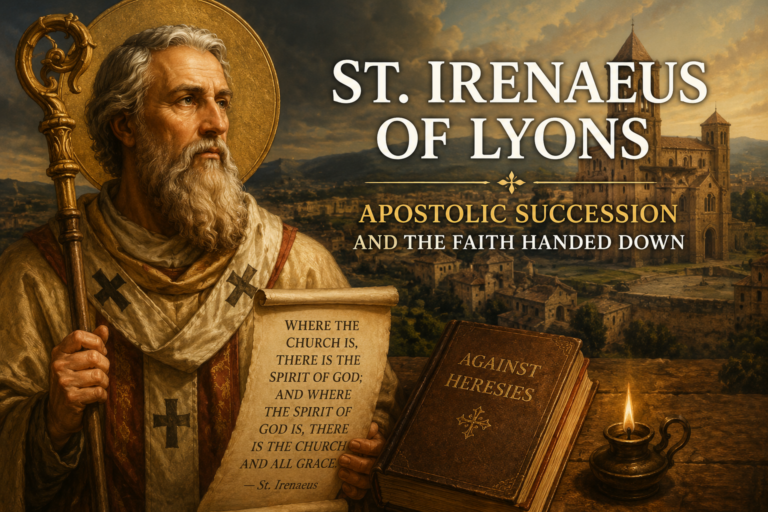
St Irenaeus: The Church’s Pure Offering
St Irenaeus, writing in the second century, likewise speaks of the Church’s Eucharistic oblation.
He connects Christian offering, thanksgiving and the Eucharist and describes the offering of the Church in sacrificial terms.
So within generations of the Apostles we already find:
Eucharist.
Real Presence.
Offering.
Sacrificial language.
Sunday worship.
Bread and wine.
The fulfilment of Old Testament prophecy.
This is not medieval Catholicism being read backwards into Scripture.
It is part of ancient Christianity’s own understanding of the New Covenant.
—
Old Covenant Shadow — New Covenant Fulfilment
The parallels can now be seen together.
Old Covenant| New Covenant Fulfilment
Tabernacle where God dwells| God dwells among us in Christ; Christ remains sacramentally present in the Eucharist
High priest| Jesus Christ, eternal High Priest
Ministerial priesthood| Ordained ministry serving under Christ’s one priesthood
Sacred vestments| Priestly liturgical vestments
Priest washed before ministry| Christian purification imagery and the priest’s liturgical washing
Altar| Eucharistic altar
Unblemished lamb| Jesus, Lamb of God
Passover lamb sacrificed| Christ sacrificed once for all
Passover lamb eaten| Christ received in Holy Communion
Blood saved Israel from death| Christ’s Blood redeems from sin and death
“Blood of the covenant” at Sinai| “Blood of the New Covenant” at the Last Supper
Blood and water used in ritual sprinkling| Fulfilled purification through Christ; water continues sacramentally in Baptism and blessed-water rites
Hyssop used for sprinkling| Psalm 51 imagery retained especially vividly in the traditional Asperges
Bread continually before the Lord| Christ, the true Bread from Heaven
Melchizedek: priest with bread and wine| Christ’s priesthood and Eucharistic bread and wine
Incense before God| Incense in Christian and heavenly worship
Sacred lamps| Candles and sanctuary lamps
Sacred vessels| Consecrated vessels of the Eucharistic liturgy
Sacred priestly garments| Liturgical vestments
People’s contributions for sanctuary| Christian offerings and collections
Earthly Holy of Holies| Christ enters the true heavenly sanctuary
Repeated animal sacrifices| Christ’s one perfect sacrifice
Covenant meal| Eucharistic communion
Earthly worship patterned after heaven| Mass participating in heavenly worship
Passover feast| New Passover in Christ
Israel as God’s covenant people| The Church, people of the New Covenant
Bride imagery| Christ the Bridegroom and the Church his Bride
Sacrificial banquet| Wedding Supper of the Lamb
—
The Old Covenant Was Not Meaningless — It Was Prophetic
This is perhaps the most important point.
Catholics do not believe Christians should return to the Mosaic Law and begin offering animals again.
Hebrews makes clear that those sacrifices could never accomplish what Christ accomplished.
But that does not mean they were meaningless.
They were prophetic signs.
The old lamb pointed toward the Lamb of God.
The old priesthood pointed toward Christ the High Priest.
The old sanctuary pointed toward the heavenly sanctuary.
The old covenant blood pointed toward the Blood of Christ.
The old sacred bread pointed toward the true Bread from Heaven.
The old sacrificial meal pointed toward Holy Communion.
The old sprinklings pointed toward true purification.
The old altar pointed toward the perfect sacrifice of Calvary.
The old dwelling of God among Israel pointed toward Emmanuel — God with us.
What was concealed begins to be revealed.
—
And Then We Stand at Mass
Now imagine walking into a Catholic church with all of this biblical history in mind.
You enter a sacred space.
At its centre stands an altar.
A priest approaches wearing sacred vestments.
Candles burn.
Incense may rise.
Sacred vessels are prepared.
The Scriptures are proclaimed.
The people make their offering.
Bread and wine are brought to the altar.
The priest washes his hands.
The Church enters the Eucharistic Prayer.
The words of the New Covenant are proclaimed.
Christ’s one sacrifice is sacramentally made present.
The Lamb of God is shown to the people.
And then comes the invitation to the sacrificial feast.
“Behold the Lamb of God.”
The Lamb is not merely remembered.
The Lamb is received.
And suddenly Exodus, Leviticus, Passover, Melchizedek, Sinai, the prophets, the Last Supper, Calvary, Hebrews and Revelation begin to converge before our eyes.
This is why the Catholic Mass feels so deeply biblical once one learns how to read the Bible typologically.
It is not because the Church decided centuries later to imitate ancient Israel.
It is because the God who established the Old Covenant is the same God who established the New.
The first was preparation.
The second is fulfilment.
The first contained shadows.
The second reveals Christ.
The first had the lamb.
The New Covenant has the Lamb of God.
The first had the blood of sacrifice.
The New Covenant has the Blood of Christ.
The first had bread before God’s presence.
The New Covenant has the Bread of Life.
The first had an earthly high priest.
The New Covenant has Jesus Christ, our eternal High Priest.
The first had an earthly sanctuary.
Christ has entered the true sanctuary in heaven.
And the worship of the Church on earth joins that heavenly worship until the shadows finally disappear and we enter the eternal Wedding Supper of the Lamb.
The Catholic Mass is not a departure from biblical worship.
It is biblical worship brought to its fulfilment in Jesus Christ.