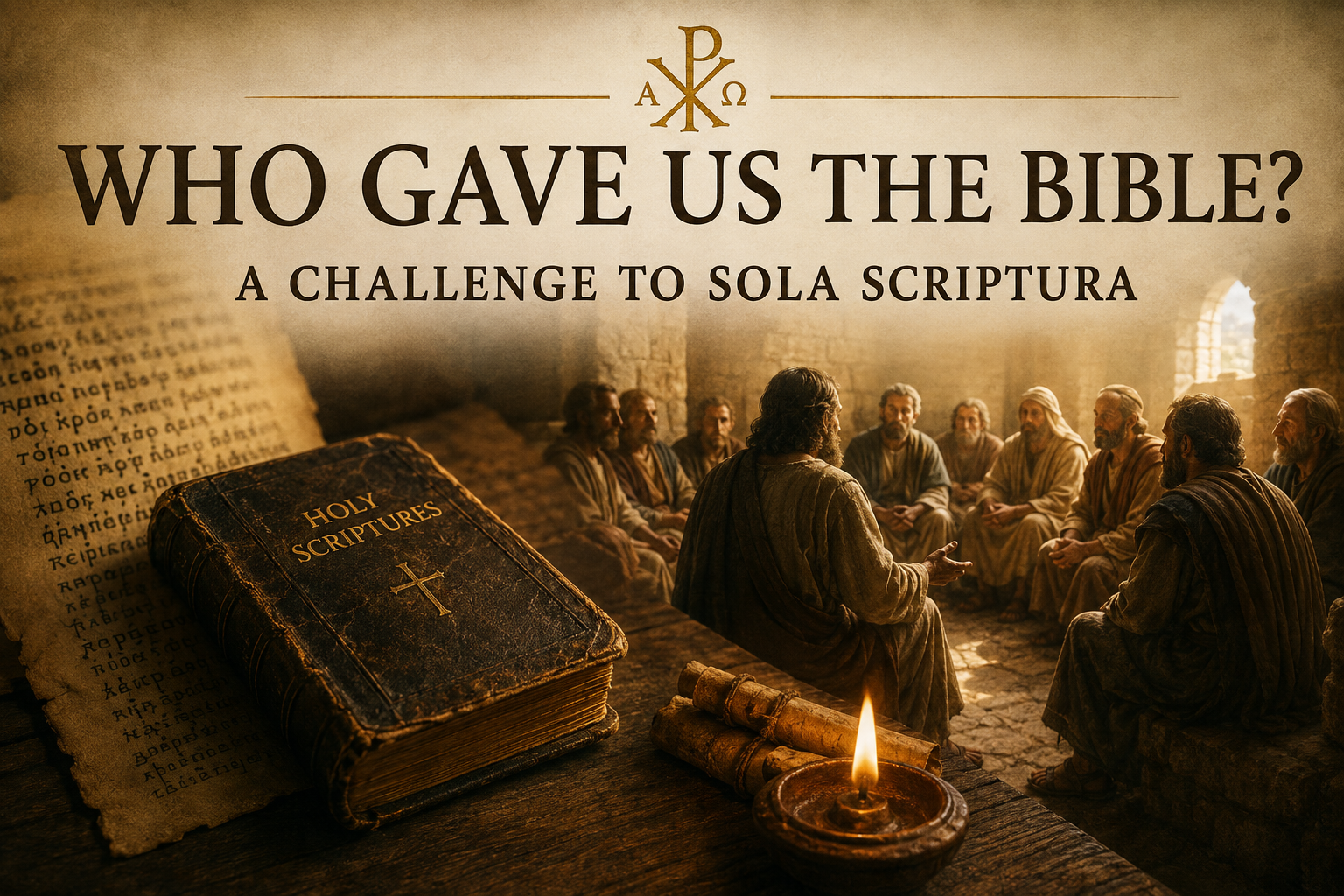
Who Gave Us the Bible?
A Challenge to Sola Scriptura
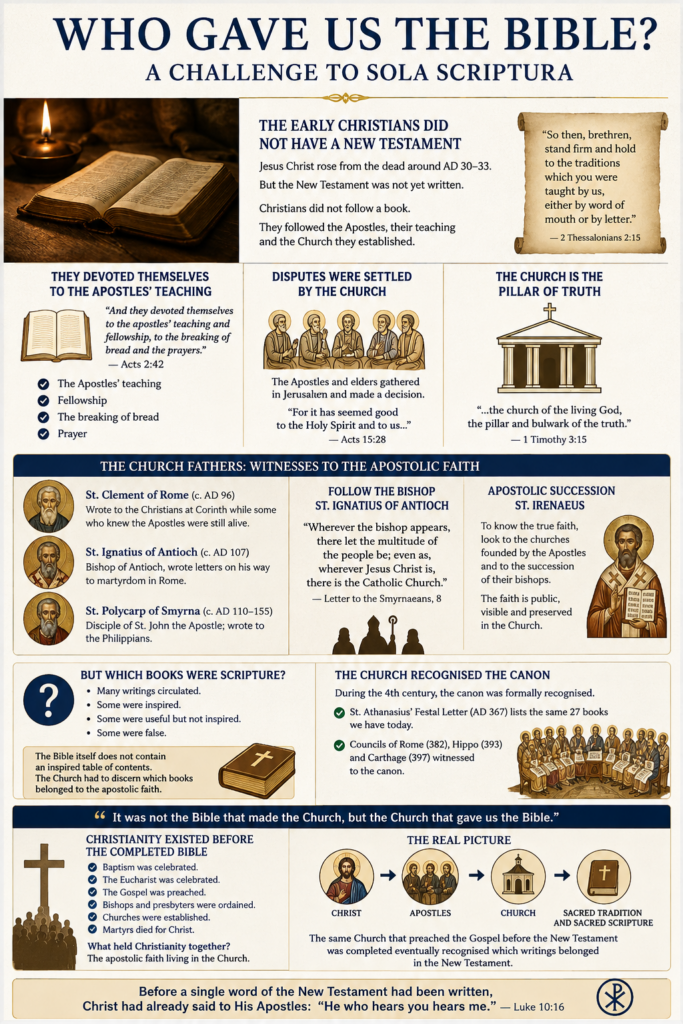
Many Christians today sincerely believe in Sola Scriptura — the idea that the Bible alone is the Christian’s final rule of faith.
But there is a historical question that every Christian should consider:
How did Christianity work before there was a completed New Testament?
The answer takes us directly back to the Apostles and the earliest Christians.
The First Christians Did Not Have a New Testament
Jesus Christ rose from the dead around AD 30–33.
But on the morning of the Resurrection, there was no Gospel of Matthew, Mark, Luke or John sitting on a Christian’s bookshelf.
There was no Letter to the Romans.
There was no Book of Revelation.
There was no completed New Testament.
In fact, much of the New Testament had not even been written yet.
This gives us a striking way of looking at the early Church:
A Christian today owns more of the completed New Testament than St. Paul himself possessed during much of his ministry.
Paul obviously knew the Gospel he preached and eventually wrote a substantial part of the New Testament. But he did not walk around carrying the twenty-seven-book New Testament that Christians possess today.
So what did the first Christians do?
How did they know what to believe?
How did they settle disputes?
How did they know authentic Christian teaching from false teaching?
They had the Church, the Apostles and the apostolic faith handed down to them.
They Devoted Themselves to the Apostles’ Teaching
The Book of Acts gives us a picture of the earliest Christian community:
“And they devoted themselves to the apostles’ teaching and fellowship, to the breaking of bread and the prayers.”
— Acts 2:42
Notice the pattern.
The earliest Christians devoted themselves to:
- The Apostles’ teaching
- Fellowship
- The breaking of bread
- Prayer
Christianity was already alive.
The Church was already teaching.
Christians were already worshipping.
The Eucharist was already being celebrated.
And yet the New Testament had not been completed.
The Christian faith therefore existed before the completed New Testament existed.
St. Paul Commands Christians to Hold to Oral Tradition
This becomes even clearer in St. Paul’s Second Letter to the Thessalonians.
Paul tells Christians:
“So then, brethren, stand firm and hold to the traditions which you were taught by us, either by word of mouth or by letter.”
— 2 Thessalonians 2:15
Read that carefully.
Paul identifies two ways in which apostolic teaching was handed on:
By word of mouth
and
By letter.
In other words:
Oral Apostolic Teaching + Written Apostolic Teaching
Paul does not tell Christians:
“Ignore everything that was taught orally and follow only what has been written.”
He tells them precisely the opposite.
Hold fast to both.
This is the biblical foundation for what Catholics call Sacred Scripture and Sacred Tradition.
They are not two competing revelations.
They are two ways in which the one apostolic faith was transmitted.
What Happened When Christians Disagreed?
Acts 15 gives us an extraordinary example.
A major controversy erupted in the early Church concerning whether Gentile converts needed to be circumcised and observe the Mosaic Law.
How was the dispute settled?
Did everyone simply take out their Bible and interpret it for themselves?
No.
The Apostles and elders gathered together in Jerusalem.
They debated the matter.
Peter spoke.
Paul and Barnabas testified.
James spoke.
And then the Church made a binding decision.
The letter announcing that decision contains remarkable words:
“For it has seemed good to the Holy Spirit and to us…”
— Acts 15:28
Think about the authority contained in that statement.
“The Holy Spirit and us.”
The early Church believed that the Holy Spirit was guiding the Church as it made an authoritative decision concerning Christian doctrine and practice.
This is the Council of Jerusalem.
And it happened while the New Testament itself was still being written.
The Church Is the Pillar of Truth
St. Paul says something else that is extremely important.
Writing to Timothy, he describes:
“…the church of the living God, the pillar and bulwark of the truth.”
— 1 Timothy 3:15
Paul does not describe the Church as an optional Bible-study group.
He calls the Church:
“The pillar and bulwark of the truth.”
Scripture is the inspired Word of God.
Catholics do not diminish Scripture.
But Scripture itself tells us that Christ established a visible, teaching Church.
The Church Fathers Were Writing Before the New Testament Canon Was Settled
This is where history becomes particularly interesting.
After the Apostles began to die, Christianity did not disappear while everyone waited for someone to assemble a Bible.
The next generations of Christians continued living and teaching the apostolic faith.
And we still possess some of their writings.
For example:
St. Clement of Rome — around AD 96
Clement wrote to the Christians at Corinth while some people who had personally known the Apostles were probably still alive.
St. Ignatius of Antioch — around AD 107
Ignatius was Bishop of Antioch and wrote a series of letters while being transported to Rome for martyrdom.
St. Polycarp of Smyrna — early second century
Polycarp had connections with the Apostolic generation and wrote to the Philippians.
These writings are not Scripture.
The Church never placed them on the same level as the inspired books of the Bible.
But they are enormously valuable because they allow us to see what Christians immediately after the Apostles actually believed and practised.
And what we find looks remarkably Catholic.
We find bishops.
We find priests and deacons.
We find the Eucharist.
We find baptism.
We find Church authority.
We find apostolic succession.
And remarkably, we even find the name Catholic Church.
St. Ignatius: Follow the Bishop
Around AD 107, St. Ignatius of Antioch wrote:
“Wherever the bishop appears, there let the multitude of the people be; even as, wherever Jesus Christ is, there is the Catholic Church.”
— St. Ignatius of Antioch, Letter to the Smyrnaeans, 8
This was written extremely early in Christian history.
Ignatius does not present Christianity as thousands of independent congregations interpreting Christianity separately.
He points Christians toward the bishop.
Why?
Because bishops were understood as successors to the Apostles and guardians of the apostolic faith.
St. Irenaeus and Apostolic Succession
Later in the second century, St. Irenaeus confronted heretical groups claiming that they possessed secret teachings from Jesus and the Apostles.
His response is extremely important.
Instead of arguing that every Christian should simply interpret Scripture privately, Irenaeus points to the churches founded by the Apostles and to the succession of their bishops.
He argues that the authentic apostolic faith could be publicly traced through those churches.
And among them, he gives particular attention to the Church at Rome, tracing its succession of bishops from the Apostles Peter and Paul.
The principle is simple:
If you want to know what the Apostles taught, look to the churches they founded and to those who succeeded them.
Christianity was not based upon secret knowledge.
The apostolic faith was public, visible and preserved within the Church.
But Which Books Were Scripture?
There is another problem for Sola Scriptura.
Even once Christian writings began circulating, how did Christians know which writings belonged in the Bible?
There were many writings circulating in the ancient Christian world.
Some were inspired.
Some were orthodox and useful but not inspired.
Others were completely false.
The four Gospels were eventually universally recognised:
Matthew
Mark
Luke
John
But questions remained in parts of the early Church concerning certain other books.
Hebrews.
James.
2 Peter.
2 and 3 John.
Jude.
Revelation.
At the same time, some other early Christian writings were highly respected and were sometimes read in churches.
So there was an unavoidable question:
Which books are actually inspired Scripture?
And here we encounter a difficulty for Sola Scriptura:
The Bible itself does not contain an inspired table of contents.
There is no verse saying:
“The New Testament shall contain exactly these twenty-seven books…”
Someone had to discern which books genuinely belonged to the apostolic deposit of faith.
That discernment occurred within the Church.
The Church Recognised the Canon
During the fourth century, the canon became formally recognised through the life and councils of the Church.
St. Athanasius’ Festal Letter of AD 367 contains the same twenty-seven New Testament books Catholics and Protestants recognise today.
Regional councils including Rome (382), Hippo (393) and Carthage (397) are important witnesses to the Church’s recognition of the biblical canon.
The Church did not make these writings inspired.
God inspired them.
Rather, the Church recognised and authoritatively identified which writings were inspired.
That distinction is important.
The Catholic claim is not:
“The Church created the Word of God.”
It is:
God gave us His inspired Word, and the Church He established recognised, preserved, proclaimed and handed those Scriptures down through history.
Christianity Existed Before the Completed Bible
This brings us back to our original question.
Imagine that you were a Christian in AD 50.
There is no completed New Testament.
St. John has not yet written his Gospel.
Many of Paul’s letters have not yet been written.
Revelation has not been written.
You cannot walk into a Christian bookshop and purchase a Bible.
Yet Christianity exists.
Christians are being baptised.
The Eucharist is being celebrated.
The Gospel is being preached.
Bishops and presbyters are being appointed.
Churches are being established.
Martyrs are dying for Christ.
So what is holding Christianity together?
The answer is the apostolic faith living within the Church.
This Creates a Serious Question for Sola Scriptura
Catholics absolutely believe in the supreme authority and inspiration of Sacred Scripture.
The question is not:
“Bible or Church?”
That is a false choice.
The real historical picture is:
Christ → Apostles → Church → Sacred Tradition and Sacred Scripture
The same Church that preached the Gospel before the New Testament was completed eventually recognised which writings belonged to that New Testament.
So we should ask:
If the earliest generations of Christians could not possibly practise “Bible alone” because the New Testament was not yet complete, how could Sola Scriptura have been the rule of faith Christ intended for Christianity from the beginning?
And there is an even deeper question.
If Scripture alone is our authority:
Where does Scripture itself teach Scripture alone?
Instead, we find Paul commanding Christians to preserve what they received “by word of mouth or by letter.”
We find Christians devoted to “the apostles’ teaching.”
We find doctrinal disputes settled by the authority of the Apostles and elders gathered in council.
We find the Church called “the pillar and bulwark of the truth.”
And immediately after the Apostolic age, we find Christians being told to remain united to their bishops and to the Catholic Church.
The Bible Is a Catholic Treasure
None of this diminishes the Bible.
It does exactly the opposite.
Catholics believe Sacred Scripture is truly the inspired Word of God.
The Mass is saturated with Scripture.
Catholic theology is rooted in Scripture.
The Church Fathers constantly quoted Scripture.
The Church guarded Scripture through centuries of persecution, controversy and upheaval.
The question is not whether Christians should love the Bible.
We absolutely should.
The question is whether Christ intended Christians to separate the Bible from the Church in which it was written, proclaimed, recognised, preserved and handed down.
Historically, those two things were never meant to be enemies.
The Bible did not fall from Heaven already bound, printed and containing a table of contents.
It emerged from the life of the apostolic Church.
Before Christians possessed a completed New Testament, they possessed the Faith.
Before they possessed twenty-seven New Testament books collected together, they possessed the Church.
And before a single word of the New Testament had been written, Christ had already said to His Apostles:
“He who hears you hears me.”
— Luke 10:16
That is where the story of the Bible really begins.