St. Justin Martyr — The Mass in AD 155
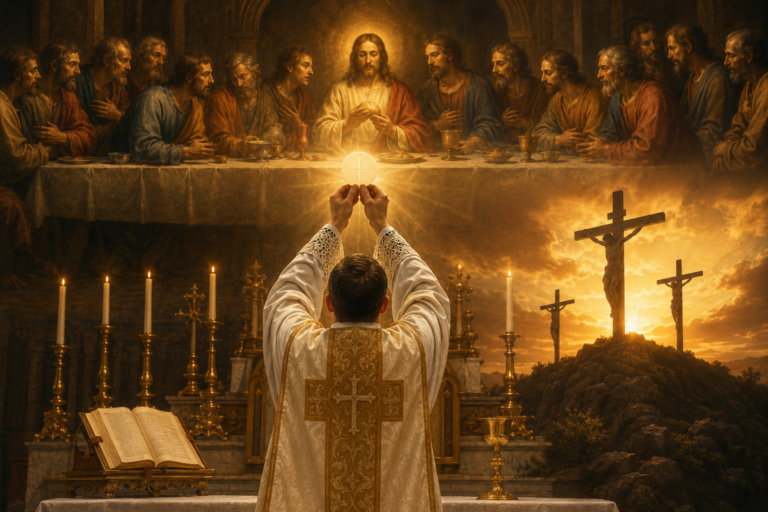
What would happen if we could walk into a Christian church less than 130 years after the Resurrection of Jesus and watch Christians worship?
Would we find something completely unfamiliar?
Would we find Christians simply gathering informally, reading Scripture and sharing ordinary bread and wine as symbols?
Or would we recognise something remarkably similar to the Catholic Mass?
One of the greatest witnesses from the second century allows us to answer that question.
His name was:
St. Justin Martyr
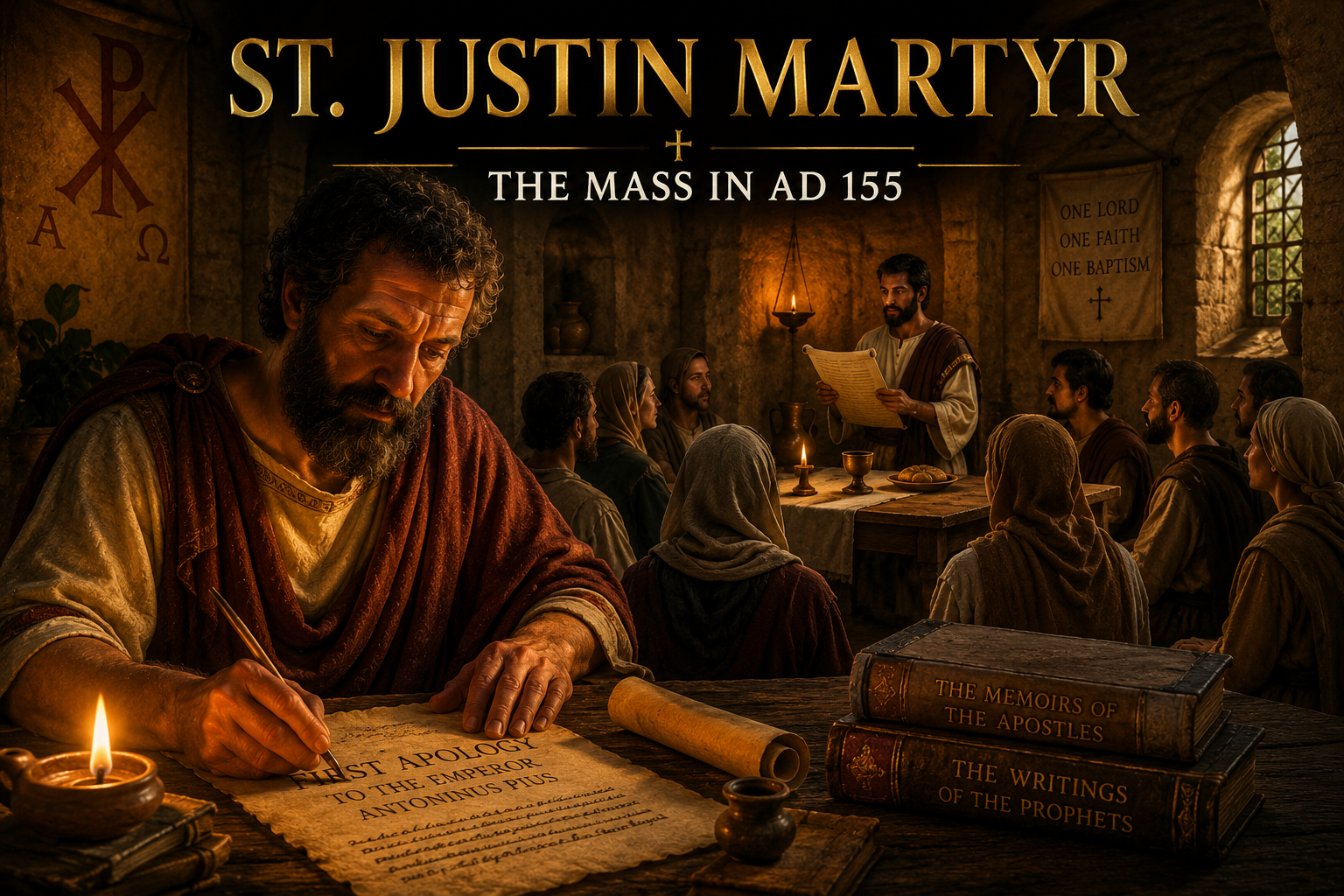
Around AD 155, Justin wrote an extraordinary defence of Christianity addressed to the Roman Emperor Antoninus Pius.
And in that defence, he did something incredibly valuable for us today.
He described Christian Sunday worship.
Not a reconstruction.
Not a theory.
Not a description written centuries later.
Justin tells the Roman authorities what Christians of his own time were actually doing when they gathered together. The Catechism itself highlights his account as an early witness to the basic structure of the Eucharistic celebration.
And when we examine his description, something becomes very difficult to ignore.
It looks remarkably like the Catholic Mass.
Who Was St. Justin Martyr?
Justin was born around AD 100, near ancient Shechem in Samaria.
He was not raised as a Christian.
Instead, Justin became a passionate seeker of truth.
He studied different schools of Greek philosophy, searching for answers to the deepest questions of human existence:
Who is God?
What is truth?
What is the purpose of life?
How can man know the divine?
According to Justin’s own account, his search eventually brought him into contact with Christianity.
He became convinced that in Jesus Christ he had discovered what he had been seeking.
For Justin, Christianity was not opposed to the search for truth.
It was its fulfilment.
He eventually went to Rome, where he taught Christianity and defended the faith publicly. Pope Benedict XVI described Justin as one of the most important Christian apologists of the second century and recounts his journey from Greek philosophy to Christianity.
Justin would eventually pay for that faith with his life.
Around AD 165, during the reign of Marcus Aurelius, he was condemned and executed.
That is why history remembers him as:
Justin Martyr.
What Is an Apologist?
Justin belongs to a group of early Christian writers known as:
The Apologists
An apologist is not someone apologising for Christianity.
The Greek idea of apologia means a:
Defence
These Christians defended the faith against accusations from the surrounding pagan world.
Christians were accused of atheism because they rejected the Roman gods.
They were accused of strange secret practices.
They were accused of being dangerous to society.
Justin wanted Roman authorities to understand what Christians actually believed and how they actually lived.
So he wrote his:
First Apology
And in it, Justin gives us one of the greatest gifts in the history of Christian apologetics.
He explains what Christians did when they met for worship.
Christians Gathered on Sunday
Justin begins by telling us when Christians assembled.
Sunday
He explains that Christians living both in cities and in the countryside gathered together on that day.
Why Sunday?
Because Sunday was the day of:
The Resurrection of Jesus Christ.
Justin explicitly connects the Christian Sunday gathering with Christ rising from the dead on the first day of the week.
This is enormously significant.
We are only in the second century, and Sunday worship is already a normal and established Christian practice.
Christians are gathering together every week on:
The Lord’s Day.
And what happens when they gather?
This is where things become really interesting.
First — Scripture Is Read
Justin tells us that when Christians gather, they listen to readings from:
“the memoirs of the apostles”
and:
“the writings of the prophets.”
The “memoirs of the apostles” refers to the apostolic accounts associated with what Christians would recognise as the Gospels.
The writings of the prophets refer to the Scriptures inherited from Israel.
So what do Christians do first?
They hear the Word of God.
Does that sound familiar?
At every Catholic Mass today, the first major part of the celebration is:
The Liturgy of the Word
We hear readings from Scripture.
The Old Testament.
The Psalms.
The Apostolic writings.
The Gospel.
Justin is describing the same fundamental pattern in the second century. The Catechism explicitly compares Justin’s description with the enduring structure of the Mass.
Then Comes the Homily
After the Scriptures have been read, Justin says the person presiding addresses the congregation.
He explains what has been read and encourages the Christians to imitate the good things they have heard.
Again, this should sound very familiar.
At Mass today, after the readings and the Gospel, the priest or deacon gives:
The Homily
The purpose is not simply to provide information.
Scripture is proclaimed and then applied to the Christian life.
Justin describes essentially the same movement:
Scripture is read.
Scripture is explained.
Christians are encouraged to live according to it.
And this is around AD 155.
Then Everyone Stands and Prays
Justin continues.
After the readings and instruction, the Christians:
rise together and pray.
They pray not merely for themselves but for others as well.
Again, compare this with the Catholic Mass.
After hearing the Word of God, the congregation offers:
The Prayers of the Faithful
or:
The Universal Prayer
The Church prays for the needs of:
the Church,
the world,
those who suffer,
and the wider human family.
The pattern Justin describes is recognisable.
The Kiss of Peace
Justin then tells us that after the prayers, Christians greet one another with:
a kiss.
This was an ancient Christian sign of peace and communion.
Again, something survives from this ancient practice in the Catholic liturgy today:
The Sign of Peace
The external cultural expression has changed.
We do not normally greet everyone with an ancient Mediterranean kiss.
But the principle remains:
Christians express their communion and peace with one another.
Then Bread, Wine and Water Are Brought Forward
Now Justin moves into the Eucharistic part of Christian worship.
He says that bread and a cup containing wine mixed with water are brought to the person presiding over the Christian assembly.
Once again:
Bread.
Wine.
Water.
Brought forward.
What happens at Mass today?
After the Liturgy of the Word, the gifts are brought forward:
Bread
and:
Wine
And a small amount of water is mixed with the wine.
The fundamental pattern is already present in Justin’s description.
The President Gives Thanks
Justin tells us that the one presiding takes the bread and cup and offers praise and thanksgiving to:
The Father
through:
The Son
and:
The Holy Spirit.
He offers prayers and thanksgiving, and the assembled Christians respond:
Amen.
Again, stand inside a Catholic church today.
The priest offers the Eucharistic Prayer.
The prayer is directed to the Father.
Through Christ.
In the Holy Spirit.
And the people respond:
Amen.
The details of the liturgical prayers have developed across the centuries.
But the basic structure is unmistakable.
Then the Eucharist Is Distributed
After the thanksgiving has been completed, Justin says that those whom Christians call:
Deacons
distribute the Eucharistic food to those present.
Even more remarkably, portions are taken to Christians who could not attend.
That tells us something important.
The Eucharist was not treated like ordinary food that simply remained on the table when the meal was finished.
It was treated with sufficient seriousness that deacons carried it to absent members of the Christian community.
The Eucharist already had a sacred character.
But Justin is about to make that even clearer.
“Not as Common Bread”
Justin then explains to the pagan emperor what Christians believe about the Eucharist.
And these are among the most important words we possess from second-century Christianity.
He says Christians do not receive it:
“as common bread and common drink.”
Why not?
Because Justin says Christians have been taught that the Eucharistic food is:
the flesh and blood of Jesus Christ who became incarnate.
Think carefully about the date.
Around AD 155.
We are not reading Thomas Aquinas.
We are not reading the Council of Trent.
We are not reading a medieval pope.
We are reading a Christian writing roughly a century after the Apostolic age.
And Justin is explaining Christianity to a pagan Roman emperor.
He does not tell him:
“We eat ordinary bread which simply reminds us of Jesus.”
He explicitly distinguishes the Eucharist from:
common bread and common drink.
Justin Connects the Eucharist Directly to the Last Supper
Justin then explains where Christians received this belief.
He says that the Apostles recorded that Jesus took bread and declared:
“This is My body.”
And regarding the cup:
“This is My blood.”
In other words, Justin does not present Eucharistic belief as a later Christian invention.
He traces it directly back to:
Jesus Christ
and:
The Apostles.
The Eucharist exists because Christ commanded it.
The Christian community continues what Jesus instituted.
Is Justin Teaching Transubstantiation?
We need to be precise here.
Justin does not use the later technical word:
Transubstantiation
That terminology developed much later as Christian theologians sought increasingly precise language to explain how the bread and wine become the Body and Blood of Christ.
It would therefore be historically careless to claim:
“Justin explains the complete later doctrine of Transubstantiation.”
He does not.
But that is not the important question.
The important question is:
What did Justin believe Christians were receiving?
And his answer is extremely difficult to reduce to mere symbolism.
He explicitly says that Christians do not receive the Eucharist as ordinary bread and drink and identifies the Eucharistic food with the flesh and blood of the incarnate Jesus.
That is powerful early evidence for belief in the:
Real Presence of Christ in the Eucharist.
Not Everyone Could Receive Communion
Justin then tells us something else that sounds remarkably Catholic.
Not everybody present could simply receive the Eucharist.
According to Justin, a person had to:
believe Christian teaching to be true,
have received the washing associated with remission of sins and regeneration,
and:
be living according to Christ’s commands.
In other words:
Eucharistic communion had conditions.
This was not simply an open meal offered indiscriminately to anyone who happened to walk into the gathering.
There was a connection between:
Faith
Baptism
Christian life
and:
The Eucharist.
That sacramental order is extraordinarily important.
Baptism Before Eucharist
Justin’s description also gives us a valuable picture of early Christian initiation.
Before describing the Eucharist, he speaks about those who have accepted the Christian teaching being washed in Baptism.
He associates this washing with:
remission of sins
and:
regeneration.
Then the newly baptised person joins the Christian community in prayer and Eucharistic worship.
The pattern is:
Faith → Baptism → Eucharistic communion
Again, this bears a remarkable resemblance to the sacramental life of the Catholic Church.
The Collection for the Poor
Justin’s description contains another element we should not overlook.
During the Sunday gathering, those who are able voluntarily contribute to help people in need.
Justin specifically mentions support for:
orphans
widows
the sick
prisoners
strangers
and others suffering hardship.
Christian worship therefore leads directly to:
Christian charity.
The Eucharist is not separated from care for the poor.
This was so significant that the Catechism quotes Justin when discussing the Christian tradition of bringing gifts for those in need alongside the Eucharistic offering.
The early Church worshipped Christ at the altar and served Christ in the poor.
Put Justin’s Description in Order
Now put everything Justin describes together.
Around AD 155, Christians gather on:
Sunday
Then:
1. The Scriptures are read
2. The presider explains the readings
3. The people pray together
4. They exchange a sign of peace
5. Bread, wine and water are brought forward
6. The presider offers thanksgiving to God
7. The congregation responds “Amen”
8. The Eucharist is distributed
9. Deacons take Communion to absent Christians
10. An offering is made for the poor and needy
And the Eucharist itself is explicitly distinguished from:
ordinary bread and drink.
Compare that with the basic structure of the Catholic Mass.
The resemblance is not superficial.
The Catechism itself says that Justin gives us the basic lines of the Eucharistic celebration and notes that this fundamental structure has remained through the centuries.
The Liturgy of the Word
Today we call the first great part of the Mass:
The Liturgy of the Word
Justin describes:
Scripture readings
followed by:
instruction
and then:
common prayer.
The Liturgy of the Eucharist
Today we call the second great part:
The Liturgy of the Eucharist
Justin describes:
the presentation of bread and wine
prayer and thanksgiving
the people’s Amen
and:
Holy Communion.
The Catholic Mass still possesses these same two fundamental movements:
Word
and:
Eucharist.
Was the Mass Invented Centuries Later?
This is where Justin becomes especially important in Catholic apologetics.
Sometimes people hear words such as:
Mass
Eucharist
liturgy
priest
altar
and assume these belong to a Christianity that developed many centuries after Jesus.
But Justin makes that simplistic picture impossible.
Around AD 155, Christians were already gathering every Sunday for a structured Eucharistic celebration centred upon:
Scripture
instruction
prayer
bread and wine
thanksgiving
the Amen
and:
Communion.
And they did not regard that Eucharist as ordinary food.
The precise liturgical forms would naturally develop.
Languages would change.
Prayers would develop.
Church architecture would change.
Vestments and ceremonial practices would develop.
But the essential structure is already there.
Justin Is Describing Christianity Before Constantine
This point is worth emphasising.
Justin lived long before the Emperor Constantine.
Christianity was not yet the favoured religion of the Roman Empire.
Christians could still face accusation, imprisonment and execution.
Justin himself would eventually become a martyr.
So the Eucharistic Christianity Justin describes cannot simply be dismissed as something created after Christianity gained political power.
It existed while Christians were still vulnerable within the Roman world.
Compare Justin With Ignatius of Antioch
The evidence becomes even more powerful when Justin is placed beside the witnesses we have already examined.
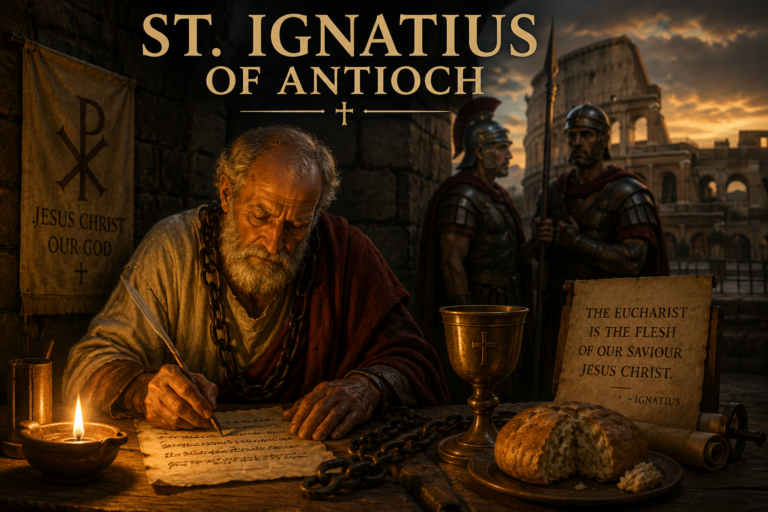
St. Ignatius of Antioch, writing near the beginning of the second century, condemned those who refused the Eucharist because they would not acknowledge it as the flesh of Jesus Christ.
Then, several decades later, Justin explains that Christians do not receive the Eucharist as ordinary bread and drink but as connected with Christ’s flesh and blood.
These are two different Christian writers.
Different places.
Different circumstances.
Yet both witness to an extremely serious understanding of the Eucharist.
That matters.
Now Add the Didache
And before Justin, the Didache had already shown us Christians:
gathering on the Lord’s Day
breaking bread
giving thanks
practising Baptism
and:
maintaining a disciplined Eucharistic community.
So now we have a progression.
The Didache
shows an early sacramental and liturgical Christian community.
Ignatius of Antioch
speaks of bishops, priests, deacons, the Catholic Church and the Eucharist as the flesh of Christ.
And now:
Justin Martyr
actually walks us through the Sunday Eucharistic gathering.
The picture is becoming increasingly clear.
Christianity Was Already Liturgical
The earliest Church was not simply a collection of individuals privately interpreting Christian writings.
Christians gathered together.
They had recognised ministers.
They heard Scripture proclaimed.
They received instruction.
They prayed corporately.
They celebrated the Eucharist.
They maintained requirements for admission to Communion.
They cared for their poor.
And they did this:
Every Sunday.
The faith was:
Biblical
communal
sacramental
and:
liturgical.
Why Justin Martyr Matters
Justin’s testimony matters because it allows us to move beyond speculation.
We do not have to ask:
“What do we imagine Christians might have done around AD 155?”
Justin tells us.
They gathered on Sunday.
They heard the Apostles and the Prophets read.
They listened to instruction.
They prayed.
They brought bread, wine and water.
Thanksgiving was offered.
The people said:
Amen.
Then they received the Eucharist.
And Justin went out of his way to explain that it was not ordinary bread and ordinary drink.
Walk Into a Catholic Mass Today
Now imagine walking into a Catholic church this Sunday.
Listen carefully.
First:
Scripture.
Then:
The Gospel.
Then:
The homily.
Then:
The prayers of the faithful.
Then the Eucharistic liturgy begins.
Bread and wine are presented.
Thanksgiving is offered.
The people say Amen.
Holy Communion is distributed.
And the Church teaches that what is received is not ordinary bread and wine but the Body and Blood of Christ.
Now go back approximately 1,870 years.
Read Justin.
And ask:
How much of this do you recognise?
That is why St. Justin Martyr is such an extraordinary witness.
The Mass Did Not Appear Out of Nowhere
The Catholic claim is not that the Mass of AD 155 looked externally identical in every detail to a Catholic Mass celebrated in Dublin, Rome or New York today.
Obviously it did not.
The Church has lived through nearly two thousand years of history.
Liturgical expressions have developed.
But development is not the same thing as invention.
An oak tree does not look identical to the acorn from which it grew.
But it is the same living organism.
In Justin Martyr we can already see the basic shape of Catholic Eucharistic worship.
The Scriptures
The homily
the prayers
the offering
the Eucharistic thanksgiving
the Amen
the Eucharist
the deacons
the communion of the faithful
the care of the poor
These are not medieval additions appearing without roots.
Their roots reach deep into the earliest centuries of Christianity.
A Martyr’s Witness
And there is a final reason Justin deserves our attention.
He did not merely write about Christianity.
He died for it.
After a lifetime spent searching for truth, Justin believed he had found that truth in:
Jesus Christ.
He defended Christianity publicly.
He taught it.
He explained it to the Roman authorities.
And when remaining faithful eventually cost him his life, he did not abandon it. Benedict XVI places his martyrdom around AD 165.
The man who described the Eucharist of the early Christians ultimately sealed his Christian testimony with his blood.
That is why history calls him:
St. Justin Martyr.
And almost nineteen centuries later, his description of Sunday worship still asks us a very uncomfortable historical question:
If this is what Christians were doing around AD 155, where did they get it?
Justin’s own answer is clear.
They received it from the faith handed down by:
Jesus Christ and His Apostles.
And when we compare that ancient worship with the Catholic Mass today, the family resemblance is impossible to miss.