The Perpetual Virginity of Mary — What Does the Bible Really Say?
One of the most common objections to Catholic teaching about Mary sounds very simple:
“The Bible says Jesus had brothers. Therefore Mary must have had other children.”
Another objection points to Matthew:
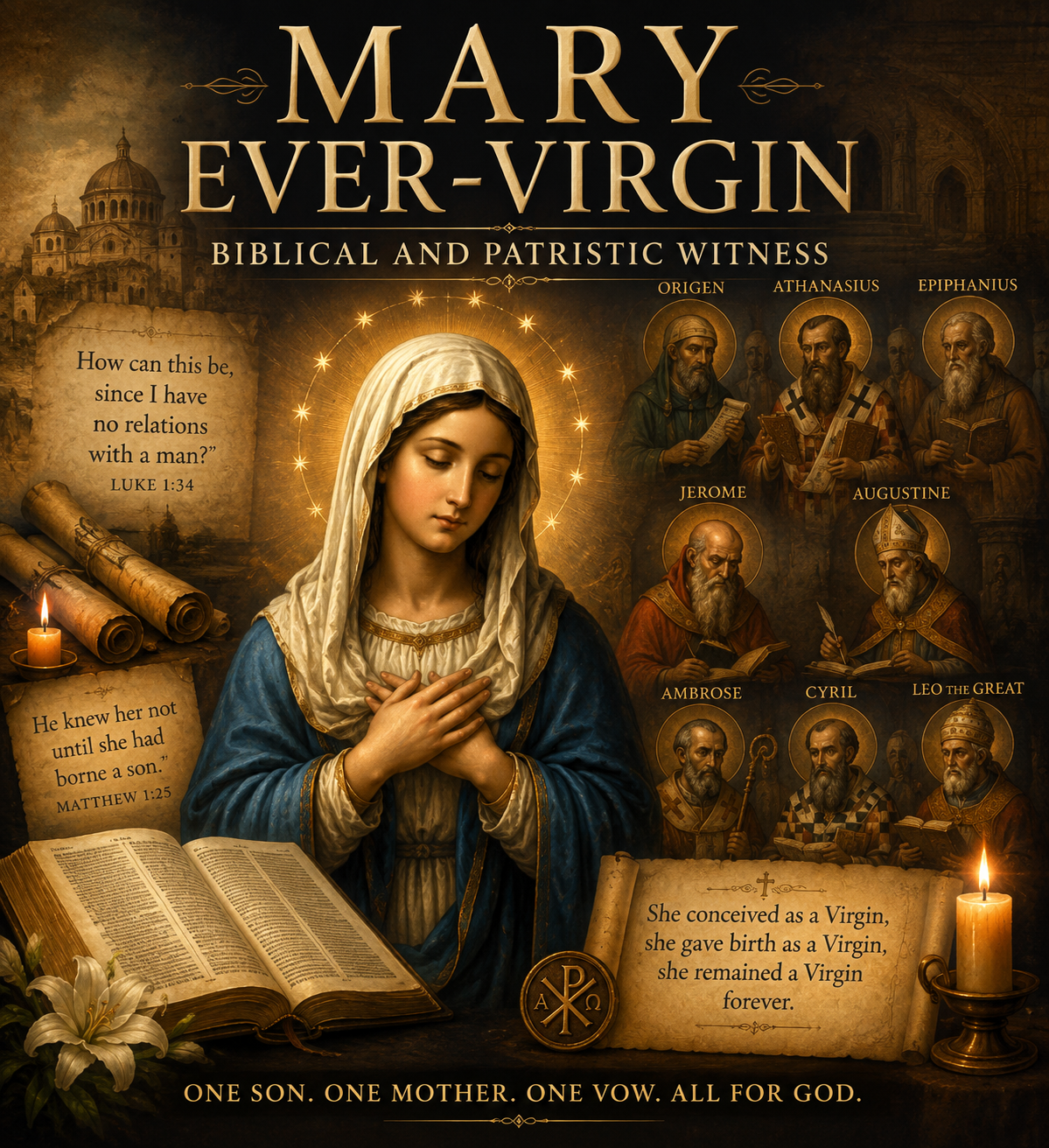
«“He knew her not until she had borne a son.”
— Matthew 1:25»
And another asks:
“Why would Mary and Joseph remain virginal after they were married?”
At first glance, these objections may seem decisive.
But when we slow down and examine the biblical language, the family relationships mentioned in the Gospels, Mary’s extraordinary words at the Annunciation, what happens at the Cross, and the testimony of the earliest Christians, the picture becomes much more complicated.
The Catholic Church teaches that Mary remained a virgin:
before the birth of Christ
in giving birth to Christ
and:
after the birth of Christ.
For this reason Christian tradition has called her:
Aeiparthenos — Ever-Virgin
The Catechism explicitly identifies Mary as the “Ever-virgin” and teaches her real and perpetual virginity.
But is this merely a later Catholic tradition?
Or are there biblical and historical reasons for believing it?
Let’s examine the evidence.
—
Begin With Mary’s Strange Question
At the Annunciation, Gabriel tells Mary:
«“Behold, you will conceive in your womb and bear a son, and you shall call his name Jesus.”
— Luke 1:31»
Mary responds:
«“How can this be, since I have no relations with a man?”
— Luke 1:34»
This is an extraordinary question.
Why?
Because Mary is already:
betrothed to Joseph.
If Mary expected an ordinary married life with Joseph, Gabriel’s announcement that she would eventually have a son would not, by itself, seem impossible.
A woman preparing for marriage would normally understand perfectly well how she might one day conceive a child.
Yet Mary’s immediate response is:
“How can this be?”
And she gives the reason:
“I have no relations with a man.”
This verse has therefore led many Christians throughout history to wonder whether Mary had already made some form of commitment to virginity.
We should be careful.
Scripture does not explicitly say:
«“Mary made a vow of perpetual virginity.”»
So we should not pretend that it does.
But her question is nevertheless unusual enough to deserve serious attention.
—
Could a Jewish Woman Make a Binding Vow?
This is where the Old Testament becomes relevant.
Numbers 30 clearly shows that women could make serious vows before God.
It even gives rules governing vows made by young unmarried women and married women. A woman’s vow could under certain circumstances be confirmed or annulled by her father or husband.
So the idea that a woman could consecrate herself to God through a vow is thoroughly biblical.
However, Numbers 30 does not specifically command or describe Mary’s supposed lifelong vow of virginity.
That distinction matters.
The Catholic argument should therefore be:
A vow by Mary is biblically possible.
Not:
“Numbers 30 proves Mary took a vow of virginity.”
It doesn’t.
But when Numbers 30 is placed beside Mary’s question in Luke 1:34, the traditional interpretation becomes quite reasonable:
Mary may already have intended a virginal form of consecration to God.
This would also help explain why her question is not simply:
«“When will this happen?”»
but:
“How can this be?”
—
An Ancient Christian Tradition Remembered Such a Vow
Interestingly, an extremely early Christian writing called the:
Protoevangelium of James
preserves precisely this tradition.
It is an apocryphal work.
That means:
It is not Scripture.
The Catholic Church does not treat it as inspired revelation, and we should not use it as though it were another Gospel.
But historically it is important.
The work comes from early Christianity and portrays Mary as having been consecrated to God, with Joseph chosen to protect her virginity.
That does not prove that every detail of the work is historically accurate.
What it does prove is something much more modest but still significant:
Belief in Mary’s continuing virginity is extremely ancient.
It was not an idea suddenly invented in medieval Europe.
Christians were already telling Mary’s story in this way very early in the history of the Church.
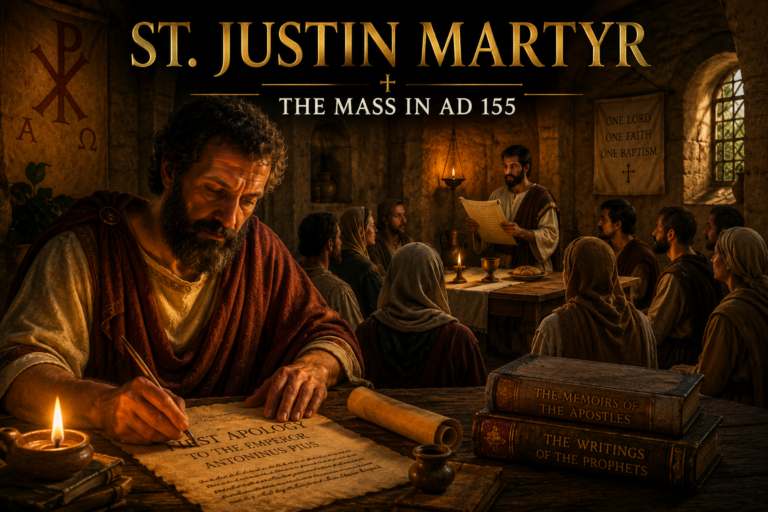
Origen, writing in the third century, was already aware of the tradition preserved in the “Book of James” that Jesus’ brethren were children of Joseph from an earlier marriage.
That brings us to the biggest objection.
—
“But Jesus Had Brothers”
The New Testament plainly refers to:
the brothers of Jesus.
Matthew records people in Jesus’ hometown saying:
«“Is he not the carpenter’s son? Is not his mother named Mary and his brothers James, Joseph, Simon, and Judas?”
— Matthew 13:55»
The passage then mentions His sisters as well.
So Catholics should never respond by saying:
“The Bible doesn’t say Jesus had brothers.”
It does.
The real question is:
What does “brother” mean in these passages?
That is a very different question.
—
“Brother” Does Not Always Mean Another Child of the Same Mother
The Greek word commonly translated brother is:
ἀδελφός — adelphos
Its normal meaning can certainly be a biological brother.
Catholics should not deny that.
But biblical family language can also be broader than modern English usage.
A clear Old Testament example is Abraham and Lot.
Lot is Abraham’s nephew.
Yet when Abraham speaks to Lot in Genesis 13:8, he describes them as kin — the underlying biblical tradition uses familial “brother” language despite Lot not being Abraham’s biological brother. The USCCB translation renders the relationship there as “kindred.”
This matters because Semitic family language could use words such as “brother” for relatives belonging to the same extended family or clan.
Therefore:
“Brother of Jesus” does not automatically prove “another biological son of Mary.”
We have to identify who these men actually were.
—
James and Joseph Appear Again
Matthew names two of Jesus’ “brothers” as:
James
and:
Joseph
— Matthew 13:55.
Later, at the Crucifixion, Matthew mentions another woman:
«“Mary the mother of James and Joseph.”
— Matthew 27:56»
The Catechism specifically points to this evidence when explaining that the “brothers” of Jesus are not understood by the Church to be other children of the Virgin Mary. It identifies James and Joseph with the sons of another Mary and describes them as close relations of Jesus.
At the very least, this shows why we cannot simply read:
«“James, the brother of Jesus”»
and immediately conclude:
«“James must therefore be another son of Mary, the mother of Jesus.”»
The family relationships require more careful examination.
—
Two Ancient Explanations
Historically, two principal explanations developed among Christians for the “brothers of the Lord.”
One held that they were:
children of Joseph from an earlier marriage.
This is the explanation reflected in the Protoevangelium of James and known to Origen. Origen explicitly reports the tradition that Jesus’ brethren were Joseph’s sons by a former wife.
Another explanation, defended famously by:
St. Jerome
understood the brothers as:
close relatives or cousins of Jesus.
Catholic doctrine does not require us to settle every detail of their precise genealogy.
What the doctrine maintains is simply:
They were not later biological children of the Virgin Mary.
And this understanding is explicitly maintained by the Catechism.
—
“Until” — Doesn’t Matthew Settle the Question?
Then comes Matthew 1:25.
Speaking about Joseph, Matthew says:
«“He had no relations with her until she bore a son.”»
At first this can sound conclusive.
The argument goes:
Joseph did not have relations with Mary until Jesus was born.
Therefore:
Joseph must have had relations with Mary afterward.
But that conclusion does not necessarily follow from the word until.
In fact, the USCCB’s own biblical note on Matthew 1:25 states that the Greek expression translated “until” does not imply normal marital relations after Jesus’ birth — nor, by itself, does it exclude them.
In other words:
Matthew 1:25 tells us what happened before Jesus’ birth.
Its purpose is to make clear that:
Joseph was not responsible for Jesus’ conception.
It does not tell us what Joseph and Mary did afterward.
—
Scripture Often Uses “Until” Without Implying a Later Change
St. Jerome noticed this objection in the fourth century when answering Helvidius, who argued that Matthew 1:25 proved Mary and Joseph later had marital relations.
Jerome pointed out that Scripture frequently uses words such as until to describe what is true up to a particular moment without implying that the opposite becomes true afterward.
For example, Jesus says:
«“I am with you always, until the end of the age.”
— Matthew 28:20»
Obviously this does not mean:
“And after the end of the age, Christ will no longer be with us.”
Jerome used precisely this kind of biblical reasoning in his defence of Mary’s perpetual virginity.
So Matthew 1:25 cannot prove that Mary and Joseph later had sexual relations.
The verse simply does not answer that question.
—
“But Jesus Is Called Mary’s Firstborn”
Another objection comes from Luke.
Jesus is called Mary’s:
firstborn son.
People sometimes reason:
«“If Jesus was the firstborn, there must have been a second-born.”»
But biblically, firstborn was not merely a statement about how many children eventually existed.
It was a legal and covenantal status.
God commanded Israel:
«“Consecrate to me every firstborn; whatever opens the womb among the Israelites … belongs to me.”
— Exodus 13:2»
A child became the firstborn when he opened the womb — not when another child was eventually born after him.
Parents did not have to wait for a second baby before their first child acquired the status of firstborn.
Therefore:
Calling Jesus “firstborn” does not prove Mary later had additional children.
—
Then We Come to the Cross
There is another piece of evidence that deserves serious consideration.
Jesus is dying on Calvary.
His mother stands nearby.
John tells us:
«“When Jesus saw his mother and the disciple there whom he loved, he said to his mother, ‘Woman, behold, your son.’”»
Then:
«“He said to the disciple, ‘Behold, your mother.’”»
And Scripture tells us:
«“From that hour the disciple took her into his home.”
— John 19:26–27»
This raises an obvious question.
If Mary had several other biological sons, why does Jesus entrust her to John?
According to the “Mary had other children” interpretation, James, Joseph, Simon and Judas would all have been Mary’s sons.
Yet Jesus does not say:
“Mother, James will care for you.”
or:
“Go and live with your other sons.”
Instead, Jesus establishes a new relationship:
Mary → John
and:
John → Mary.
John then takes her into his own care.
—
John 19 Does More Than One Thing
We should be fair here as well.
John 19:26–27 is not a mathematical proof that Mary had no other children.
Christians can propose explanations for why Jesus might have entrusted Mary to John even if other relatives existed.
But the passage certainly fits naturally with Mary’s perpetual virginity.
And Christians were already noticing this very early.
Origen, writing in the third century, explicitly reasons from this passage that Mary had:
«“no other son but Jesus.”»
That is extremely significant.
The John 19 argument is not something invented by modern Catholic apologists.
A major Christian theologian was making essentially the same observation around the beginning of the third century.
—
Mary as a Woman Consecrated to God
Now put Mary’s story together.
At the Annunciation:
The Holy Spirit comes upon her.
The power of the Most High:
overshadows her.
The eternal Son of God takes flesh within her.
Mary becomes what we have already seen in another article:
The Ark of the New Covenant.
The Old Ark was set apart for God because it carried the signs of God’s presence.
Mary carried:
God the Son Himself.
This does not prove perpetual virginity by itself.
But it helps us understand the theological logic that developed very early in Christianity.
Mary’s life had become uniquely:
consecrated to God.
Her virginity was therefore not viewed as a rejection of marriage or of human sexuality.
Marriage is good.
Sexual union within marriage is good.
Children are good.
The argument is not:
sex is impure, therefore Mary could not have had marital relations.
That would be bad Catholic theology.
Rather, the traditional Christian idea is:
Mary had been set apart by God for a singular vocation.
Her perpetual virginity expresses the completeness of that consecration.
The Catechism describes Mary’s virginity as a sign of her undivided gift of herself to God’s will.
—
What Did the Earliest Christians Believe?
Now we move from Scripture into history.
This is important.
Even if someone remains unconvinced by every biblical argument, another question must still be answered:
What did Christians closest to the Apostolic age believe?
If perpetual virginity were a medieval Catholic invention, we would expect silence or widespread opposition in early Christianity.
Instead, we find something very different.
—
The Protoevangelium of James
The Protoevangelium of James is not part of the Bible.
Again, that must be emphasised.
But historically it is an early witness to Christian beliefs about Mary.
Its story portrays Mary as having been dedicated to God and presents Joseph not simply as a husband expecting an ordinary marriage but as a guardian entrusted with protecting the virgin.
We do not have to accept all of the document’s stories as historical to recognise its importance.
It demonstrates that Christians were already associating Mary with:
lifelong virginity
very early indeed.
Later Christians did not have to invent this idea from nothing.
It was already present within ancient Christian memory.
—
Clement of Alexandria
The historical material from the early centuries also shows:
Clement of Alexandria
speaking about Mary’s virginity in the early third century.
Clement draws a remarkable comparison between Mary and the Church:
both are mothers,
yet:
both remain virginal.
This gives us an important insight.
Mary was already becoming an image of:
the Church herself.
Virgin and Mother.
Faithful to God.
Yet fruitful in bringing forth life.
—
Origen — Around AD 230
Origen gives us particularly useful evidence.
He knows traditions concerning the perpetual virginity of Mary.
He knows the explanation that the “brothers” were children of Joseph from an earlier marriage.
And, as we have already seen, he specifically points to Jesus’ words from the Cross.
For Origen, Mary had:
no other son but Jesus.
This is approximately a century before the Council of Nicaea.
Christian belief in Mary’s continuing virginity clearly did not originate in the Middle Ages.
—
Athanasius — “Ever-Virgin”
By the fourth century the language becomes even more explicit.
St. Athanasius
the great defender of Christ’s divinity against Arianism, refers to Mary within the tradition as:
Ever-Virgin.
This is especially noteworthy because Athanasius’ primary concern was not Marian devotion.
His great theological battle concerned:
Who is Jesus Christ?
Yet the language of Mary’s continuing virginity appears naturally within his Christology.
—
St. Epiphanius
Later in the fourth century:
St. Epiphanius
strongly defended Mary’s perpetual virginity against those who denied it.
His language could be fiery — fourth-century theological arguments were rarely dull.
But his intensity tells us something historically important.
For Epiphanius, the idea that Mary had ordinary marital relations after Christ’s birth was not a harmless alternative interpretation.
It contradicted what he understood to be the received Christian tradition.
—
St. Jerome and Helvidius
Then we come to one of the most famous controversies.
Around AD 383, a Christian writer named:
Helvidius
argued that Mary and Joseph had normal marital relations after Jesus’ birth and that the “brothers of Jesus” were Mary’s other children.
St. Jerome responded with an entire work:
The Perpetual Virginity of Blessed Mary
Jerome takes on the very objections still heard today.
“Until.”
“Firstborn.”
“Brothers of Jesus.”
These are not modern discoveries.
Christians were already debating the exact same biblical passages in the fourth century.
Jerome argued from Scripture that until does not require later intercourse and that the brothers of Jesus need not be children of Mary.
This is valuable because it shows something important:
Catholics are not afraid of these verses.
The verses have been examined and debated for well over sixteen centuries.
—
St. Ambrose
St. Ambrose of Milan
also defended Mary’s continuing virginity.
For Ambrose, Mary’s virginity belonged to her unique dedication to God and her role as the Mother of Christ.
Again we see the same theme:
Mary’s virginity is not presented as contempt for marriage.
It is a sign of:
consecration.
—
St. Augustine
Then comes:
St. Augustine
one of the most influential Christian theologians in history.
Augustine understood Mary as having freely chosen virginity and remaining a virgin while becoming the Mother of Christ.
The Catechism itself preserves Augustine’s description of Mary as remaining virgin in conceiving, giving birth, carrying and nursing Christ — “always a virgin.”
This is mainstream ancient Christianity.
Not an obscure medieval speculation.
—
St. Cyril of Alexandria
In the fifth century:
St. Cyril of Alexandria
the great defender of Christ at the Council of Ephesus, also belongs to the tradition affirming Mary’s continuing virginity.
Remember what we saw in our article on:
Theotokos
Cyril’s concern was ultimately Christological.
Who is the child born of Mary?
God the Son made flesh.
Mary’s identity and Mary’s consecration always point beyond Mary herself to:
Jesus Christ.
—
Pope St. Leo the Great
And:
Pope St. Leo the Great
speaks of the mystery in similarly strong terms:
Christ was conceived through divine power.
The virgin conceived.
The virgin gave birth.
And:
the virgin remained.
By the fifth century, Mary’s perpetual virginity was deeply embedded within the faith and preaching of both East and West.
—
Look at the Historical Progression
Now stand back and look at what we have.
We are not starting in the Middle Ages.
We begin with:
Scripture itself
Then very early Christian tradition.
Then:
the Protoevangelium of James
Then:
Clement
Origen
Athanasius
Epiphanius
Jerome
Ambrose
Augustine
Cyril
Leo
Different centuries.
Different countries.
Greek-speaking Christians.
Latin-speaking Christians.
Eastern Christians.
Western Christians.
And yet Mary’s continuing virginity repeatedly appears.
That historical evidence cannot simply be brushed aside.
—
What About Tertullian?
There were exceptions.
Catholic apologetics should acknowledge them.
Tertullian appears to have understood the brothers of Jesus as Mary’s later biological children.
So it would be wrong to say:
«“Absolutely every early Christian writer agreed without exception.”»
History is rarely that tidy.
But one dissenting or ambiguous voice does not erase the overwhelming development of the tradition.
What matters is what became the settled conviction of the ancient Church.
And the historical evidence shows that Mary’s perpetual virginity became firmly and broadly confessed across ancient Christianity.
—
The Question Becomes Historical
At this point, someone who rejects the doctrine has to answer an interesting question.
If Mary actually had several other biological children and everyone in the earliest Church knew this, then:
How did Christianity so quickly come to believe the opposite?
Remember how close these Christians were to the events.
Jesus’ family was known.
James became an enormously important figure in the Jerusalem Church.
The early Christian communities cared deeply about Apostolic memory.
Yet the tradition that emerges is not:
“Mary later had a large family with Joseph.”
Instead, the ancient debate concerns whether the “brothers” were:
Joseph’s children from an earlier marriage
or:
other close relatives of Jesus.
The assumption that they were Mary’s later children did not become the dominant belief of historic Christianity.
That deserves an explanation.
—
The “Brothers” Argument Does Not Settle the Question
We can now return to where we began.
Does the Bible call James, Joseph, Simon and Judas:
brothers of Jesus?
Yes.
Does that automatically mean:
sons of Mary?
No.
Scripture never says:
“Mary gave birth to James.”
It never says:
“Mary gave birth to Joseph.”
It never says:
“Mary gave birth to Simon.”
It never says:
“Mary gave birth to Judas.”
Jesus is repeatedly identified as:
the son of Mary.
But Scripture never gives us a verse saying that Mary, the Mother of Jesus, bore another child.
That distinction is important.
—
“Until” Does Not Settle It Either
Does Matthew say Joseph knew her not until she gave birth?
Yes.
Does until prove what happened afterward?
No.
Even the USCCB’s biblical commentary specifically says it does not.
—
“Firstborn” Does Not Settle It
Is Jesus Mary’s firstborn?
Yes.
Does firstborn necessarily mean Mary later had another child?
No.
Firstborn was a covenantal status belonging to the child who opened the womb.
—
And the Cross Points in the Other Direction
Then John gives us this extraordinary scene:
“Woman, behold, your son.”
“Behold, your mother.”
John takes Mary into his care.
That scene fits naturally with what Christians would later confess:
Jesus was Mary’s only biological Son.
And Origen was already making that connection in the third century.
—
Does Scripture Explicitly Say “Mary Remained a Virgin Forever”?
No.
And good Catholic apologetics should simply admit that.
There is no verse that reads:
«“Mary remained a virgin until the end of her earthly life.”»
But many Christian doctrines are established by examining the whole biblical picture rather than demanding one sentence containing later theological terminology.
The question is therefore not:
“Where is the one verse?”
The better question is:
“Which interpretation best fits Scripture and the earliest Christian evidence?”
And the cumulative case is substantial.
—
Mary Had One Son — Jesus Christ
The Catholic position is beautifully simple.
Mary’s motherhood was unique because her Son was unique.
She was chosen to carry:
The Word made flesh.
She was overshadowed by:
The Holy Spirit.
She became:
The Ark of the New Covenant.
She gave birth to:
Theotokos’ Son — God the Son made man.
And at the end of Jesus’ earthly life, the Son she had borne entrusted her not to another biological son but to:
the Beloved Disciple.
Her virginity therefore forms part of a much larger biblical picture of:
consecration
faith
obedience
and:
complete self-gift to God.
—
The Perpetual Virginity of Mary
When everything is placed together, the Catholic belief does not depend upon one isolated argument.
It rests upon a cumulative case.
Mary’s unusual question:
“How can this be?”
The biblical possibility of binding vows to God.
The flexible biblical use of family language.
The identity of the “brothers of Jesus.”
The fact that until does not require a later change.
The legal meaning of firstborn.
Jesus entrusting Mary to John.
And then the testimony of the ancient Church.
All of these pieces point in the same direction.
The doctrine is not saying that marriage is impure.
It is not saying that marital relations are sinful.
It is saying that one woman received an utterly unique vocation.
The woman who said:
«“Behold, I am the handmaid of the Lord.”
— Luke 1:38»
gave herself completely to God’s plan.
She conceived as a virgin.
She gave birth to:
Jesus Christ.
And the ancient Church came to know her by a title that expresses the uniqueness of that vocation:
Aeiparthenos
Mary — Ever-Virgin.