The Protestant Reformation: What Actually Happened?
Introduction
The Protestant Reformation was one of the most significant events in Christian history.
Beginning in the early sixteenth century, it shattered the religious unity of Western Christianity and eventually gave rise to numerous Protestant traditions.
But the story is often reduced to something far too simple:
The Catholic Church became corrupt, Martin Luther discovered the true Gospel in the Bible, and Christianity was finally restored to its original form.
The real history is considerably more complicated.
There were genuine abuses within the Catholic Church. There were corrupt clergy, political struggles, poorly educated priests, scandalous churchmen and serious abuses connected with the preaching of indulgences.
Catholics do not need to deny any of this.
The Church herself had repeatedly recognised the need for reform.
But abuses committed by members of the Church raise a different question from whether the doctrines of the Church themselves were false.
That distinction is essential.
A corrupt priest does not make the Eucharist false.
A sinful bishop does not disprove apostolic succession.
An abuse involving indulgences does not establish Sola Scriptura.
And the sins of Catholics cannot by themselves demonstrate that doctrines held by Christians for centuries had ceased to be true.
To understand the Reformation properly, therefore, we have to ask a deeper question:
What actually happened?
Christianity Before Martin Luther
Martin Luther was born in 1483.
Christianity, of course, did not begin with him.
For approximately fifteen centuries before Luther, Christians had already been reading Scripture, celebrating the Eucharist, baptising, preaching the Gospel, debating heresies and handing the Christian faith from one generation to another.
The great controversies concerning the Trinity and the identity of Christ had already occurred.
The Councils of Nicaea (AD 325), Constantinople (AD 381), Ephesus (AD 431) and Chalcedon (AD 451) had already defended fundamental Christian doctrines.
The biblical canon had long been recognised and used by the Church.
Christian thinkers such as:
Ignatius of Antioch
Justin Martyr
Irenaeus
Athanasius
Augustine
Jerome
John Chrysostom
and many others had written extensively about Christian doctrine centuries before the Reformation.
This matters because Christianity did not disappear between the Apostles and Martin Luther.
If someone claims that the Reformation represented a restoration of original Christianity, we are entitled to ask:
When exactly was original Christianity lost?
And:
What did Christians believe during the centuries between the Apostles and the Reformers?
These are historical questions.
They require historical evidence.
Was the Catholic Church Corrupt?
In certain places and at certain times, unquestionably.
The late medieval Church suffered from serious problems.
Some bishops accumulated wealth and political power.
Some clergy were badly educated.
Ecclesiastical offices could become entangled with money and politics.
There were scandals involving members of the hierarchy.
And abuses arose surrounding indulgences.
Catholic historians do not need to conceal these facts.
Indeed, reform movements had existed within Catholicism long before Luther.
Saints, religious orders, theologians and Church leaders repeatedly called Christians — including clergy — to repentance and reform.
This reveals an important distinction:
Reforming the Church is not the same thing as creating new doctrines.
A Catholic could condemn corruption while continuing to believe in:
The Eucharist
The Mass
Confession
Baptism
Apostolic succession
The episcopacy
Sacred Tradition
The authority of the Church
and the other historic doctrines of Christianity.
The existence of sinful Catholics does not logically establish that these doctrines are false.
Christ Himself chose twelve Apostles.
One betrayed Him.
Peter denied Him.
The failures of the men did not invalidate the authority Christ had given them.
The Indulgence Controversy
One of the immediate controversies leading to the Reformation concerned indulgences.
This subject is frequently misunderstood.
An indulgence is not permission to commit a future sin.
Nor is it simply the Catholic Church “selling forgiveness.”
Catholic teaching holds that forgiveness of sin comes through God’s grace and requires genuine repentance.
Nevertheless, serious abuses developed in the way indulgences were sometimes promoted.
One particularly controversial preacher was Johann Tetzel, whose preaching in Germany became closely associated with fundraising connected to an indulgence.
The manner in which indulgences were preached could give ordinary Christians a dangerously distorted impression of what the Church actually taught.
Martin Luther strongly objected.
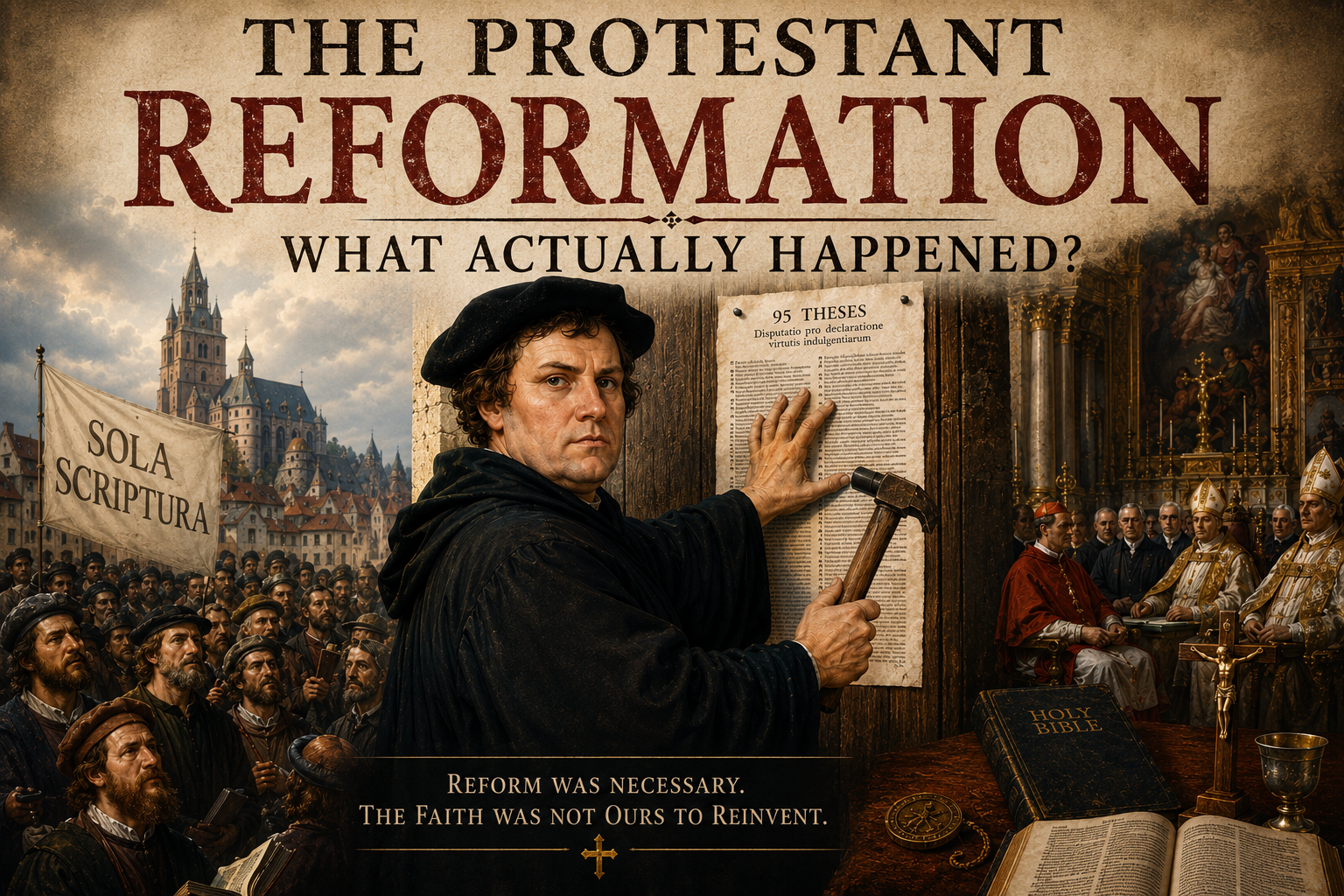
And on 31 October 1517, Luther sent his famous Ninety-Five Theses to Archbishop Albrecht of Mainz, challenging practices and theological claims surrounding indulgences.
This moment is traditionally regarded as the beginning of the Protestant Reformation.
But there is something important to understand.
The dispute did not begin with Luther rejecting the entire Catholic faith.
The controversy developed.
Questions about indulgences became questions about papal authority.
Questions about authority became questions about councils.
Questions about councils became questions about Scripture.
And eventually Luther’s theology departed from Catholic teaching in much more fundamental ways.
The debate was no longer simply:
“Should abuses in the Church be corrected?”
It became:
“Who possesses the authority to determine Christian doctrine?”
That question would become the heart of the Reformation.
The Real Issue: Authority
Behind many of the theological disputes of the Reformation lies one enormous question:
How did Christ intend His revelation to be preserved?
The Catholic answer is not:
Scripture or Tradition.
It is:
Scripture, Sacred Tradition and the teaching authority of the Church.
All three belong to the transmission of the one Apostolic faith.
The Protestant principle that eventually became known as Sola Scriptura proposed something fundamentally different:
Scripture alone is the only infallible rule of Christian faith.
That immediately raises several questions.
Where does Scripture itself teach that principle?
How did Christians know which writings belonged in Scripture?
Who settled disputes over the biblical canon?
How were doctrinal controversies resolved before every Christian possessed a Bible?
What happened during the centuries before the invention of the printing press?
And perhaps most importantly:
Is this how the earliest Christians understood Christian authority?
Those questions take us far beyond Martin Luther.
They take us back to Christ, the Apostles and the early Church.
And that is where the Catholic-Protestant debate ultimately has to be examined.
Reform or Revolution?
Catholics should readily agree with Protestants on one important point:
The Church was always in need of reform.
Every generation of Christians is.
Sin exists within the Church because sinners exist within the Church.
But the crucial historical question is whether the Reformation merely corrected abuses — or whether it eventually altered fundamental principles of Christian authority and doctrine.
That distinction will guide everything that follows.
Because once the question becomes:
“Who has the authority to determine what Christianity teaches?”
we arrive at the central dispute of the Reformation.
And from there we must examine one of its most influential principles:
Sola Scriptura — Scripture Alone
At the heart of the Protestant Reformation was a fundamental dispute about authority.
Catholics and Protestants agree on something extremely important:
Sacred Scripture is the inspired Word of God.
The Catholic Church does not place the Bible beneath human tradition. Scripture is inspired by God and therefore possesses divine authority.
The disagreement concerns a different question:
Did Christ establish Scripture as the only infallible rule of faith?
That is the principle commonly called Sola Scriptura — Scripture alone.
According to this principle, every Christian doctrine necessary for faith must ultimately be established from Scripture, and no Church, council or tradition possesses an infallible authority alongside it.
But before accepting that principle, we have to ask a surprisingly basic question:
Where Does the Bible Teach Sola Scriptura?
One passage frequently cited is:
“All scripture is inspired by God and profitable for teaching, for reproof, for correction, and for training in righteousness.”
— 2 Timothy 3:16
Catholics wholeheartedly accept this verse.
But notice what St. Paul says.
He says Scripture is inspired and profitable.
He does not say:
Scripture is the Christian’s only infallible authority.
In fact, immediately before this passage Paul reminds Timothy that he had learned the faith from trustworthy teachers:
“Continue in what you have learned and have firmly believed, knowing from whom you learned it.”
— 2 Timothy 3:14
And elsewhere Paul explicitly commands Christians to preserve teachings transmitted in more than one way:
“Stand firm and hold to the traditions which you were taught by us, either by word of mouth or by letter.”
— 2 Thessalonians 2:15
That verse is extremely important.
Paul identifies two means of transmitting Apostolic teaching:
By word of mouth.
By letter.
The written word was authoritative.
But so was the Apostolic teaching delivered orally.
Before the New Testament Existed
There is also a historical problem with Sola Scriptura.
On the day of Pentecost there was no completed New Testament.
The Apostles did not leave the Upper Room carrying twenty-seven New Testament books.
Christianity was already being preached, believed and practised before most of those books were written.
People were baptised.
The Eucharist was celebrated.
Churches were established.
Bishops and presbyters were appointed.
Doctrine was taught.
Disputes arose and were settled.
The Christian faith therefore existed before the completed New Testament existed.
How?
Because Christ entrusted His Gospel first to people.
He commanded the Apostles:
“Go therefore and make disciples of all nations…”
— Matthew 28:19
And:
“He who hears you hears me.”
— Luke 10:16
Christian revelation was proclaimed and handed on within the Church.
The New Testament emerged from within that Apostolic Church.
The Council of Jerusalem
Acts 15 provides an extraordinary example of how the earliest Church resolved a major doctrinal controversy.
The dispute concerned whether Gentile converts had to be circumcised and observe the Mosaic Law.
Notice what did not happen.
The Christians were not simply told:
“Read Scripture and decide for yourselves.”
Instead, the Apostles and elders gathered in Jerusalem.
There was debate.
Peter spoke.
Paul and Barnabas gave testimony.
James spoke.
And an authoritative decision was sent to the churches.
The resulting letter contains remarkable language:
“For it has seemed good to the Holy Spirit and to us…”
— Acts 15:28
This is the Church exercising authority.
And the decision was binding upon Christians beyond Jerusalem.
Acts therefore gives us an early biblical model of:
A doctrinal controversy.
Church leaders gathering to settle it.
An authoritative judgment.
That judgment being communicated to the wider Church.
This looks remarkably similar to the principle behind later Church councils.
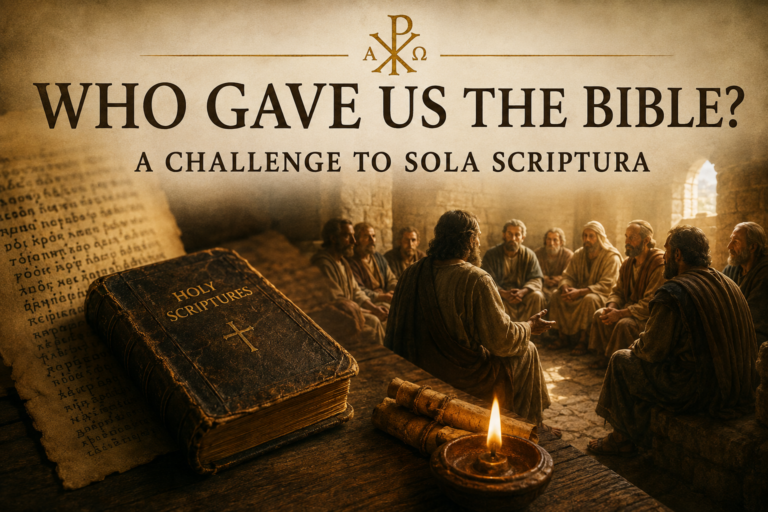
But Who Gave Us the Bible?
There is another question that Sola Scriptura must answer:
Which books constitute Scripture?
The Bible does not contain an inspired table of contents.
Nowhere in Matthew, John, Romans or Revelation do we find a divinely inspired list saying:
“These are the twenty-seven books of the New Testament.”
The early Christians had to distinguish genuine Apostolic writings from other Christian writings.
Some books were widely accepted very early.
Others were disputed in certain regions.
Questions arose concerning books such as:
Hebrews
James
2 Peter
2 and 3 John
Jude
Revelation
Other Christian writings were highly respected but ultimately were not included in the New Testament.
The Church therefore had to discern which books belonged to the canon.
By the fourth century we find councils giving lists corresponding to the Catholic biblical canon, including the councils of Hippo (AD 393) and Carthage (AD 397).
This creates an important question:
If the Bible alone is our infallible authority, how do we know infallibly which books belong to the Bible?
We cannot answer:
“Because the Bible tells us.”
It doesn’t.
We already need to know what the Bible is before we can appeal to its authority.
Scripture, Tradition and the Church
The Catholic position is sometimes caricatured as though Catholics believe in:
Bible + random human traditions.
That is not Catholic teaching.
The Catholic Church distinguishes Sacred Tradition from ordinary human customs and traditions.
Sacred Tradition refers to the Apostolic faith handed down from Christ through the Apostles and preserved within the Church.
Scripture and Tradition therefore do not represent two competing revelations.
They transmit the same deposit of faith.
The Second Vatican Council expressed this relationship clearly:
“Sacred tradition and Sacred Scripture form one sacred deposit of the word of God.”
— Dei Verbum, 10
And the Church’s teaching authority — the Magisterium — does not stand above God’s Word.
The same document explicitly states:
“This teaching office is not above the word of God, but serves it.”
— Dei Verbum, 10
That distinction matters enormously.
The Catholic claim is not that the Pope can invent revelation.
Nor can a council simply manufacture new Apostolic teaching.
The Church is entrusted with guarding, interpreting and faithfully handing on what she has received.
Paul Describes the Pattern
St. Paul gives Timothy an extraordinary description of how Christian teaching is transmitted:
“What you have heard from me before many witnesses entrust to faithful men who will be able to teach others also.”
— 2 Timothy 2:2
Look at the generations contained in that single verse:
Paul
↓
Timothy
↓
Faithful men
↓
Others whom those men will teach
This is transmission.
The Christian faith is being handed from one generation to another through appointed teachers.
It is remarkably close to what we encountered when examining apostolic succession and the Church Fathers.
The Real Catholic Question
Catholics are not asking Christians to choose between:
The Bible
or
The Church.
That would create a false opposition.
The real historical picture is:
Christ established the Apostles.
The Apostles preached the Gospel.
The Apostles established churches.
Apostolic teaching was transmitted orally and in writing.
Inspired writings circulated among those churches.
The Church recognised and preserved those writings as Scripture.
The Bible is therefore not an enemy of the Church.
It is one of the Church’s greatest treasures.
The question is whether Christ intended the Bible to function apart from the Apostolic Church that received, preserved, proclaimed and interpreted it.
And when we examine the New Testament itself, we repeatedly encounter Scripture, Apostolic Tradition and Church authority operating together.
That leads directly to another major Reformation doctrine:
Sola Fide — Are We Saved by Faith Alone?
Perhaps no issue became more closely associated with the Protestant Reformation than justification — how a sinner is made right with God.
Martin Luther came to emphasise the doctrine commonly expressed as:
Sola Fide — Faith Alone.
But this subject requires careful treatment because Catholics and Protestants agree on far more than is sometimes recognised.
Catholics do not believe that we can earn our way into Heaven.
We cannot place God in our debt.
We cannot save ourselves by performing enough good deeds.
Salvation begins with God’s grace.
The Catechism states plainly:
“Our justification comes from the grace of God.”
— Catechism of the Catholic Church, 1996
So the dispute is not:
Grace versus works.
The deeper question is:
What happens when God’s grace justifies us?
Does God merely declare the sinner righteous while leaving him inwardly unchanged?
Or does God’s grace actually transform the sinner, giving him new life in Christ?
And what place do faith, Baptism, obedience and works of love have within that life?
“By Grace You Have Been Saved”
One of the strongest Protestant texts is Ephesians 2:
“For by grace you have been saved through faith; and this is not your own doing, it is the gift of God — not because of works, lest any man should boast.”
— Ephesians 2:8–9
Catholics affirm every word.
Salvation is by grace.
It is God’s gift.
We cannot boast that we saved ourselves.
But the passage does not end at verse 9.
Paul immediately continues:
“For we are his workmanship, created in Christ Jesus for good works, which God prepared beforehand, that we should walk in them.”
— Ephesians 2:10
Good works do not replace grace.
They are the fruit of grace.
God saves us and then transforms the way we live.
What “Works” Is Paul Rejecting?
This is where context matters.
When Paul argues that we are justified by faith apart from “works of the law,” he is frequently confronting the claim that Gentile Christians must observe requirements of the Mosaic Law — particularly matters such as circumcision.
Paul writes:
“For we hold that a man is justified by faith apart from works of law.”
— Romans 3:28
But Paul cannot mean:
“Nothing we do after coming to faith matters.”
The same Paul writes:
“For he will render to every man according to his works.”
— Romans 2:6
And:
“For in Christ Jesus neither circumcision nor uncircumcision is of any avail, but faith working through love.”
— Galatians 5:6
That final phrase is particularly important:
“Faith working through love.”
Biblical saving faith is not merely intellectual agreement.
It is living faith.
Faith formed and expressed through love.
The Only Place Scripture Says “Faith Alone”
There is a remarkable fact in this debate.
The exact expression “faith alone” appears in Scripture in a passage that says:
“You see that a man is justified by works and not by faith alone.”
— James 2:24
That does not mean James believes we earn salvation independently of grace.
His argument is that a claimed faith which produces no obedience is dead.
He writes:
“Faith by itself, if it has no works, is dead.”
— James 2:17
And again:
“As the body apart from the spirit is dead, so faith apart from works is dead.”
— James 2:26
James therefore distinguishes between:
Living faith
and
Dead faith.
Simply claiming to believe is not enough.
Paul and James Do Not Contradict Each Other
At first glance, Paul and James can appear to disagree.
Paul says:
A man is justified by faith apart from works of the law.
James says:
A man is justified by works and not by faith alone.
But they are confronting different errors.
Paul attacks the idea that salvation can be obtained through works independently of God’s grace, and particularly the attempt to impose the Mosaic Law upon Gentile Christians.
James attacks the idea that a person can possess saving faith while producing no corresponding obedience or love.
Paul himself rejects that idea.
That is why he speaks of:
“faith working through love.”
— Galatians 5:6
There is no contradiction when the passages are read within their contexts.
Abraham: Paul and James Use the Same Man
Interestingly, both Paul and James appeal to Abraham.
Paul writes:
“Abraham believed God, and it was reckoned to him as righteousness.”
— Romans 4:3
James quotes the same passage.
But then James points to Abraham’s later obedience when he offered Isaac:
“You see that faith was active along with his works, and faith was completed by works.”
— James 2:22
This is extremely important.
James does not say Abraham’s works replaced his faith.
He says:
His faith was active with his works.
And:
His faith was completed by his works.
Faith and obedience are not enemies.
True faith produces obedience.
Jesus and Salvation
We should also ask how Jesus Himself speaks about judgment.
In Matthew 25, Christ describes the final judgment.
He separates the sheep from the goats.
And what does He discuss?
Feeding the hungry.
Giving drink to the thirsty.
Welcoming the stranger.
Clothing the naked.
Caring for the sick.
Visiting the imprisoned.
Jesus concludes:
“As you did it to one of the least of these my brethren, you did it to me.”
— Matthew 25:40
These works do not purchase God’s grace.
But neither does Jesus describe them as irrelevant to salvation.
Our response to grace matters.
“Not Everyone Who Says to Me, Lord, Lord”
Jesus gives an even more direct warning:
“Not every one who says to me, ‘Lord, Lord,’ shall enter the kingdom of heaven, but he who does the will of my Father who is in heaven.”
— Matthew 7:21
A verbal profession of faith is not enough.
Christ expects obedience.
Again, this is not salvation without grace.
No Christian obedience would be possible without God’s grace.
But grace does not make our response meaningless.
Grace enables our response.
Can Christians Lose Salvation?
This becomes another important difference between Christian traditions.
The New Testament repeatedly warns believers against falling away.
Paul tells Christians:
“Let any one who thinks that he stands take heed lest he fall.”
— 1 Corinthians 10:12
He also tells the Christians at Philippi:
“Work out your own salvation with fear and trembling.”
But immediately adds:
“for God is at work in you, both to will and to work for his good pleasure.”
— Philippians 2:12–13
Notice the balance.
We act.
God is working within us.
Catholic theology does not place human effort against divine grace.
Even our ability to respond faithfully is itself made possible by grace.
Grace Does Not Destroy Human Freedom
Catholic teaching rejects two opposite errors.
The first would be:
“I can save myself by my own works.”
False.
Without God’s grace, we cannot attain salvation.
But the opposite extreme would be:
“Once I believe, my subsequent response to God’s grace has no real consequence.”
Scripture does not teach that either.
God’s grace calls for a genuine human response.
We can cooperate with grace.
We can also resist it.
St. Paul even warns Christians:
“Do not receive the grace of God in vain.”
— 2 Corinthians 6:1
Grace is entirely God’s gift.
But it is a gift intended to transform us.
Justification Is More Than a Legal Fiction
This brings us to an important difference in theological emphasis.
Catholicism understands justification not simply as God declaring something about us externally.
God actually makes us participants in His life.
Paul writes:
“If anyone is in Christ, he is a new creation.”
— 2 Corinthians 5:17
And:
“God’s love has been poured into our hearts through the Holy Spirit who has been given to us.”
— Romans 5:5
The justified Christian is not merely a guilty sinner wearing an external label of righteousness.
Grace begins a genuine interior renewal.
We are adopted as children of God.
We receive the Holy Spirit.
We become members of Christ.
We are sanctified.
Salvation therefore involves not merely being declared righteous but being transformed by grace.
What About Good Works and Merit?
The word merit can easily cause misunderstanding.
Catholic teaching does not mean that we perform works independently and then demand Heaven as payment from God.
Everything begins with grace.
Even our ability to perform genuinely good supernatural works comes from God’s grace operating within us.
Jesus gives us the image:
“I am the vine, you are the branches.”
— John 15:5
Then He says:
“Apart from me you can do nothing.”
That is the foundation.
The branch bears fruit only because it remains connected to the vine.
Likewise, Christian works have supernatural value only because the Christian is united to Christ.
The Council of Trent
The Catholic response to the Reformation was formally expressed at the Council of Trent, which met in several sessions between 1545 and 1563.
Trent rejected the idea that human beings can justify themselves through their natural works.
It taught that justification begins through God’s prevenient grace — grace that comes before and enables our response.
The sinner cannot simply decide to save himself.
God acts first.
But Trent also rejected the idea that justification leaves the person merely externally declared righteous while remaining inwardly unchanged.
Grace truly renews the person.
This distinction is essential when discussing Catholic teaching fairly.
The Catholic position is not:
Faith + human works = earning salvation.
It is:
Grace produces faith, renewal, love and obedience within the Christian.
A Necessary Modern Qualification
Catholic-Protestant disagreement over justification remains real.
But we should not speak as though nothing has happened since the sixteenth century.
In 1999, the Catholic Church and the Lutheran World Federation issued the Joint Declaration on the Doctrine of Justification.
It stated a significant area of common confession:
“By grace alone, in faith in Christ’s saving work and not because of any merit on our part, we are accepted by God…”
This does not mean every Catholic-Lutheran disagreement disappeared.
They did not.
But it demonstrates something important:
Catholics do not teach that we earn initial salvation through our own works.
Much of the historic hostility has also involved different theological language and misunderstandings about what the other side actually teaches.
Faith Must Be Alive
When the whole New Testament is considered, the picture is richer than either:
“Works save us.”
or:
“Works don’t matter.”
Scripture gives us:
Grace.
Faith.
Baptism.
Conversion.
Love.
Obedience.
Perseverance.
Good works produced by God’s grace.
Paul perhaps expresses the balance most beautifully:
“For in Christ Jesus neither circumcision nor uncircumcision is of any avail, but faith working through love.”
— Galatians 5:6
That is very close to the heart of the Catholic understanding.
We are saved by God’s grace.
We cannot earn that grace.
But the grace that saves us is not intended to leave us unchanged.
It creates new life.
It produces love.
It calls us to obedience.
It bears fruit.
And it must be persevered in.
The Reformation disagreement over justification therefore cannot be reduced to:
Protestants believe in grace; Catholics believe in works.
That is historically and theologically false.
The real disagreement concerns what justification does, how righteousness is received, and how the transformed Christian cooperates with God’s grace.
And Martin Luther’s developing answers to those questions would bring him into increasingly serious conflict with the Catholic Church.
That brings us to the man at the centre of the Reformation:
Martin Luther — From Catholic Monk to Reformer
Martin Luther — From Catholic Monk to Reformer
Martin Luther did not begin his life intending to create a new branch of Christianity.
He was born in 1483 in Eisleben, in what is now Germany. He entered the Augustinian religious life, was ordained a Catholic priest in 1507, and became a professor of theology at the University of Wittenberg.
Luther was intelligent, deeply religious and intensely concerned with sin, judgment and salvation.
His eventual break with Rome did not happen overnight.
It developed through a series of theological controversies that gradually moved far beyond the original dispute over indulgences.
Understanding that development is important.
The Reformation did not begin with Luther announcing:
“I am founding Protestantism.”
It began within the Catholic Church as an argument about reform.
It eventually became an argument about authority itself.
The Ninety-Five Theses — 1517
The traditional starting point of the Protestant Reformation is 31 October 1517, when Luther sent his Ninety-Five Theses to Archbishop Albrecht of Mainz.
The theses focused primarily on indulgences, repentance and abuses surrounding their preaching.
Contrary to some popular versions of the story, the Ninety-Five Theses were not yet a complete declaration of later Protestant theology.
Luther had not yet rejected everything that would eventually separate him from Catholicism.
His theology developed over the following years.
And some of his criticisms concerned real abuses that Catholics themselves could legitimately condemn.
This distinction is important.
Luther was not wrong simply because he criticised corruption.
Catholic saints had criticised corruption before him.
The crucial question is what conclusions should follow from those abuses.
Should corrupt practices be reformed?
Certainly.
But should established Christian doctrines and structures be rejected?
That is a different question entirely.
Johann Tetzel and Indulgences
The indulgence controversy is often presented as:
“The Catholic Church was selling tickets to Heaven.”
That is not an accurate description of Catholic doctrine.
An indulgence does not forgive an unrepented mortal sin.
Nor does it give someone permission to sin.
Nevertheless, the way indulgences were promoted could become seriously abusive.
The Dominican preacher Johann Tetzel became particularly associated with aggressive indulgence preaching in Germany.
Fundraising was connected with the indulgence campaign, including money destined for the rebuilding of St. Peter’s Basilica in Rome, while Archbishop Albrecht’s financial arrangements added another controversial dimension.
Whatever the precise slogans used in popular preaching, the danger was obvious:
People could be given the impression that spiritual benefits were effectively being purchased with money.
That required reform.
But again:
Abuse of a doctrine does not automatically disprove the doctrine.
The question was rapidly becoming larger.
Leipzig — 1519
A crucial turning point came during Luther’s debate with the Catholic theologian Johann Eck at Leipzig in 1519.
The controversy moved beyond indulgences.
Eck pressed Luther concerning the authority of popes and councils and connected some of Luther’s positions with those of Jan Hus, who had been condemned at the Council of Constance.
Luther increasingly argued that Church councils could err.
This dramatically raised the stakes.
If popes could err…
and councils could err…
then where did final doctrinal authority lie?
Luther’s answer increasingly became:
Sacred Scripture.
But this created the question we examined earlier:
Who possesses the authority to interpret Scripture when Christians disagree?
The Reformation was moving from a dispute over abuses toward a fundamental disagreement over the structure of Christian authority.
1520 — The Break Accelerates
By 1520, the conflict had become much more serious.
Luther published several enormously influential works, including:
To the Christian Nobility of the German Nation
The Babylonian Captivity of the Church
The Freedom of a Christian
In these writings, Luther challenged major aspects of Catholic theology and ecclesiastical authority.
The dispute was no longer principally about indulgences.
The foundations were shifting.
Pope Leo X Responds
In June 1520, Pope Leo X issued the papal bull Exsurge Domine, identifying propositions associated with Luther’s teaching and demanding that he retract his errors.
Luther did not submit.
Instead, in December 1520, he publicly burned the papal bull along with other ecclesiastical legal texts.
The symbolic meaning was unmistakable.
This was no longer simply an internal appeal for reform.
Luther was rejecting the authority demanding his submission.
In January 1521, he was excommunicated.
The Diet of Worms — 1521
Luther was then summoned before the Diet of Worms, an imperial assembly held in 1521 in the presence of Emperor Charles V.
He was confronted with his writings and asked whether he would retract them.
This event later became surrounded by famous quotations and Protestant legend.
The phrase commonly associated with Luther:
“Here I stand, I can do no other”
is famous, but historians cannot establish with confidence that Luther actually spoke those exact words at Worms.
We therefore should not build the historical account around them.
What is securely documented is the substance of Luther’s response.
He maintained that unless he could be convinced by Scripture and evident reason, he could not retract because his conscience was bound by the Word of God.
This represents the central problem of authority in dramatic form.
Luther was effectively placing his interpretation of Scripture against the judgment of established ecclesiastical authority.
Was Luther Simply Choosing the Bible Over the Pope?
This is where the story is often oversimplified.
It can sound compelling:
Luther stood with the Bible.
Rome stood against the Bible.
But that was not the real question.
Catholic theologians also believed Scripture was the inspired Word of God.
They quoted Scripture.
They interpreted Scripture.
They appealed to the Fathers.
The disagreement was:
Who possesses authority to determine the correct interpretation of Scripture?
Luther believed ecclesiastical authorities had contradicted Scripture.
Catholics believed Luther was interpreting Scripture contrary to the Apostolic faith preserved within the Church.
Therefore both sides could appeal to Scripture while reaching different conclusions.
And that problem would become increasingly important as the Reformation spread.
Luther and the Sacraments
Luther did not simply discard every Catholic belief.
This is sometimes forgotten.
For example, Luther maintained a very strong belief in Christ’s real presence in the Eucharist.
He fiercely opposed reformers who interpreted Christ’s words:
“This is my body”
in a purely symbolic manner.
This is historically important because the Reformers themselves soon began disagreeing about the meaning of Scripture.
Luther and the Swiss reformer Huldrych Zwingli became deeply divided over the Eucharist.
Both accepted Scripture.
Both rejected papal authority.
Both believed their position was biblical.
Yet they could not agree on what one of Christianity’s central passages meant.
The Marburg Colloquy — 1529
The disagreement became especially visible at the Marburg Colloquy in 1529.
Luther and Zwingli attempted to reach agreement on major theological issues.
They agreed on much.
But they could not agree on the Eucharist.
Luther insisted upon the reality of Christ’s Body and Blood.
Zwingli understood the Eucharist much more symbolically.
According to traditional accounts, Luther emphasised Christ’s words:
“This is my body.”
The significance is enormous.
Only twelve years after the Ninety-Five Theses, leading Reformers who appealed to Scripture against Rome were already unable to agree about what Scripture taught concerning the Eucharist.
This does not prove Catholicism automatically.
But it demonstrates the difficulty created by the question:
Who settles the dispute?
If Scripture is the sole infallible authority but two sincere Christians interpret Scripture differently, Scripture remains infallible…
but the interpreters are not.
Luther and the Biblical Canon
Another subject requiring careful treatment is Luther’s attitude toward certain biblical books.
It is sometimes claimed that:
“Martin Luther removed books from the Bible.”
That statement needs qualification.
Luther’s German Bible did include the Old Testament books Catholics call the Deuterocanonical books, but he placed them in a separate section labelled Apocrypha and did not regard them as equal to canonical Scripture.
He also expressed serious reservations concerning several New Testament books.
Most famously, Luther described the Epistle of James very negatively in an early preface because he believed it did not proclaim Christ as clearly as other books and because of its language concerning faith and works.
He also expressed varying reservations concerning:
Hebrews
James
Jude
and
Revelation.
Nevertheless, these books remained in Luther’s New Testament.
So accuracy matters.
Luther did not simply delete James from his Bible.
But his treatment of disputed books demonstrates something extremely important:
The question of the canon did not disappear with Sola Scriptura.
It became even more significant.
James and “Faith Alone”
The reason Luther’s difficulty with James attracts so much attention is obvious.
Luther strongly emphasised justification by faith.
Yet James states:
“You see that a man is justified by works and not by faith alone.”
— James 2:24
We should not pretend that Luther simply rejected James because one verse was inconvenient.
His concerns were broader and involved his understanding of Apostolic teaching and the Gospel.
Nevertheless, the tension is historically important.
If Scripture alone is the supreme infallible rule, what principle determines whether a disputed book belongs within Scripture in the first place?
That brings us back to the canon problem.
Luther’s Translation of Romans 3:28
Another famous controversy concerns Luther’s German translation of Romans 3:28.
Paul writes that a person is justified by faith apart from works of the law.
In his German translation, Luther famously rendered the sense using:
“faith alone” — allein durch den Glauben
even though the word corresponding to alone is not explicitly present in the Greek text at that point.
Luther defended this translation on linguistic grounds, arguing that idiomatic German required it to communicate Paul’s meaning properly.
So again, we should present the argument accurately.
It would be too simplistic to say:
“Luther secretly inserted a word into the Bible to change it.”
He openly defended the translation.
But the theological significance remains worth examining because “faith alone” was central to his understanding of justification.
And, as we have already seen, the only place where the biblical text explicitly uses the formulation “faith alone” in this controversy is James 2:24:
“not by faith alone.”
That does not settle the entire justification debate by itself.
But it certainly means the issue deserves more careful examination than slogans allow.
Luther Was Not the Entire Reformation
There is another misconception worth correcting.
The Protestant Reformation was not simply:
Martin Luther versus the Catholic Church.
Other reform movements developed.
Among the major figures were:
Huldrych Zwingli
John Calvin
Thomas Cranmer
and many others.
And they did not all agree with Luther.
They disagreed about:
The Eucharist
Baptism
Predestination
Church government
Worship
The relationship between Church and state
and other important theological questions.
This is where the Reformation story becomes much larger.
Once the authority capable of giving a binding interpretation of Christian doctrine was rejected, multiple competing interpretations emerged.
Did Luther Intend Thousands of Denominations?
No.
It would be unfair to suggest that Luther deliberately wanted Christianity to fragment into countless competing churches.
He clearly did not.
Nor can every later Protestant division simply be personally blamed on Luther.
History is far more complicated.
But the structural question remains:
Once Christians reject a final visible teaching authority, what happens when equally sincere Christians interpret Scripture differently?
The Luther-Zwingli dispute demonstrates that the problem appeared almost immediately.
Both men appealed to Scripture.
Both were convinced.
Neither recognised an authority capable of definitively settling the dispute between them.
And their followers went separate ways.
The Reformation Had Now Changed
The controversy that began publicly around indulgences had become something much larger.
By the 1520s, fundamental questions were being asked about:
Authority.
Scripture.
Tradition.
Justification.
The sacraments.
The priesthood.
The Mass.
Church structure.
The original call for reform had become a division over the nature of Christianity itself.
And once Luther was no longer alone, another question became unavoidable:
If Scripture alone is sufficient to settle Christian doctrine, why did the Reformers themselves disagree about what Scripture taught?
That takes us into the next major chapter of the story:
From One Reformation to Many — Why Protestantism Divided
The Protestant Reformation did not produce a single alternative to Catholicism.
Within a remarkably short period, the Reformers themselves were divided over major questions of Christian doctrine.
This fact needs to be handled fairly.
Disagreement by itself does not prove that one side is wrong.
Catholics have disagreements among themselves too.
The important distinction is that Catholicism claims there remains a final teaching authority capable of definitively settling questions of faith and morals.
The Reformation rejected that authority.
So a new problem emerged:
What happens when Christians who all accept the authority of Scripture cannot agree about what Scripture means?
The answer began to unfold almost immediately.
Luther and Zwingli — “This Is My Body”
One of the earliest and clearest divisions concerned the Eucharist.
Martin Luther rejected the Catholic explanation of the Eucharist, particularly the doctrine of transubstantiation.
But he absolutely did not believe Communion was merely symbolic.
Luther insisted strongly upon Christ’s real presence.
The Swiss reformer Huldrych Zwingli, however, understood Christ’s words differently.
When Jesus said:
“This is my body.”
— Matthew 26:26
Luther took those words with strong realism.
Zwingli interpreted the bread primarily as a memorial sign representing Christ’s Body.
Both men believed the Bible was authoritative.
Both rejected the authority of Rome.
Both believed they were following Scripture.
And yet they reached incompatible conclusions about one of Christianity’s central sacraments.
Marburg — 1529
An attempt was made to resolve their disagreement at the Marburg Colloquy in 1529.
Luther and Zwingli reached agreement on many points.
But they could not resolve the Eucharistic controversy.
The division remained.
This is historically significant because it occurred extremely early in the Reformation.
The principle of Scripture’s authority had not produced agreement over Scripture’s meaning.
That does not reveal a weakness in Scripture.
Scripture cannot be wrong.
The disagreement existed between its interpreters.
And neither interpreter recognised a higher visible authority capable of giving a judgment binding upon both.
John Calvin
A second major Protestant tradition emerged through the work of John Calvin.
Calvin was born in France in 1509, more than twenty-five years after Luther.
His Institutes of the Christian Religion became one of the most influential theological works of the Reformation.
Calvin agreed with Luther on important principles, including the rejection of papal authority.
But Calvinism and Lutheranism were not identical.
Their traditions developed significant differences concerning subjects such as:
The Eucharist
Predestination
The relationship between divine sovereignty and human freedom
Church government
and aspects of worship.
Again, both appealed to Scripture.
Yet distinct Protestant theological traditions emerged.
The English Reformation
England followed yet another path.
The English Reformation cannot simply be reduced to Luther’s theological struggle.
Political and dynastic factors played an enormous role.
King Henry VIII had originally opposed Luther and was granted the title Defender of the Faith by Pope Leo X.
The crisis with Rome developed principally around Henry’s attempt to obtain an annulment of his marriage to Catherine of Aragon.
Eventually, the Act of Supremacy of 1534 declared the king supreme head of the Church of England.
But England did not immediately become Protestant in every theological respect.
Under Henry, many traditional Catholic beliefs and practices remained.
After his death, England moved much further in a Protestant direction under Edward VI.
Under Mary I, communion with Rome was restored.
Under Elizabeth I, a lasting English religious settlement developed.
The English Reformation therefore demonstrates again that there was no single uniform event called “the Reformation.”
Different countries followed different theological and political paths.
Anabaptists
Other Christians believed that the major Reformers had not gone far enough.
Groups commonly gathered under the broad description Anabaptist rejected infant Baptism and insisted upon Baptism following a personal profession of faith.
This placed them in conflict not only with Catholics but also with Lutherans and Reformed Protestants.
Remember what this means.
Catholics read the Bible and baptised infants.
Lutherans read the Bible and baptised infants.
Reformed Christians read the Bible and baptised infants.
Anabaptists read the Bible and rejected infant Baptism.
The disagreement could not therefore be reduced to:
People who follow Scripture
versus
People who do not.
All sides claimed biblical support.
The dispute concerned interpretation.
The Problem Becomes Clear
Consider only a few questions that emerged from the Reformation:
| Question | Competing Christian Answers |
|---|---|
| What happens in the Eucharist? | Catholic, Lutheran, Reformed and symbolic understandings |
| Should infants be baptised? | Yes / No |
| How should the Church be governed? | Papal, episcopal, presbyterian and congregational models |
| What is the relationship between free will and predestination? | Significantly different systems |
| How should Christian worship be structured? | Different liturgical and non-liturgical approaches |
| What authority does Tradition possess? | Widely differing answers |
All of these Christians could appeal to the Bible.
So the real problem is not:
Is Scripture authoritative?
Catholics, Lutherans, Calvinists, Anglicans and many other Christians can answer:
Yes.
The harder question is:
Who authoritatively determines what Scripture teaches when Christians disagree?
Does Division Disprove Protestantism?
We need to be precise here.
The mere existence of Protestant denominations does not logically prove Catholicism true.
Nor would it be fair to pretend that every Protestant denomination disagrees about every essential Christian doctrine.
Many share fundamental beliefs:
The Trinity
The divinity of Christ
Christ’s Resurrection
The inspiration of Scripture
and much more.
Furthermore, not every modern Protestant accepts exactly the same understanding of Sola Scriptura.
Serious Protestant theologians do not generally teach:
“Ignore all history and interpret the Bible however you like.”
Many value creeds, councils, Church Fathers and historic confessions.
So the Catholic argument should be stronger than simply:
“There are lots of denominations, therefore Protestantism is false.”
That is too easy.
The deeper problem concerns final authority.
Who Has the Final Word?
Suppose two Christians disagree about Baptism.
Both study Scripture.
Both know Greek.
Both pray.
Both consult commentaries.
Both study the Fathers.
Both sincerely believe the Holy Spirit is guiding them.
One concludes:
Infants should be baptised.
The other concludes:
Only professing believers should be baptised.
Who decides?
They can continue debating Scripture.
They can appeal to different theologians.
They can establish separate congregations.
But unless there is an authority recognised by both sides, there is no mechanism capable of issuing a binding judgment.
That is the Catholic challenge to Sola Scriptura.
Not:
“Protestants cannot understand the Bible.”
Clearly they can.
Rather:
Scripture alone does not provide a living tribunal capable of resolving every dispute over Scripture’s interpretation.
We Have Seen This Problem Before
The New Testament itself records a major doctrinal controversy in Acts 15.
The early Christians disagreed about circumcision and the Mosaic Law.
How was it settled?
The Apostles and elders assembled.
They debated.
Peter spoke.
Paul and Barnabas testified.
James spoke.
A judgment was reached.
Then a letter was sent declaring:
“It has seemed good to the Holy Spirit and to us…”
— Acts 15:28
The churches were expected to receive the decision.
The controversy was not resolved by establishing:
The circumcision church
and
The non-circumcision church.
The Church rendered a judgment.
Christ Prayed for Unity
Christian division should trouble every Christian, Catholic or Protestant.
On the night before His Passion, Jesus prayed:
“that they may all be one.”
— John 17:21
Christian unity therefore cannot simply mean that division does not matter.
At the same time, unity cannot mean pretending important doctrinal disagreements do not exist.
Jesus’ prayer points toward something deeper:
Unity in truth.
The earliest Church expressed that unity visibly through common faith, sacraments and ecclesial communion.
That is why St. Paul could write:
“one Lord, one faith, one baptism.”
— Ephesians 4:5
Did Protestantism Immediately Produce Thousands of Denominations?
Another popular Catholic argument needs correcting.
You will sometimes hear:
“Luther created 30,000 — or 40,000 — Protestant denominations.”
We should not use that argument.
Those numbers usually come from modern statistical classifications that may count separate national organisations or administrative bodies as distinct denominations.
They do not mean Luther personally caused tens of thousands of different theologies.
That claim is unnecessary and easily challenged.
The historical point is strong enough without exaggeration:
The Reformation produced multiple competing Protestant traditions very early.
Lutherans.
Reformed Christians.
Anabaptists.
Anglicans.
And later many additional movements.
The exact modern number is not the important issue.
The important issue is the principle of doctrinal authority.
The Catholic Claim
Catholicism proposes a fundamentally different model.
Christ gave His revelation to the Apostles.
The Apostles transmitted it to the Church.
Their successors preserved that Apostolic faith.
Sacred Scripture exists at the heart of that Tradition.
And when serious disputes threaten the unity of the faith, the Church possesses a teaching authority — the Magisterium — capable of rendering definitive judgments.
That does not mean Catholics never argue.
We do.
It does not mean every theological question has received an infallible definition.
It has not.
And it certainly does not mean every bishop or pope is always correct about everything.
The claim is much narrower:
Christ did not leave His Church without a final teaching authority in matters where the deposit of faith requires an authoritative judgment.
Reformation or Restoration?
We can now return to the claim with which we began:
Was the Reformation a restoration of original Christianity?
To answer that, we cannot simply compare modern Catholicism with modern Protestantism.
We have to compare both with the Christianity that existed before either modern form developed.
We have already examined Christians from the first and second centuries.
And what did we find?
Bishops.
Apostolic succession.
Eucharistic realism.
Baptismal regeneration.
Sacred Tradition.
Visible Church authority.
Liturgical worship.
The Catholic Church.
That evidence creates a difficult historical question.
If the Reformers were restoring the Christianity of the Apostles:
Where do we find distinctly Protestant Christianity in the earliest centuries?
Not simply Christians who loved Scripture.
Catholics claim that too.
Not Christians who believed salvation comes through grace.
Catholics claim that too.
The question is whether we find the distinctive principles of the Reformation operating as the rule of Christianity from the beginning.
That is the historical test.
And it brings us toward the final part of our investigation:
Was Protestantism a Return to the Early Church?
The Protestant Reformers generally did not believe they were inventing a new religion.
They believed important errors had entered Western Christianity and that reform was necessary.
Martin Luther, John Calvin and other Reformers appealed constantly to Sacred Scripture.
They also appealed at times to St. Augustine and other Church Fathers.
Their claim, in different forms, was that the Church needed to recover the purity of the Apostolic Gospel.
That gives us a historical test.
If the Reformation restored original Christianity, what does Christianity look like when we move backward toward the Apostles?
We do not have to guess.
We possess Christian writings from before Constantine, before Nicaea and centuries before the Reformation.
And those writings allow the restoration claim to be examined.
Start With the First Christians
Imagine moving backwards through Christian history.
Past the Middle Ages.
Past Constantine.
Past the great fourth-century councils.
Back into the second century.
Eventually we arrive at Christians who lived only generations after the Apostles.
What do we find?
Do we find churches organised around the principle that Scripture is the sole infallible rule of faith?
Do we find a purely symbolic Eucharist?
Do we find Baptism treated merely as a public declaration?
Do we find independent congregations without bishops?
Do we find Christians rejecting Apostolic Tradition?
The surviving evidence points in another direction.
Clement of Rome — c. AD 96
Near the end of the first century, Clement of Rome describes the Apostles appointing ministers and making provision for their ministry to continue after their deaths.
He explains that the Apostles foresaw disputes concerning ministry and provided that:
“other approved men should succeed them”
— 1 Clement, 44
This is extremely early evidence for the principle underlying Apostolic succession.
Clement is not writing in medieval Europe.
He is writing within the first century of Christianity.
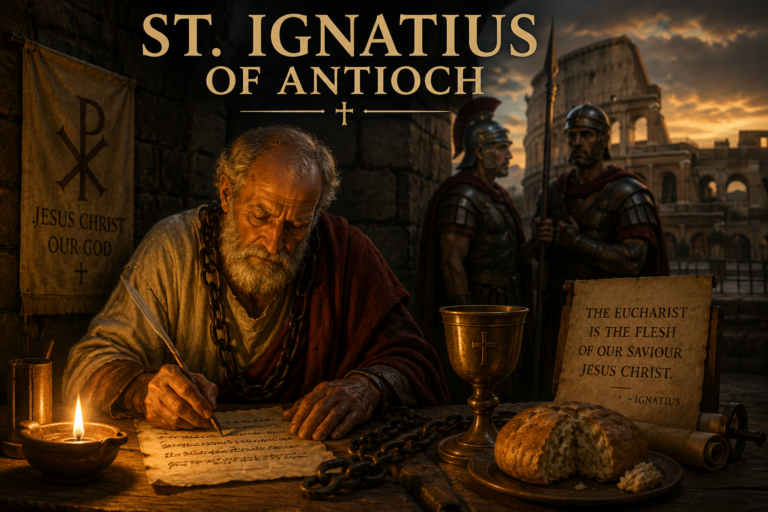
Ignatius of Antioch — Early Second Century
Only a short time later, Ignatius of Antioch gives us an extraordinary picture of Christian life.
His letters repeatedly speak of:
Bishops.
Presbyters.
Deacons.
The Eucharist.
The altar.
Visible Church unity.
He tells the Smyrnaeans:
“Wherever Jesus Christ is, there is the Catholic Church.”
— Letter to the Smyrnaeans, 8
And when describing certain heretics, Ignatius says they abstain from the Eucharist because:
“they do not confess the Eucharist to be the flesh of our Saviour Jesus Christ.”
— Letter to the Smyrnaeans, 7
This is approximately fourteen centuries before the Reformation.
Already we have a bishop speaking of:
The Catholic Church.
Episcopal authority.
The Eucharist as Christ’s Flesh.
That presents a serious difficulty for the theory that these ideas were medieval corruptions.
Justin Martyr — c. AD 150
Move forward several decades.
Justin Martyr describes Christian Sunday worship.
Christians gather together.
The writings of the Apostles and prophets are read.
Instruction is given.
Prayers are offered.
Bread, wine and water are brought forward.
Thanksgiving is offered.
The people respond.
The Eucharist is distributed.
And Justin explicitly says:
“We do not receive these as common bread and common drink.”
— First Apology, 66
He connects the Eucharistic food with the Flesh and Blood of Jesus Christ.
Again, this is not medieval Christianity.
It is Christianity around AD 150.
Irenaeus — c. AD 180
Then we encounter Irenaeus of Lyons.
When confronting heretics claiming secret Christian knowledge, Irenaeus does not simply tell every individual to interpret Scripture independently.
He appeals to the:
Tradition of the Apostles.
And to:
The succession of bishops.
He argues that authentic Christian teaching can be traced publicly through churches established by the Apostles.
He even gives the succession of bishops at Rome as a major example.
Once again we encounter a Christianity built around:
Scripture.
Tradition.
Church authority.
Apostolic succession.
This is still approximately a century before Constantine’s birth.
Put the Evidence Together
Now compare some characteristic Reformation disputes with the earliest Christian evidence:
| Question | Early Christian Evidence |
|---|---|
| Is Christianity visibly governed? | Bishops, presbyters and deacons appear extremely early |
| Is Apostolic Tradition important? | Irenaeus explicitly appeals to it |
| Does ministry continue through succession? | Clement and Irenaeus describe succession |
| Is Baptism merely symbolic? | Early Christians speak of regeneration and forgiveness |
| Is the Eucharist merely symbolic? | Ignatius and Justin use strongly realistic language |
| Is Christian worship purely informal? | Justin describes structured Sunday liturgical worship |
| Is the Church merely invisible? | Ignatius describes visible unity around bishops and Eucharist |
| Was “Catholic Church” invented after Constantine? | Ignatius uses the expression in the early second century |
This does not prove every later Catholic doctrine in one stroke.
History rarely works that simply.
But it establishes something extremely important:
The Christianity immediately following the Apostles already possesses recognisably Catholic characteristics.
But Didn’t the Fathers Sometimes Disagree?
Absolutely.
The Church Fathers were not individually infallible.
They disagreed on various theological questions.
Some made statements the Church would later reject or refine.
Some questions had not yet been fully resolved.
Catholic apologetics becomes weaker when isolated quotations from Fathers are treated as though every Father taught every later Catholic doctrine in its final form.
That is not the Catholic claim.
The important question is the overall structure of Christianity we encounter.
And that structure is strikingly sacramental, Apostolic and ecclesial.
What About Augustine?
Protestants — particularly those from Reformed traditions — often appeal strongly to St. Augustine of Hippo.
And rightly so.
Augustine’s enormous emphasis upon God’s grace had a profound influence upon Western Christianity.
Luther himself was an Augustinian friar.
But Augustine cannot simply be turned into a sixteenth-century Protestant.
Augustine also believed strongly in:
The authority of the Catholic Church.
Sacramental Baptism.
The Eucharist.
The episcopacy.
Apostolic succession.
The value of Tradition.
Most famously, while arguing against the Manichaeans, Augustine wrote:
“I would not believe the Gospel except as moved by the authority of the Catholic Church.”
— Against the Fundamental Epistle of Manichaeus, 5
That statement should not be misused to suggest Augustine placed the Church above God’s revelation.
His point concerns the authority by which the Gospel is presented and recognised.
But whatever interpretation one gives the passage, Augustine plainly does not sound like someone who believed Christianity consisted of Scripture isolated from the authority of the Catholic Church.
The Reformers Inherited Catholic Christianity
There is another historical point worth remembering.
The Reformers did not discover Christianity from nothing.
They inherited:
The Bible.
The doctrine of the Trinity.
The doctrine of Christ’s two natures.
The ancient creeds.
Centuries of Christian theology.
A developed Christian vocabulary.
And much of this inheritance had been preserved through the very Church they came to oppose.
This does not automatically prove every Catholic claim.
But it complicates the idea that fifteen centuries of Christianity can simply be placed between brackets and Christianity reconstructed from the biblical text alone.
Where Was the Church?
This produces perhaps the most difficult question for a complete “Great Apostasy” theory.
Christ promised:
“I will build my church, and the powers of death shall not prevail against it.”
— Matthew 16:18
He also promised the Apostles:
“I am with you always, to the close of the age.”
— Matthew 28:20
If the visible Christian Church fell into fundamental doctrinal corruption shortly after the Apostolic period and remained that way until the Reformation, what happened to those promises?
Where was Christ’s Church during those centuries?
This question should not be exaggerated.
Many Protestants do not believe that Christianity completely vanished for fifteen hundred years.
They recognise genuine Christians throughout Catholic history.
But that produces another difficulty.
Those Christians overwhelmingly lived within sacramental, episcopal churches possessing beliefs the Reformers would later reject.
The historical problem remains.
The Catholic Claim Is Continuity
Catholicism does not claim that every external feature of the modern Church existed fully developed in AD 100.
That would be historically indefensible.
The claim is one of organic continuity.
The seed develops.
Terminology becomes more precise.
Discipline changes.
Liturgical forms develop.
New controversies require increasingly precise doctrinal definitions.
But the identity remains.
This is why development matters.
Development preserves what came before.
Corruption contradicts it.
The historical question is therefore not:
“Did Catholicism develop?”
Obviously it did.
The real question is:
“Did Catholic doctrine develop organically from the Apostolic faith, or did it contradict and replace it?”
That question must be answered doctrine by doctrine.
Follow the Evidence Backwards
If we trace Catholic Christianity backward, we find:
The medieval Church.
↓
The Patristic Church.
↓
Ignatius, Clement, Justin and Irenaeus.
↓
The Apostolic Church described in Scripture.
↓
The Apostles.
↓
Jesus Christ.
There are developments throughout that history.
There are controversies.
There are scandals.
There are terrible sinners.
There are reforms.
But the fundamental Catholic claim is that there remains an identifiable continuity of faith, sacrament and Apostolic ministry.
The Reformation asks us to believe that significant parts of that inherited Christianity had become corrupted and required correction.
That claim deserves serious consideration.
But it also carries a burden of proof.
Because rejecting a doctrine practised across ancient Christianity requires answering:
When did it enter Christianity?
Who introduced it?
Where was the opposition?
What did Christians believe beforehand?
And:
Does the surviving evidence actually support that reconstruction?
The Question Is Bigger Than Luther
Ultimately, the Catholic-Protestant question cannot be settled simply by asking:
Was Martin Luther sincere?
He undoubtedly believed enormously important issues were at stake.
Nor can it be settled by pointing to corrupt Catholics.
There were corrupt Catholics.
The question is about truth.
What did Christ establish?
What did the Apostles teach?
How was that faith transmitted?
What did the Christians immediately following them believe?
And which understanding of Christianity best accounts for the entire historical record?
Once those questions are asked, the Reformation looks very different.
It was certainly a call for reform.
Some of that reform was desperately needed.
But it also introduced or crystallised principles of authority and justification that must themselves be tested against the Christianity that preceded them.
And that brings us to the conclusion:
Reform Was Necessary — Division Was Not Inevitable
The Protestant Reformation arose during a period when parts of the Catholic Church genuinely needed reform.
That fact should not be hidden.
There were scandals among clergy.
There were abuses involving money and ecclesiastical office.
There were serious problems in the preaching of indulgences.
There were bishops whose lives did not reflect the Gospel they were supposed to proclaim.
Catholics can acknowledge all of this without fear.
The holiness of Christianity has never depended upon every Christian being holy.
The Church began with twelve Apostles — and among them were betrayal, denial, ambition and weakness.
Christ did not promise that His Church would contain no sinners.
He promised that He would remain with His Church.
The question raised by the Reformation was therefore not whether reform was necessary.
It was.
The deeper question was:
How should the Church be reformed?
The Catholic Church Also Reformed
The sixteenth century did not produce reform only outside the Catholic Church.
A major Catholic renewal also took place.
New religious orders emerged.
Seminary formation was strengthened.
Abuses were confronted.
Clerical discipline was tightened.
Catholic scholarship flourished.
Missionary activity expanded across the world.
And the Council of Trent, meeting between 1545 and 1563, addressed both doctrinal controversies and genuine problems of discipline.
Trent condemned abuses associated with indulgences while maintaining the underlying doctrine.
It strengthened the education and formation of priests.
It confronted corruption and clarified Catholic teaching on subjects disputed during the Reformation.
This distinction is fundamental:
The Church could reform abuses without abandoning her Apostolic faith.
Saints Reform the Church From Within
The Catholic Reformation produced some extraordinary saints.
St. Charles Borromeo
worked extensively to implement genuine reform among bishops and clergy.
St. Teresa of Ávila
helped reform the Carmelite Order and called religious life back toward deeper prayer and discipline.
St. John of the Cross
worked alongside Teresa in Carmelite reform and became one of Christianity’s great spiritual writers.
St. Ignatius of Loyola
founded the Society of Jesus, whose members became enormously influential in education, missions and Catholic renewal.
St. Philip Neri
worked for spiritual renewal in Rome itself.
These men and women recognised serious problems.
But their response was not:
Abandon the Church.
Their response was:
Become holy and reform the Church.
That is an important difference.
The Church Is Always in Need of Reform
Catholics should never use the indefectibility of the Church as an excuse for complacency.
Church history contains magnificent saints.
It also contains terrible sinners.
There have been courageous bishops and cowardly bishops.
Holy priests and scandalous priests.
Wise popes and deeply flawed popes.
None of this should surprise Christians who know Scripture.
Peter himself denied Christ.
Yet Christ had already told him:
“Feed my sheep.”
— John 21:17
The treasure Christ entrusted to His Church is carried by human beings who remain capable of sin.
St. Paul describes this beautifully:
“We have this treasure in earthen vessels.”
— 2 Corinthians 4:7
The weakness of the vessel does not change the identity of the treasure.
Reform Is Different From Changing the Deposit of Faith
This gives us an important principle for evaluating every period of Church history.
Authentic reform calls Christians back to greater fidelity.
It corrects corruption.
It removes abuses.
It renews discipline.
It calls sinners to repentance.
But authentic reform cannot turn something Christ revealed into its opposite.
The Church cannot legitimately “reform” by deciding:
Christ is not divine.
The Resurrection did not happen.
The Trinity is false.
Those would not be reforms.
They would be denials of the faith.
The same principle applies when evaluating the Reformation.
The existence of Catholic abuses explains why reform was needed.
It does not by itself establish that doctrines such as the Eucharist, Baptismal regeneration, Apostolic succession or Church authority were corruptions.
Those claims must be tested independently against Scripture and history.
And when we do that, we encounter those beliefs centuries before the medieval abuses that provoked the Reformation.
What Was Lost in the Division?
The Reformation did not remain a theological debate between scholars.
Western Christianity fractured.
Communities separated from communion with Rome.
Reformers disagreed among themselves.
Religious conflicts became entangled with political struggles between princes, kings and emperors.
Eventually, distinct Christian traditions developed across Europe.
Catholic.
Lutheran.
Reformed.
Anglican.
Anabaptist.
And others.
Later centuries would produce still more movements.
Again, we should resist simplistic explanations.
Not every division occurred for exactly the same reason.
Political, cultural, theological and personal factors all played roles.
But something precious had been damaged:
The visible unity of Western Christianity.
Christ Desired Christian Unity
On the night before His Crucifixion, Jesus prayed for His disciples:
“that they may all be one.”
— John 17:21
Christian unity is therefore not merely a Catholic preference.
It comes from Christ Himself.
St. Paul likewise pleaded with Christians:
“that there be no dissensions among you, but that you be united in the same mind and the same judgment.”
— 1 Corinthians 1:10
And he describes the Church as possessing:
“one Lord, one faith, one baptism.”
— Ephesians 4:5
Christians should therefore never become comfortable with division.
Catholics should not celebrate Protestant fragmentation as though division itself were a victory.
Nor should the Reformation simply be used as ammunition for attacking other Christians.
The historical divisions of Christianity are a wound.
Catholics Also Bear Responsibility
Historical honesty requires Catholics to recognise something else.
The sins and failures of Catholics contributed to the conditions in which the Reformation occurred.
That does not establish Protestant theology as correct.
But Catholics should not tell the story as though every Catholic behaved perfectly until Martin Luther suddenly appeared and caused a division for no reason.
There were legitimate grievances.
There were scandals.
There were failures of leadership.
There were opportunities for reform that had not been adequately addressed.
Catholics should be capable of saying:
Some of our predecessors failed badly.
The truth of the Catholic faith does not require us to defend their sins.
Nor Should Protestants Be Caricatured
The same fairness must be extended in the other direction.
Millions of Protestants today sincerely love Jesus Christ.
They read Scripture.
They pray.
They proclaim the Gospel.
They defend the Trinity and the divinity and Resurrection of Christ.
Many have inherited their Christian tradition through their families and communities and have never consciously made a personal decision to “reject Catholicism.”
Catholic apologetics should therefore be concerned with truth, not hostility.
The question is not:
Are Protestants bad Christians?
The question is:
What did Christ establish?
Those are completely different questions.
The Catholic Church herself recognises that Christians who are baptised and believe in Christ but are separated from full Catholic communion are joined to Catholics by real, though imperfect, communion.
The goal should therefore be reconciliation in truth — not triumphalism.
Return to the Original Question
We began this investigation by asking:
What actually happened during the Protestant Reformation?
The answer cannot be reduced to a single sentence.
Yes, serious reform was needed.
Yes, abuses existed within Catholicism.
Yes, Luther raised legitimate concerns about some practices.
But the controversy eventually moved far beyond those abuses.
It became a dispute concerning:
Scripture.
Tradition.
Church authority.
Justification.
The sacraments.
The Mass.
Apostolic succession.
The nature of the Church itself.
And those questions cannot be answered simply by pointing to corruption in sixteenth-century Rome.
They must be taken back to their source.
Back to Christ and the Apostles
When we move backwards through history, something remarkable happens.
We pass Luther.
We pass the Middle Ages.
We pass Constantine.
We enter the second century.
And we encounter Christians speaking about:
The Eucharist as the Flesh and Blood of Christ.
Baptism as regeneration.
Bishops, presbyters and deacons.
Apostolic succession.
Sacred Tradition.
Visible Church authority.
The Catholic Church.
Then we enter the New Testament itself and encounter:
Christ establishing His Church.
Peter receiving the keys.
Apostles possessing teaching authority.
The Eucharist.
Baptism.
Oral and written Apostolic Tradition.
Councils settling doctrinal disputes.
Ministers being appointed to continue the Apostolic mission.
There is development between these periods.
But there is also profound continuity.
The Question Every Christian Should Ask
The Reformation should therefore lead us beyond arguments about Martin Luther.
The ultimate question is not:
“Which side won the Reformation?”
Nor:
“Which Christians behaved better?”
The question is:
What Church did Jesus Christ establish?
Did Christ intend Christianity to consist ultimately of individual believers interpreting Scripture without a continuing visible teaching authority?
Or did He establish a visible, sacramental and Apostolic Church entrusted with preserving His revelation?
Did that Church disappear?
Did it become fundamentally corrupted?
Or did Christ remain faithful to His promise:
“I am with you always, to the close of the age.”
— Matthew 28:20
Those questions deserve more than slogans.
They deserve Scripture.
They deserve history.
They deserve the testimony of the earliest Christians.
And above all, they deserve an honest search for truth.
Because Christianity is not ultimately about defending a denomination.
It is about following Jesus Christ and receiving the faith He entrusted to His Apostles.
Reform is always necessary.
Repentance is always necessary.
Holiness is always necessary.
But the faith itself is not ours to reinvent.
It is something we receive.
Something we guard.
And something we faithfully hand on.
“Stand firm and hold to the traditions which you were taught by us, either by word of mouth or by letter.”
— 2 Thessalonians 2:15