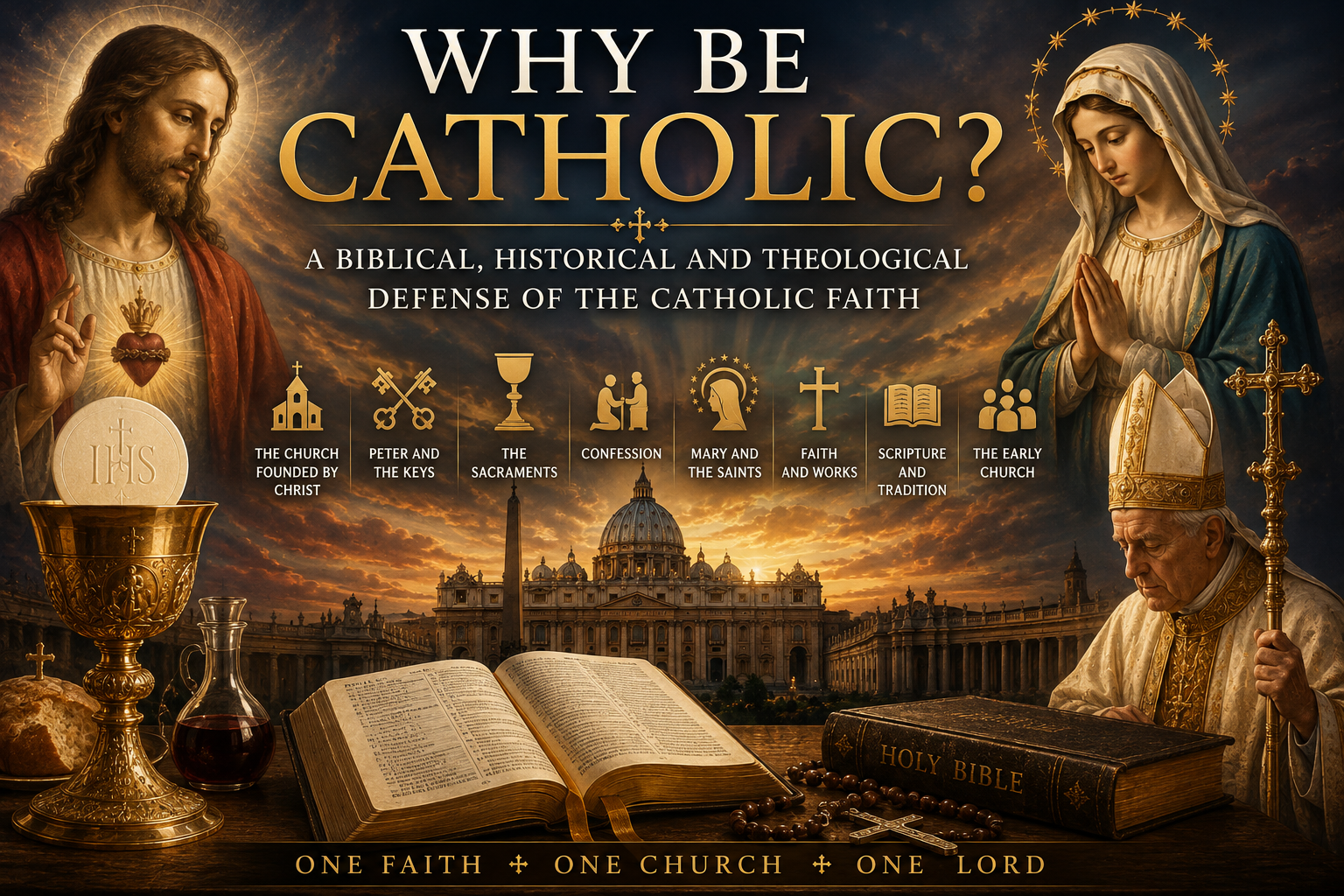
Why Be Catholic? — The Biblical and Historical Case for the Catholic Church
Introduction
Why should someone be Catholic?
For Catholics, the answer is not simply that Catholicism is an old tradition, a particular style of worship, or the religion into which they happened to be born. The Catholic claim is much greater: Jesus Christ founded a visible Church, gave that Church authority, entrusted His teaching to the Apostles, and promised to remain with it until the end of the age.
The question, therefore, is not merely “Which form of Christianity suits me best?” but:
What Church did Jesus Christ establish, and can that Church still be identified today?
To answer that, we need to look at Sacred Scripture, the authority Christ gave to the Apostles, the role of Peter, apostolic succession, and the witness of the earliest Christians.
The Catholic case begins not in the Middle Ages, nor at the Council of Trent, but with Jesus Christ Himself.
1. Christ Founded a Church
Jesus did not leave behind only a book or a collection of individual believers. He explicitly spoke of building His Church:
“And I tell you, you are Peter, and on this rock I will build my church, and the powers of death shall not prevail against it.”
— Matthew 16:18
Notice Christ says “I will build my Church.”
He then gives Peter extraordinary authority:
“I will give you the keys of the kingdom of heaven, and whatever you bind on earth shall be bound in heaven, and whatever you loose on earth shall be loosed in heaven.”
— Matthew 16:19
This is where the Catholic case really begins.
Christ establishes a Church, promises that the powers of death will not overcome it, and gives the keys of the Kingdom to Peter.
2. Peter and the Keys — Why Matthew 16 Matters
One of the central claims of Catholic Christianity is that Jesus gave St. Peter a unique role among the Apostles.
Catholics do not believe Peter replaced Christ.
Christ is the true Head of the Church.
Peter’s authority exists only because Christ gives it to him.
The key passage is Matthew 16.
Jesus asks His disciples:
“Who do you say that I am?”
Simon Peter answers:
“You are the Christ, the Son of the living God.”
— Matthew 16:15–16
Jesus responds:
“Blessed are you, Simon Bar-Jona! For flesh and blood has not revealed this to you, but my Father who is in heaven.”
Then comes the crucial passage:
“And I tell you, you are Peter, and on this rock I will build my church.”
— Matthew 16:18
And immediately afterward:
“I will give you the keys of the kingdom of heaven.”
— Matthew 16:19
These statements belong together.
Peter.
The rock.
Christ’s Church.
The keys.
Binding and loosing.
But what exactly do they mean?
“You Are Peter”
Jesus changes Simon’s name.
The Aramaic word behind Peter’s name is Kepha — rock.
That is why St. Paul can refer to Peter as Cephas:
“He appeared to Cephas, then to the twelve.”
— 1 Corinthians 15:5
Jesus’ saying would have carried the wordplay:
“You are Kepha, and upon this kepha I will build my Church.”
The familiar distinction in Greek between Petros and petra should therefore not be exaggerated into Peter meaning a tiny pebble while the second word means an enormous rock.
Jesus deliberately gives Simon a new name associated with rock.
And throughout Scripture, receiving a new name frequently accompanies a new mission.
Abram becomes Abraham.
Jacob becomes Israel.
Simon becomes Peter.
Something significant is happening.
But Isn’t Jesus the Rock?
Yes.
Scripture unquestionably describes Christ as the rock and foundation.
Catholicism does not deny this.
Paul writes:
“For no other foundation can any one lay than that which is laid, which is Jesus Christ.”
— 1 Corinthians 3:11
Yet Scripture can apply related imagery to Christ’s servants without taking anything away from Christ.
For example, Revelation describes the heavenly Jerusalem:
“And the wall of the city had twelve foundations, and on them the twelve names of the twelve apostles of the Lamb.”
— Revelation 21:14
Are the Apostles therefore competing with Jesus?
Of course not.
Their authority and position exist because of Him.
Likewise, Peter can function as a rock within Christ’s Church while Christ remains the ultimate foundation and source of all authority.
The Keys of the Kingdom
Then Jesus says something even more striking:
“I will give you the keys of the kingdom of heaven.”
Why keys?
To a modern reader this can sound like a general symbol of authority.
But the Old Testament provides an important background.
In Isaiah 22, we encounter the kingdom of David and an office of authority under the king.
Shebna is removed from that office and replaced by Eliakim.
God says concerning Eliakim:
“And I will place on his shoulder the key of the house of David.”
— Isaiah 22:22
Then:
“He shall open, and none shall shut; and he shall shut, and none shall open.”
The parallel with Matthew is difficult to miss.
Isaiah 22
Kingdom of David
Key of the house of David
Authority to open and shut
Matthew 16
Kingdom of Heaven
Keys of the Kingdom
Authority to bind and loose
Jesus is the Messianic Son of David, the true King.
Peter is given the keys of the King’s Kingdom.
This makes the keys far more significant than a decorative metaphor.
They represent an office of delegated authority.
The King and His Steward
The Catholic argument is not that Peter becomes the king.
Jesus is King.
The better analogy is that Peter receives an office under the King.
In the Davidic kingdom, the king could appoint a chief steward who exercised genuine authority on his behalf.
The steward’s authority did not compete with the king.
It came from the king.
That provides a biblical framework for understanding Peter.
Christ — the King.
Peter — entrusted with the keys.
This also explains why Catholic teaching concerning the pope does not mean:
“The pope replaces Jesus.”
Quite the opposite.
Any genuine papal authority exists entirely under the authority of Jesus Christ.
Binding and Loosing
Jesus continues:
“Whatever you bind on earth shall be bound in heaven, and whatever you loose on earth shall be loosed in heaven.”
— Matthew 16:19
Binding and loosing were expressions associated with genuine authority — including decisions concerning teaching and discipline.
Later, in Matthew 18:18, authority to bind and loose is also given to the Apostles collectively.
This is important.
Catholicism does not teach that Peter is the only Apostle with authority.
The Apostles possess genuine authority together.
But Matthew 16 still gives something specifically to Peter:
Peter alone receives the keys.
There is therefore both:
Apostolic authority shared by the Apostles
and
a distinctive commission given to Peter.
Peter’s Role Continues
Matthew 16 is not an isolated incident.
At the Last Supper Jesus tells Peter:
“Simon, Simon, behold, Satan demanded to have you, that he might sift you like wheat.”
Then:
“But I have prayed for you that your faith may not fail; and when you have turned again, strengthen your brethren.”
— Luke 22:31–32
Peter will fail personally.
He will deny Christ.
Yet Christ specifically commands him afterward:
“Strengthen your brethren.”
Then after the Resurrection, Jesus again singles Peter out.
Three times He asks Peter whether he loves Him.
And three times He commands him:
“Feed my lambs.”
“Tend my sheep.”
“Feed my sheep.”
— John 21:15–17
Christ’s sheep remain Christ’s sheep.
But Peter receives a particular pastoral responsibility for the flock.
Peter in the Book of Acts
After Christ’s Ascension, Peter repeatedly appears at decisive moments.
Peter leads the process of replacing Judas.
— Acts 1
Peter preaches the great sermon at Pentecost.
— Acts 2
Peter speaks for the Apostles before the authorities.
— Acts 4
Peter pronounces judgment concerning Ananias and Sapphira.
— Acts 5
Peter receives the revelation that leads to the admission of the Gentile Cornelius and his household.
— Acts 10
And at the Council of Jerusalem, during the controversy concerning Gentile Christians and the Mosaic Law, Peter rises and speaks.
— Acts 15
This does not mean Peter acts alone.
Paul, James and the other Apostles exercise genuine authority.
But Peter’s prominence within the Apostolic Church is difficult to dismiss.
But Paul Rebuked Peter
Galatians 2 is sometimes presented as evidence against Peter’s special authority.
Paul tells us:
“I opposed him to his face.”
— Galatians 2:11
Peter’s behaviour at Antioch was causing scandal because he withdrew from eating with Gentile Christians.
Paul confronted him.
Catholics have no difficulty with this passage.
Papal authority does not mean personal impeccability.
Peter could sin.
Peter could make poor decisions.
Peter could behave hypocritically.
We already know that because Peter denied Jesus three times.
Catholic teaching has never required Peter or his successors to be sinless.
Paul’s correction concerns Peter’s conduct.
It does not show Paul denying Peter’s office.
Indeed, the episode demonstrates something important:
God entrusted authority to imperfect human beings.
That has been true throughout the entire history of the Church.
Peter Is Not Christ’s Replacement
Everything must therefore remain in its proper order.
Jesus Christ founded the Church.
Jesus Christ is its Head.
Jesus Christ possesses authority by His own divine right.
Jesus Christ gives Peter the keys.
Peter possesses nothing independently of Christ.
The papacy, properly understood, is therefore not an alternative to the kingship of Jesus.
It is a claim about how the King chose to govern His Church on earth.
And that leads to the next question.
Peter eventually died.
The other Apostles died.
Yet Christ promised that His Church would continue until the end of the age.
So:
Was Peter’s office intended to disappear when Peter died?
Or, like other offices of Apostolic ministry, was it intended to continue?
To answer that, we have to move from Peter himself to:
3. From Peter to the Popes — Did Peter Have Successors?
If Jesus gave Peter a particular office within the Church, an obvious question follows:
What happened when Peter died?
Was Peter’s role unique to him personally and intended to disappear?
Or was the office meant to continue as the Church continued?
Catholics believe that Peter’s ministry continued in his successors as bishops of Rome.
But that claim has to be demonstrated carefully.
The Bible does not contain a verse saying:
“After Peter dies, Linus shall become the second pope.”
So the Catholic case is cumulative.
It comes from Scripture, the nature of Apostolic office, and the testimony of the earliest Church.
An Apostolic Office Can Have a Successor
We actually see the principle of succession very early in Scripture.
After Judas betrays Christ and dies, Peter addresses the disciples.
Quoting the Psalms, he says:
“His office let another take.”
— Acts 1:20
The Greek word translated here as office is episkopē, a word connected with oversight and from which we derive the term episcopal.
The Apostles then choose Matthias.
Acts tells us:
“And he was enrolled with the eleven apostles.”
— Acts 1:26
This establishes an important principle.
An Apostolic office could remain even after the individual holding it died.
Judas died.
His personal Apostleship obviously could not be transferred in every respect — Matthias did not suddenly become a witness to everything Judas had personally experienced.
But his office was filled by another man.
That gives us a biblical basis for the idea of succession.
Paul Also Looks Beyond the Apostles
St. Paul gives Timothy instructions concerning the continuation of Christian teaching:
“What you have heard from me before many witnesses entrust to faithful men who will be able to teach others also.”
— 2 Timothy 2:2
Notice the generations:
Paul
↓
Timothy
↓
Faithful men
↓
Others
Christian authority and teaching were not supposed to disappear when the original Apostles died.
They were to be handed on.
Paul likewise tells Titus:
“This is why I left you in Crete, that you might amend what was defective, and appoint elders in every town as I directed you.”
— Titus 1:5
The Apostolic Church is already preparing for continuity.
Clement of Rome — An Extremely Early Witness
Now we leave the New Testament and enter the earliest surviving Christian history.
Around the end of the first century, the Church of Rome wrote to the Christians at Corinth during a serious dispute.
The letter is traditionally associated with St. Clement of Rome.
Clement explains how Christian ministry was intended to continue.
He writes that the Apostles appointed their first converts as bishops and deacons.
Then he says the Apostles made provision so that, when these ministers died:
“other approved men should succeed them in their ministry.”
— 1 Clement 44
This is extraordinarily early.
We are not reading a medieval Catholic theologian.
We are reading a Christian document from approximately the same historical world as the final New Testament writings.
And it explicitly describes succession in Church ministry.
What About Peter Specifically?
This is where the historical evidence becomes especially interesting.
Ancient Christian testimony consistently associates Peter’s final ministry and martyrdom with Rome.
Clement, writing from Rome near the end of the first century, speaks of the sufferings and martyrdom of both Peter and Paul.
Several generations later, St. Irenaeus of Lyons gives us something even more explicit.
Around AD 180, while arguing against Gnostic heretics, Irenaeus points Christians toward churches whose teaching could be traced back through their bishops to the Apostles.
And his principal example is:
Rome.
Irenaeus Gives the Roman Succession
In Against Heresies, Irenaeus describes the Church at Rome as associated with the Apostles Peter and Paul.
Then he gives the succession of its bishops.
He writes that the Apostles entrusted the episcopate to:
Linus.
After Linus came:
Anacletus.
Then:
Clement.
And the succession continues down to Irenaeus’ own time.
Why is this important?
Because Irenaeus is writing around AD 180.
That is approximately a century and a half after the Crucifixion.
He is already appealing to an identifiable succession of Roman bishops as evidence against heresy.
The Early Roman Succession
Irenaeus gives the following succession:
| Peter and Paul | Apostolic foundation of the Roman Church |
| Linus | First in Irenaeus’ succession |
| Anacletus | Succeeds Linus |
| Clement | Succeeds Anacletus |
| Evaristus | Succeeds Clement |
| Alexander | Succeeds Evaristus |
| Sixtus | Succeeds Alexander |
| Telesphorus | Succeeds Sixtus |
| Hyginus | Succeeds Telephorus |
| Pius | Succeeds Hyginus |
| Anicetus | Succeeds Pius |
| Soter | Succeeds Anicetus |
| Eleutherius | Bishop of Rome when Irenaeus was writing |
— St. Irenaeus, Against Heresies, III.3.3
This is important historical evidence.
The succession of Roman bishops was not something Catholics first invented in the Middle Ages.
Christians were recording and appealing to that succession in the second century.
Was Linus Really the Second Pope?
We need to be precise with terminology.
Calling Linus the “second pope” is understandable in modern Catholic language.
But the early Church did not necessarily use the word pope in exactly the later technical sense at that time.
The title developed historically.
So the strongest argument is not:
“Christians in AD 70 were already using every modern papal title.”
They weren’t.
The stronger historical claim is:
The Church at Rome possessed a continuing episcopal ministry whose succession was traced back to the Apostolic foundation associated with Peter and Paul.
Later terminology developed around an office that already existed.
Did Peter Personally Ordain Linus as His Successor?
Again, we should not claim more than our evidence permits.
Irenaeus tells us that Peter and Paul entrusted the Roman episcopate to Linus.
Other early sources preserve traditions concerning the early Roman succession.
But we do not possess a surviving first-century document recording a ceremony in which Peter announces:
“Linus is now my successor.”
We don’t need to invent one.
The important historical evidence is that by the second century Christians understood the Roman episcopal succession as extending back to the Apostles.
That’s the claim we can defend.
Why Does Succession Matter?
Apostolic succession is not merely about creating an impressive historical family tree.
The reason Irenaeus appeals to succession is truth.
Gnostic groups claimed that Jesus or the Apostles had secretly passed down teachings unavailable to ordinary Christians.
Irenaeus essentially responds:
Show us your succession.
The genuine Apostolic churches were public.
Their bishops were known.
Their teaching was known.
Their connection with the Apostles could be examined.
The Church’s doctrine had not been hidden away in secret groups.
Succession and Apostolic Faith Belong Together
This gives us an important qualification.
Catholic Apostolic succession does not mean:
“If someone can trace his ordination historically, everything he teaches must therefore be true.”
Succession of office must remain united to the Apostolic faith.
That is exactly why Irenaeus uses succession against heretics.
The bishops were supposed to preserve what had been handed down.
Paul had already commanded Timothy:
“Guard the truth that has been entrusted to you by the Holy Spirit who dwells within us.”
— 2 Timothy 1:14
The office exists to guard the deposit of faith, not reinvent it.
From Peter to a Continuing Office
Now put the evidence together.
Christ gives Peter the keys.
— Matthew 16:19
Christ commands Peter to strengthen his brethren.
— Luke 22:32
Christ commands Peter to tend His flock.
— John 21:15–17
Acts demonstrates that an Apostolic office can be filled after its holder dies.
— Acts 1:20–26
Paul describes Christian teaching passing through successive generations.
— 2 Timothy 2:2
Clement says the Apostles provided for successors in ministry.
— 1 Clement 44
Irenaeus records a succession of bishops at Rome extending back to its Apostolic foundation.
— Against Heresies III.3
The Catholic argument therefore does not rest upon one isolated verse.
It rests upon a pattern.
The Pope Is a Successor, Not Another Apostle
There is another important distinction.
Catholics do not believe each pope becomes a new Apostle in exactly the same sense as Peter.
The Apostles occupied a unique foundational place in salvation history.
They were witnesses commissioned directly by Christ.
Public revelation ended with the Apostolic age.
A pope cannot add a new Gospel.
He cannot receive a new public revelation that overturns what Christ gave the Apostles.
His responsibility is precisely the opposite:
To preserve what was received.
The pope succeeds to Peter’s pastoral office, not to Peter’s unique status as an original Apostle and witness of Christ’s ministry.
Christ’s Church Outlived Peter
Peter died.
Paul died.
John died.
Eventually every original Apostle died.
But Christ had said:
“I am with you always, to the close of the age.”
— Matthew 28:20
The Church’s mission therefore could not end with the first generation.
Someone had to preach.
Someone had to baptise.
Someone had to celebrate the Eucharist.
Someone had to ordain new ministers.
Someone had to defend the Apostolic faith against new heresies.
The Church required continuity.
And that is exactly what we find as the New Testament period gives way to the earliest Christian writings:
Apostles.
↓
Bishops.
↓
Successors.
↓
A continuing visible Church.
The next question is therefore even bigger:
If the Apostles had successors, what authority did those successors actually possess?
That takes us to:
4. Apostolic Succession — Did Christ Give His Church Continuing Teaching Authority?
Apostolic Succession — Did Christ Give His Church Continuing Teaching Authority?
If the Apostles appointed successors, another question immediately follows:
What exactly were those successors supposed to do?
Were bishops simply administrators who organised Christian communities?
Or did they inherit a genuine responsibility to teach, govern and preserve the Apostolic faith?
The Catholic Church teaches that the bishops, as successors of the Apostles, continue the Apostolic ministry, always under the authority of Christ.
This does not mean bishops receive new revelation.
Their task is to guard and faithfully transmit the revelation already entrusted to the Apostles.
And once again, the foundations of this idea are visible in Scripture.
Christ Gave the Apostles Real Authority
Jesus did not commission the Apostles merely to offer their personal opinions about Him.
He sent them with authority.
He tells them:
“He who hears you hears me, and he who rejects you rejects me.”
— Luke 10:16
After His Resurrection, Christ commands them:
“Go therefore and make disciples of all nations… teaching them to observe all that I have commanded you.”
— Matthew 28:19–20
The Apostles therefore receive a teaching mission.
And Christ promises:
“I am with you always, to the close of the age.”
— Matthew 28:20
That final phrase matters.
The Apostles themselves would not physically live until the end of the age.
Yet the mission Christ gives them would continue.
The Church Has Teaching Authority
Jesus also describes what should happen when serious disputes arise among Christians.
In Matthew 18, He gives a process of correction that eventually reaches the Church:
“If he refuses to listen even to the church, let him be to you as a Gentile and a tax collector.”
— Matthew 18:17
That statement makes little sense if the Church possesses no genuine authority.
Christ does not say:
“If you still disagree, everyone should simply follow his own interpretation.”
He gives the Church a real role in rendering judgment.
Immediately afterward He says:
“Whatever you bind on earth shall be bound in heaven, and whatever you loose on earth shall be loosed in heaven.”
— Matthew 18:18
Peter had already received this authority individually in Matthew 16, together with the keys.
Here the Apostolic body shares the authority to bind and loose.
The Council of Jerusalem
We see this authority operating in practice in Acts 15.
A serious controversy threatens the early Church.
Some Christians insist:
“Unless you are circumcised according to the custom of Moses, you cannot be saved.”
— Acts 15:1
This is not a minor disagreement.
It concerns salvation.
Paul and Barnabas strongly oppose the teaching, and the matter is brought to Jerusalem.
What happens next provides an extraordinary model of Church authority.
The Apostles and elders gather.
There is debate.
Peter speaks.
Paul and Barnabas testify.
James speaks.
A judgment is reached.
Then the Church sends its decision to other Christian communities.
The letter declares:
“For it has seemed good to the Holy Spirit and to us…”
— Acts 15:28
Consider the confidence of that statement.
The Church does not merely say:
“This is our preferred interpretation.”
It connects its judgment with the guidance of the Holy Spirit.
Christians Were Expected to Obey
Acts then tells us what happened to these decisions.
Paul and Timothy travelled through the cities:
“They delivered to them for observance the decisions which had been reached by the apostles and elders who were at Jerusalem.”
— Acts 16:4
The decisions were not optional theological suggestions.
They were delivered:
“for observance.”
Here we have, within Scripture itself:
A doctrinal controversy.
Church leaders assembling.
Debate and testimony.
A decision under the guidance of the Holy Spirit.
That decision being imposed upon churches elsewhere.
This is one of the clearest biblical foundations for the Catholic understanding of counciliar teaching authority.
The Church Is the Pillar of Truth
St. Paul gives an extraordinary description of the Church when writing to Timothy.
He calls it:
“the church of the living God, the pillar and bulwark of the truth.”
— 1 Timothy 3:15
Notice what Paul does not call the Church.
He does not describe it as an irrelevant human organisation existing alongside the true Christian faith.
He calls it:
The household of God.
The Church of the living God.
The pillar and bulwark of the truth.
Of course, Scripture itself is the inspired Word of God.
But Scripture itself tells us that the Church has a God-given responsibility for truth.
Timothy Receives Authority
Paul’s letters to Timothy are particularly revealing because they show Apostolic ministry being handed to another generation.
Paul tells Timothy:
“Do not neglect the gift you have, which was given you by prophetic utterance when the council of elders laid their hands upon you.”
— 1 Timothy 4:14
He later reminds him:
“Rekindle the gift of God that is within you through the laying on of my hands.”
— 2 Timothy 1:6
We see:
Apostolic authority.
Laying on of hands.
Ministry being entrusted.
Teaching being handed on.
And then Paul commands Timothy:
“What you have heard from me before many witnesses entrust to faithful men who will be able to teach others also.”
— 2 Timothy 2:2
This is not Christianity reinventing itself after every generation.
It is Christianity being transmitted.
Guard What Has Been Entrusted
Paul repeatedly uses the language of something being received and guarded.
He tells Timothy:
“O Timothy, guard what has been entrusted to you.”
— 1 Timothy 6:20
And:
“Guard the truth that has been entrusted to you by the Holy Spirit who dwells within us.”
— 2 Timothy 1:14
This is fundamental to the Catholic understanding of the Church.
The Church does not possess authority to invent Christianity.
She has authority precisely because she has been entrusted with something she did not create.
The deposit of faith.
Her responsibility is to preserve it.
The Fathers Continue the Same Pattern
When we move from Scripture into the earliest Christian writings, the structure does not suddenly disappear.
Around AD 96, Clement of Rome explains that the Apostles appointed ministers and provided that other approved men should succeed them.
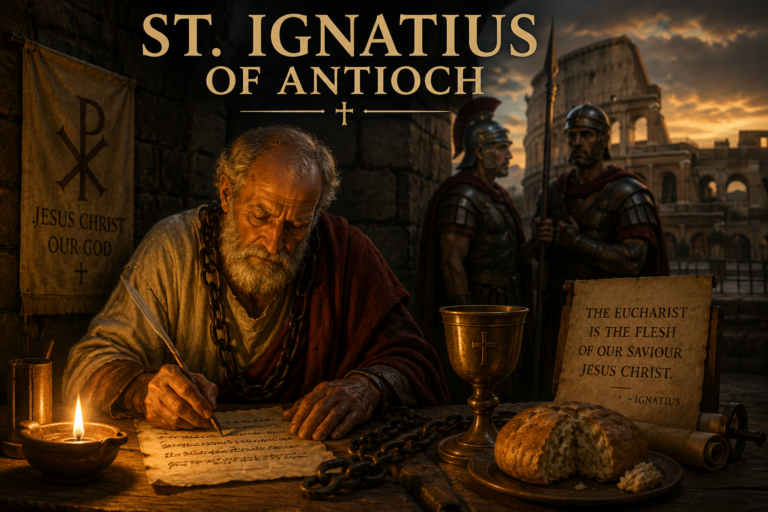
In the early second century, Ignatius of Antioch repeatedly urges Christians to remain united with their bishop, presbyters and deacons.
By approximately AD 180, Irenaeus appeals directly to the succession of bishops as a means of identifying authentic Apostolic teaching against the Gnostics.
This is crucial.
There is no enormous gap where Christianity disappears and a hierarchical Church suddenly appears centuries later.
We move from:
Paul appointing and instructing ministers
to
Clement describing succession
to
Ignatius describing bishops
to
Irenaeus using episcopal succession to defend Apostolic doctrine.
The historical continuity is remarkable.
What About Bad Bishops?
A natural objection arises:
What happens when a bishop is wrong?
Christian history contains bishops who taught error.
It contains bishops who behaved scandalously.
It contains bishops who failed in their responsibilities.
Catholicism does not claim otherwise.
Apostolic succession is not a magical guarantee that every sentence spoken by every bishop is correct.
Nor does the Catholic doctrine of infallibility apply to everything a bishop — or even a pope — says.
The authority Christ gave His Church operates within defined circumstances and exists for a specific purpose:
preserving the Apostolic faith.
This distinction is essential.
Authority Is Not Revelation
The Church cannot wake up tomorrow and announce:
“Jesus was not divine after all.”
She cannot decide:
“There is now a fourth Person of the Trinity.”
Nor can a pope manufacture a completely new public revelation.
Why?
Because the Church is servant of the revelation she received.
The Second Vatican Council explains this carefully:
“This teaching office is not above the word of God, but serves it.”
— Dei Verbum, 10
That is the Catholic claim.
The Magisterium does not stand over God’s revelation.
Its job is to guard it, explain it and defend it.
Scripture, Tradition and Magisterium
This gives us three realities that Catholic theology holds together:
Sacred Scripture
The inspired written Word of God.
Sacred Tradition
The Apostolic faith handed on within the Church.
The Magisterium
The Church’s living teaching office entrusted with authentically interpreting that deposit.
These are not three separate revelations.
There is one deposit of faith.
Scripture and Tradition transmit it.
The Magisterium serves it.
The Catechism describes them as so closely connected that one cannot properly stand without the others.
Why Does a Living Authority Matter?
Consider what happens when Christians sincerely disagree about Scripture.
One Christian says:
Baptism regenerates.
Another says:
Baptism is only symbolic.
One says:
Infants should be baptised.
Another says:
Infants must not be baptised.
One says:
Christ is truly present in the Eucharist.
Another says:
The Eucharist is only a memorial.
All may appeal to Scripture.
Scripture remains infallible.
But the individual interpreters are not.
So the question becomes:
Did Christ leave His Church with any means of definitively resolving doctrinal disputes?
Acts 15 suggests that He did.
The early Church believed that He did.
Catholicism claims that this authority did not disappear when the last Apostle died.
It continued through the Apostolic ministry entrusted to their successors.
Authority Exists to Serve Unity and Truth
Christ did not give authority to His Church so that bishops could dominate Christians.
Christian authority is supposed to be service.
Jesus tells the Apostles:
“Whoever would be great among you must be your servant.”
— Matthew 20:26
Authority exists to protect Christ’s flock.
To preserve the Gospel.
To defend the sacraments.
To correct serious error.
And to maintain the unity for which Christ prayed:
“that they may all be one.”
— John 17:21
That brings us to another crucial part of the Catholic case.
Because Catholics do not believe that Christ merely established an institution with authority.
They believe He established a sacramental Church through which He continues to give His grace.
And nowhere is that more striking than in the sacrament at the centre of Catholic worship:
5. The Eucharist — Did Jesus Really Mean “This Is My Body”?
The Eucharist — Did Jesus Really Mean “This Is My Body”?
At the centre of Catholic life is the Eucharist.
Catholics believe that after consecration, Jesus Christ is truly present — Body, Blood, Soul and Divinity — under the appearances of bread and wine.
This is one of the greatest differences between Catholicism and many forms of modern Christianity.
Some Christians understand Communion primarily as a symbolic memorial.
Catholicism makes a much stronger claim:
Jesus meant what He said.
“This is my body.”
— Matthew 26:26
But the Catholic belief does not depend upon those four words alone.
To understand the Eucharist properly, we have to begin much earlier.
The Passover
The Eucharist cannot be separated from the Jewish Passover.
In Exodus 12, Israel is enslaved in Egypt.
God commands each household to sacrifice a lamb.
The lamb must be:
Without blemish.
— Exodus 12:5
Its blood is placed upon the doorposts.
When judgment passes through Egypt, those marked by the blood of the lamb are spared.
But there is another important command.
The Israelites must eat the lamb.
“They shall eat the flesh that night.”
— Exodus 12:8
The sacrifice and the meal belong together.
The lamb is slain.
Its blood saves.
And its flesh is eaten.
This becomes enormously important when we reach the New Testament.
Jesus Is the Lamb of God
When John the Baptist sees Jesus, he declares:
“Behold, the Lamb of God, who takes away the sin of the world!”
— John 1:29
St. Paul later explicitly identifies Christ with Passover:
“For Christ, our paschal lamb, has been sacrificed.”
— 1 Corinthians 5:7
Jesus is the fulfilment of the Passover lamb.
And His Crucifixion takes place within the setting of Passover.
The Old Covenant points forward toward something greater.
A new Passover.
A new covenant.
The true Lamb.
The Last Supper
On the night before His Crucifixion, Jesus celebrates the Last Supper with His disciples.
He takes bread, blesses it and says:
“This is my body.”
— Matthew 26:26
Then He takes the cup:
“This is my blood of the covenant, which is poured out for many for the forgiveness of sins.”
— Matthew 26:28
Notice the sacrificial language:
Body.
Blood.
Covenant.
Poured out.
This is not disconnected from what will happen on Calvary.
At the Last Supper, Jesus sacramentally gives the Apostles the Body and Blood that He will offer upon the Cross.
The Eucharist and Calvary are therefore not two different sacrifices.
The Catholic Church teaches that the Eucharist makes sacramentally present the one sacrifice of Christ.
Christ is not crucified again at every Mass.
Hebrews is absolutely clear:
“We have been sanctified through the offering of the body of Jesus Christ once for all.”
— Hebrews 10:10
Calvary happened once.
The Mass does not repeat it.
It makes the one sacrifice of Christ sacramentally present.
John 6 — The Bread of Life
Long before the Last Supper, Jesus gave one of His most extraordinary teachings in John 6.
After multiplying the loaves, Jesus tells the crowd:
“I am the bread of life.”
— John 6:35
He then goes much further:
“The bread which I shall give for the life of the world is my flesh.”
— John 6:51
The listeners immediately recognise the difficulty:
“How can this man give us his flesh to eat?”
— John 6:52
This would have been the perfect opportunity for Jesus to explain that He was speaking merely symbolically.
Instead, He intensifies His language.
“Unless you eat the flesh of the Son of man and drink his blood, you have no life in you.”
— John 6:53
Then:
“He who eats my flesh and drinks my blood has eternal life.”
— John 6:54
And:
“For my flesh is food indeed, and my blood is drink indeed.”
— John 6:55
The language becomes stronger, not weaker.
“Eat My Flesh”
There is an interesting detail in the Greek text of John 6.
Earlier in the discourse, ordinary language for eating is used.
But beginning around verse 54, John uses the Greek verb trōgō, a vivid word associated with eating or chewing.
We should not exaggerate this into claiming the Greek word alone proves the entire Catholic doctrine.
It does not.
But it certainly does not weaken the realistic character of Jesus’ language.
Jesus repeatedly speaks about:
Eating His Flesh.
Drinking His Blood.
And He allows the resulting scandal to remain.
Many Disciples Walked Away
The reaction of Jesus’ listeners is extremely important.
They say:
“This is a hard saying; who can listen to it?”
— John 6:60
Then John tells us:
“After this many of his disciples drew back and no longer went about with him.”
— John 6:66
These are not merely hostile Pharisees.
They are described as disciples.
And Jesus does not chase after them saying:
“Wait — you misunderstood me. I only meant a symbol.”
Instead, He turns to the Twelve:
“Do you also wish to go away?”
— John 6:67
Peter responds:
“Lord, to whom shall we go? You have the words of eternal life.”
— John 6:68
The teaching was difficult.
But Christ did not withdraw it.
St. Paul and the Eucharist
Sometimes John 6 is treated as though Catholic Eucharistic theology depends entirely upon one disputed chapter.
It does not.
St. Paul provides remarkably strong evidence.
Writing to the Corinthians around the AD 50s, Paul asks:
“The cup of blessing which we bless, is it not a participation in the blood of Christ?”
“The bread which we break, is it not a participation in the body of Christ?”
— 1 Corinthians 10:16
Then in the following chapter Paul warns Christians about receiving the Eucharist unworthily:
“Whoever, therefore, eats the bread or drinks the cup of the Lord in an unworthy manner will be guilty of profaning the body and blood of the Lord.”
— 1 Corinthians 11:27
That raises an obvious question:
If Communion were merely ordinary bread symbolising an absent Christ, why would receiving it unworthily make someone guilty concerning Christ’s Body and Blood?
Paul continues:
“Any one who eats and drinks without discerning the body eats and drinks judgment upon himself.”
— 1 Corinthians 11:29
This is extremely serious language.
The Eucharist is not treated as an ordinary symbolic meal.
What Did the First Christians Believe?
Now we can perform the same historical test we have used throughout this article.
What happens after the Apostles?
Do Christians immediately begin describing the Eucharist as merely symbolic?
No.
Around the beginning of the second century, St. Ignatius of Antioch condemns certain heretics because:
“They abstain from the Eucharist and from prayer, because they do not confess the Eucharist to be the flesh of our Saviour Jesus Christ.”
— Letter to the Smyrnaeans, 7
Ignatius was writing only generations after Christ.
He had no medieval scholastic theology.
No Council of Trent.
No Counter-Reformation.
Yet his Eucharistic belief is unmistakably realistic.
Justin Martyr
Around AD 150, St. Justin Martyr gives us another extraordinary witness.
Describing Christian worship, Justin explains that Christians do not receive the Eucharist:
“as common bread and common drink.”
He connects the Eucharistic food directly with the Flesh and Blood of the incarnate Jesus.
— First Apology, 66
Justin also describes the structure of Sunday Christian worship:
Scripture is read.
Instruction is given.
Prayers are offered.
Bread and wine are brought forward.
Thanksgiving is offered.
The people respond.
The Eucharist is distributed.
This is approximately 150 years after Christ.
The basic shape of sacramental Christian worship is already clearly visible.
Irenaeus
Around AD 180, St. Irenaeus also speaks about the Eucharist.
He writes that bread, after receiving God’s invocation:
“is no longer common bread, but the Eucharist.”
— Against Heresies, IV.18.5
Irenaeus even uses the Eucharist in his argument concerning the resurrection of the body.
Why?
Because our bodies receive Christ’s Eucharistic gift.
Again we encounter the same belief.
Ignatius.
Justin.
Irenaeus.
Different Christian writers.
Different places.
Different decades.
Yet all speak about the Eucharist with striking realism.
Was Transubstantiation Invented in the Middle Ages?
Here an important distinction must be made.
The word transubstantiation developed much later than Ignatius or Justin.
That is true.
But the doctrine the term was created to explain is much older.
The term attempts to answer a philosophical question:
How can the bread and wine truly become Christ’s Body and Blood while continuing to appear as bread and wine?
The Church eventually used the language of substance and accidents to express that mystery precisely.
But Christians believed in Christ’s true Eucharistic presence long before that terminology developed.
This is another example of the distinction between:
Development of terminology
and
invention of belief.
The word came later.
The belief came much earlier.
Is the Mass Sacrificing Jesus Again?
No.
This is one of the most important misunderstandings to correct.
Catholic priests do not crucify Jesus again.
Christ’s sacrifice on Calvary occurred:
Once for all.
The Letter to the Hebrews repeatedly emphasises this.
Catholic teaching agrees completely.
At Mass, the same sacrifice of Christ is made sacramentally present.
There is one victim:
Jesus Christ.
One saving sacrifice:
Calvary.
The Eucharist does not compete with the Cross.
It receives its entire meaning and power from the Cross.
The Biblical Pattern
Put the pieces together:
Exodus 12
The Passover lamb is sacrificed and eaten.
↓
John 1
Jesus is identified as the Lamb of God.
↓
John 6
Jesus commands His followers to eat His Flesh and drink His Blood.
↓
The Last Supper
Jesus says:
“This is my body.”
“This is my blood.”
↓
Calvary
The true Lamb offers Himself for the salvation of the world.
↓
1 Corinthians
The earliest Christian communities participate in Christ’s Body and Blood and are warned against receiving unworthily.
↓
Ignatius, Justin and Irenaeus
The earliest post-Apostolic Christians continue speaking of the Eucharist as the true Flesh and Blood of Christ.
The continuity is extraordinary.
The Catholic Claim
Catholics do not believe in the Real Presence because medieval theologians invented it.
We believe it because of the convergence of:
The Passover.
Christ’s words.
John 6.
The Last Supper.
St. Paul.
The practice of the early Church.
The testimony of the Church Fathers.
The Eucharist stands at the centre of Catholic Christianity because Jesus Christ stands at the centre of Catholic Christianity.
At every Mass, Catholics believe that Christ continues to give His Church the gift He gave the Apostles:
“This is my body.”
And if that claim is true, the question of which Church preserved the Eucharist handed down from the Apostles becomes enormously important.
That takes us naturally to the next part:
6. Baptism — Symbol Only, or the Sacrament of New Birth?
Baptism — Symbol Only, or the Sacrament of New Birth?
Baptism provides another major difference between Catholicism and some forms of modern Christianity.
Many Christians regard Baptism primarily as an outward symbol of a salvation that has already taken place.
The Catholic Church teaches something more.
Baptism certainly is a sign — but it is not merely a sign.
Catholics believe that through Baptism, by the power of Christ:
Sin is forgiven.
We are born again.
We receive new life in the Holy Spirit.
We become members of the Body of Christ.
This raises the obvious question:
Is that actually biblical?
The evidence begins with Jesus Himself.
“Born of Water and the Spirit”
During His conversation with Nicodemus, Jesus says:
“Unless one is born of water and the Spirit, he cannot enter the kingdom of God.”
— John 3:5
Catholics have historically understood this as referring to Baptism.
That interpretation was certainly not invented during the Reformation.
Early Christians repeatedly connected John 3:5 with Baptism.
The combination of:
Water.
Spirit.
New birth.
became fundamental to Christian Baptismal theology.
And the rest of the New Testament strengthens that interpretation.
“Repent and Be Baptised”
On the day of Pentecost, Peter preaches Christ to the crowd.
His listeners are deeply moved and ask:
“Brethren, what shall we do?”
Peter answers:
“Repent, and be baptized every one of you in the name of Jesus Christ for the forgiveness of your sins; and you shall receive the gift of the Holy Spirit.”
— Acts 2:37–38
Notice what Peter connects with Baptism:
Repentance.
Forgiveness of sins.
The Holy Spirit.
He does not describe Baptism merely as a public demonstration that these things have already happened independently of it.
Baptism is incorporated into the conversion itself.
“Baptism Now Saves You”
St. Peter becomes even more explicit in his first epistle.
After comparing Baptism with Noah and the Flood, he writes:
“Baptism, which corresponds to this, now saves you.”
— 1 Peter 3:21
Peter immediately clarifies that he is not speaking about an ordinary physical washing:
“not as a removal of dirt from the body but as an appeal to God for a clear conscience, through the resurrection of Jesus Christ.”
The water possesses no magical power by itself.
Christ saves.
Christ’s Resurrection saves.
Baptism is the sacramental means through which that saving grace is given.
That distinction is essential.
Catholics do not believe water replaces Jesus.
We believe Jesus acts through Baptism.
Paul — Buried and Raised With Christ
St. Paul describes Baptism in remarkably powerful language:
“Do you not know that all of us who have been baptized into Christ Jesus were baptized into his death?”
— Romans 6:3
Then:
“We were buried therefore with him by baptism into death.”
— Romans 6:4
And why?
“so that as Christ was raised from the dead by the glory of the Father, we too might walk in newness of life.”
Baptism therefore connects the Christian directly with:
Christ’s death.
Christ’s burial.
Christ’s Resurrection.
New life.
This is far stronger than Baptism functioning merely as a public symbol.
Baptised Into Christ
Paul gives similar teaching to the Galatians:
“For as many of you as were baptized into Christ have put on Christ.”
— Galatians 3:27
And to the Corinthians:
“For by one Spirit we were all baptized into one body.”
— 1 Corinthians 12:13
Through Baptism, Christians are incorporated into:
Christ.
and:
His Body, the Church.
Again we see something actually happening.
The Washing of Regeneration
Paul’s letter to Titus contains another important passage:
“He saved us, not because of deeds done by us in righteousness, but in virtue of his own mercy…”
That immediately rules out the idea that salvation is something we earn.
But Paul continues:
“by the washing of regeneration and renewal in the Holy Spirit.”
— Titus 3:5
Notice how beautifully this fits Catholic teaching.
God saves us.
Not because we earned it.
Through His mercy.
Through a washing.
Bringing regeneration.
Through the Holy Spirit.
Baptismal regeneration therefore does not compete with salvation by grace.
Baptism itself is grace.
God is the one acting.
“Wash Away Your Sins”
When Ananias speaks to Saul — the future St. Paul — he tells him:
“Rise and be baptized, and wash away your sins, calling on his name.”
— Acts 22:16
Once again Baptism and the forgiveness of sins are closely connected.
Taken together, the New Testament evidence becomes substantial.
John speaks of:
Water and Spirit.
Peter speaks of:
Baptism for forgiveness.
and:
Baptism that saves.
Paul speaks of:
Burial with Christ.
New life.
Putting on Christ.
Baptism into Christ’s Body.
The washing of regeneration.
This is precisely why the earliest Christians understood Baptism sacramentally.
What Did the Early Christians Believe?
Again, history gives us a useful test.
If Baptism was originally only symbolic and Catholicism later transformed it into a sacrament of regeneration, we should expect the earliest Christian writings to show that.
But they do not.
Around the middle of the second century, St. Justin Martyr describes Christian Baptism.
Speaking about converts, he writes that they are brought to water and:
“are regenerated in the same manner in which we were ourselves regenerated.”
— First Apology, 61
Justin then explicitly connects Baptism with Christ’s teaching about being born again.
This is around AD 150.
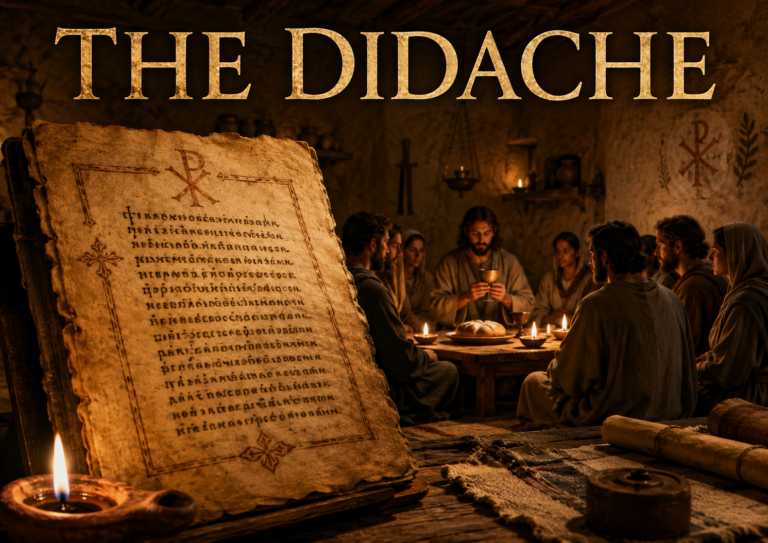
The Didache
Even earlier, the Didache gives practical instructions concerning Baptism.
It commands Christians to baptise:
“in the name of the Father, and of the Son, and of the Holy Spirit”
— Didache, 7
That is the Trinitarian formula given by Christ in Matthew 28:19.
Interestingly, the Didache prefers Baptism in living — flowing — water, but if sufficient water is unavailable, it permits water to be poured three times upon the head.
This tells us something important.
The power of Baptism did not depend upon having one particular quantity of water.
The sacrament depended upon what Christ was doing through it.
Infant Baptism
Then comes one of the most debated questions:
Why does the Catholic Church baptise babies?
Critics sometimes argue:
“A baby cannot personally profess faith.”
That’s true.
An infant cannot make an adult profession of faith.
But Scripture gives us several reasons why Christians historically came to baptise children.
First, Baptism replaces circumcision as the covenantal sign of entry into God’s people in an important Pauline comparison:
“You were circumcised with a circumcision made without hands… having been buried with him in baptism.”
— Colossians 2:11–12
Under the Old Covenant, infants were not excluded from covenant membership simply because they could not personally articulate faith.
They were brought into God’s covenant people.
The New Covenant is not less inclusive of children.
Entire Households Were Baptised
The New Testament also records the Baptism of households.
Lydia:
“She was baptized, with her household.”
— Acts 16:15
The Philippian jailer:
“he was baptized at once, with all his family.”
— Acts 16:33
Paul also tells us:
“I did baptize also the household of Stephanas.”
— 1 Corinthians 1:16
We should be careful here.
These passages do not explicitly tell us that babies were present.
So we should not claim:
“Acts proves those households contained infants.”
It doesn’t.
But household Baptisms fit comfortably within the covenantal understanding that Christianity soon displays.
The stronger evidence for infant Baptism becomes explicit in the early Church.
Origen and Infant Baptism
By the third century, Origen states that:
The Church received from the Apostles the tradition of baptising infants.
That is significant.
Origen was born around AD 185.
He was not describing a medieval innovation.
Whatever arguments Christians may have about whether infant Baptism can be demonstrated from Scripture alone, the historical evidence shows it was an established Christian practice extremely early.
And other third-century evidence confirms it.
Cyprian and the Eight-Day Question
Around AD 250, an interesting controversy arose.
The question was not:
“Should babies be baptised?”
Instead, Bishop Fidus asked whether Baptism should be delayed until the eighth day after birth, paralleling Jewish circumcision.
St. Cyprian reports that a council of bishops rejected the delay.
Their conclusion was essentially:
Do not withhold God’s grace from the newborn child.
Think about what this tells us.
By the middle of the third century, bishops are not debating whether infant Baptism is legitimate.
They are discussing:
How soon should the infant be baptised?
That places the practice long before Constantine’s conversion and more than a thousand years before the Reformation.
But Doesn’t Faith Come Before Baptism?
For an adult convert, yes.
The Church expects faith and repentance.
That is exactly what we see at Pentecost.
Adults capable of responding to the Gospel must respond.
But infant Baptism operates according to the same principle by which children can receive gifts they did not personally earn.
Baptism is primarily God’s action.
The child is brought within the faith of the Church, just as children were incorporated into God’s covenant people in the Old Testament.
Later, that child must personally embrace and live the faith received.
Baptism is not a guarantee that the person will remain faithful for life.
Grace can be rejected.
Does Water Save Us?
No created water possesses saving power independently of God.
This objection misunderstands sacramental theology.
Consider the healing of the blind man in John 9.
Jesus makes clay, places it upon the man’s eyes and commands him to wash in the pool of Siloam.
Did mud possess divine healing power?
No.
Jesus healed him.
But Jesus chose to use physical matter as an instrument.
Christianity itself is founded upon an even greater example:
The Incarnation.
God did not save humanity by remaining distant from the material world.
“The Word became flesh.”
— John 1:14
Catholic sacramental theology follows this deeply biblical pattern.
God uses created things:
Water.
Oil.
Bread.
Wine.
Human words.
Human ministers.
Not because creation replaces God, but because God chooses to work through His creation.
Baptism Is God’s Work
This is perhaps the most important point.
Catholics do not believe:
“We perform Baptism and therefore earn salvation.”
Scripture says the opposite.
“He saved us, not because of deeds done by us in righteousness, but in virtue of his own mercy.”
— Titus 3:5
And then immediately:
“by the washing of regeneration and renewal in the Holy Spirit.”
Baptism demonstrates the logic of Catholic sacramental theology beautifully.
God acts first.
God gives grace.
God regenerates.
God adopts.
God incorporates us into Christ.
The sacrament is His gift.
The Biblical and Historical Pattern
Put the evidence together:
John 3
Born of water and Spirit.
Acts 2
Baptism for the forgiveness of sins and reception of the Holy Spirit.
Romans 6
Buried and raised with Christ through Baptism.
Galatians 3
Baptised into Christ and clothed with Christ.
Titus 3
The washing of regeneration.
1 Peter 3
“Baptism… now saves you.”
The Didache
Trinitarian Baptism already practised in the earliest Christian period.
Justin Martyr
Baptism described as regeneration.
Origen
Infant Baptism described as a tradition received from the Apostles.
Cyprian
Third-century bishops discussing how quickly newborn children should be baptised.
Again we encounter continuity.
The Catholic understanding of Baptism does not suddenly appear in medieval Europe.
Its biblical foundations are clear, and its sacramental understanding is unmistakably present among the earliest Christians.
And this brings us to another Catholic teaching that is frequently misunderstood:
7. Confession — Why Tell Your Sins to a Priest?
Confession — Why Tell Your Sins to a Priest?
Few Catholic practices are misunderstood as often as Confession.
A common objection is:
“Why confess your sins to a priest? I can go directly to God.”
Catholics absolutely agree that God alone is the ultimate source of forgiveness.
A priest does not possess some independent power to forgive sins apart from Christ.
The real question is different:
Did Jesus choose to give His ministers authority to forgive sins in His name?
The Catholic answer is yes.
And the strongest evidence comes directly from the risen Christ.
“Whose Sins You Forgive Are Forgiven”
On the evening of the Resurrection, Jesus appears to His Apostles.
John tells us:
“Jesus said to them again, ‘Peace be with you. As the Father has sent me, even so I send you.’”
— John 20:21
Then something remarkable happens:
“He breathed on them, and said to them, ‘Receive the Holy Spirit.’”
— John 20:22
And immediately afterward:
“If you forgive the sins of any, they are forgiven; if you retain the sins of any, they are retained.”
— John 20:23
This is one of the clearest biblical foundations for the Sacrament of Reconciliation.
Jesus does not merely tell the Apostles:
“Go and remind people that God forgives them.”
He gives them authority to:
Forgive sins.
and:
Retain sins.
That distinction matters.
“As the Father Has Sent Me”
Notice how Jesus introduces this authority:
“As the Father has sent me, even so I send you.”
How had the Father sent Jesus?
Among other things, Christ exercised authority to forgive sins.
When Jesus heals the paralytic, He first says:
“My son, your sins are forgiven.”
— Mark 2:5
The scribes object:
“Who can forgive sins but God alone?”
— Mark 2:7
Their basic theological instinct is correct:
Sin is ultimately an offence against God.
God is the source of forgiveness.
But they fail to recognise who Jesus is.
Christ then demonstrates His authority:
“The Son of man has authority on earth to forgive sins.”
— Mark 2:10
Now return to John 20.
The risen Christ tells the Apostles:
“As the Father has sent me, even so I send you.”
Then gives them the Holy Spirit and authority concerning the forgiveness of sins.
Catholics therefore do not believe priests compete with Christ.
Christ is exercising His ministry through them.
Why Must the Sins Be Confessed?
There is another important detail.
Jesus gives the Apostles authority both to:
Forgive
and
Retain.
But how could a minister make such a judgment if he knew nothing about the person’s sins or repentance?
The authority implies some means by which the sinner’s situation becomes known.
This does not by itself describe every later detail of sacramental Confession.
The precise discipline of Confession developed historically.
But the fundamental principle is already present:
Christ entrusted His ministers with a real ministry of reconciliation involving the forgiveness or retention of sins.
“Confess Your Sins”
Confession itself is also biblical.
St. James writes:
“Confess your sins to one another, and pray for one another, that you may be healed.”
— James 5:16
The preceding verses are particularly significant.
James tells Christians who are sick:
“Let him call for the elders of the church.”
— James 5:14
The Greek word is presbyteroi — presbyters or elders, the word from which the English term priest ultimately developed.
These ministers pray over the sick and anoint them with oil.
James then says:
“If he has committed sins, he will be forgiven.”
— James 5:15
The passage brings together:
Ministers of the Church.
Anointing.
Prayer.
Confession.
Forgiveness of sins.
Again, Christianity is profoundly sacramental.
The Ministry of Reconciliation
St. Paul uses another remarkable expression.
He writes:
“God… reconciled us to himself through Christ and gave us the ministry of reconciliation.”
— 2 Corinthians 5:18
Then:
“So we are ambassadors for Christ, God making his appeal through us.”
— 2 Corinthians 5:20
That phrase captures Catholic sacramental ministry beautifully:
“God making his appeal through us.”
The minister does not replace God.
God works through the minister.
But Isn’t Jesus the Only Mediator?
Another common objection appeals to St. Paul:
“For there is one God, and there is one mediator between God and men, the man Christ Jesus.”
— 1 Timothy 2:5
Catholics completely affirm this.
Jesus Christ is the one mediator of salvation.
No priest died for our sins.
No bishop redeemed humanity.
No pope reconciled the human race to the Father.
Jesus did.
But Christ’s unique mediation does not prevent Christians from participating in His work.
Interestingly, immediately before saying Christ is the one mediator, Paul commands Christians to make:
“supplications, prayers, intercessions, and thanksgivings… for all men.”
— 1 Timothy 2:1
If asking another Christian to pray for us competed with Christ’s mediation, Paul would contradict himself within a few verses.
He doesn’t.
All Christian ministry participates in Christ’s one mediation.
The same applies to the priesthood.
“I Absolve You”
When a Catholic priest pronounces absolution, the claim is not:
“I personally possess the power to erase sin.”
The power belongs to Jesus Christ.
The priest acts sacramentally in the ministry Christ entrusted to His Church.
That is why the words of absolution centre upon God:
God, the Father of mercies…
through the death and resurrection of His Son…
sent the Holy Spirit…
for the forgiveness of sins.
The sacrament is entirely dependent upon Christ’s saving work.
Did Early Christians Confess Their Sins?
Yes, although the discipline surrounding Confession developed considerably over Christian history.
The Didache, one of the earliest Christian writings outside the New Testament, tells Christians:
“In church you shall confess your transgressions.”
— Didache, 4
It also tells Christians concerning the Lord’s Day:
“confess your transgressions, that your sacrifice may be pure.”
— Didache, 14
This is extremely early evidence of confession within Christian community and worship.
However, we should be careful.
It does not describe the modern private confessional exactly as Catholics experience it today.
That developed later.
Again:
Development is not necessarily invention.
The underlying belief in confession, ecclesial reconciliation and ministerial authority to forgive sins is already present.
Early Confession Could Be Public
In parts of the early Church, serious sins could involve public penance.
The discipline was often much more severe than modern Confession.
A Christian guilty of grave sin might undergo a lengthy period of penance before being formally reconciled with the Church.
Over the centuries, the practice increasingly developed toward private and repeatable Confession.
That was a disciplinary development.
The essential sacramental reality remained:
Sin wounds our relationship with God and His Church.
Christ gives reconciliation.
His Church exercises a ministry of reconciliation.
Why Not Just Confess Directly to God?
Catholics do confess directly to God.
Every genuine sacramental confession is ultimately directed toward Him.
Catholics also make acts of contrition privately.
But this creates an important distinction:
Can God forgive someone outside sacramental Confession?
God is not imprisoned by His sacraments.
Catholic teaching does not claim He is.
But Christians are bound to use the means Christ gave us.
The question is not:
“Could God have designed forgiveness differently?”
Of course He could.
The question is:
“What did Jesus actually establish?”
And John 20 gives a very difficult passage to explain if Christ intended forgiveness of post-Baptismal sin to be entirely private between the individual and God.
Why give His ministers authority to forgive and retain sins if that authority was never meant to be exercised?
Confession Requires Repentance
Another misconception is that Catholics can commit whatever sins they want, confess them, and simply start again.
That is not Catholic teaching.
For a valid Confession, the sinner must genuinely repent.
That includes the intention to turn away from sin.
Someone cannot legitimately approach Confession thinking:
“I’ll confess this now, but I fully intend to commit the same serious sin again tomorrow.”
Confession is not a loophole.
It is a sacrament of conversion and reconciliation.
The forgiveness is free.
But repentance must be real.
Why Confession Is a Gift
There is something deeply personal about Christ’s decision to give His Church this sacrament.
A Catholic does not merely hope:
“Perhaps God has forgiven me.”
After honestly confessing and receiving absolution, the Christian hears the words of forgiveness.
Christ uses an external sign to communicate an invisible grace.
This is the same sacramental pattern we have already encountered.
Water in Baptism.
Bread and wine in the Eucharist.
Human words in Confession.
God meets human beings through the physical world He created.
The Word Himself:
“became flesh and dwelt among us.”
— John 1:14
Christianity is profoundly incarnational.
The Biblical Pattern
Put the evidence together:
Mark 2
Christ possesses authority on earth to forgive sins.
↓
John 20
The risen Christ sends the Apostles, gives them the Holy Spirit and commands:
“Whose sins you forgive are forgiven.”
↓
James 5
Church ministers, confession, prayer and forgiveness appear together.
↓
2 Corinthians 5
The Apostles possess a:
“ministry of reconciliation.”
↓
The Didache
Christians are instructed to confess their transgressions.
↓
The Early Church
Ecclesial confession and reconciliation continue, while the discipline develops over time.
The Catholic sacrament therefore did not arise because medieval priests decided they wanted to know everyone’s secrets.
Its foundation is much deeper.
Christ gave His Church a ministry of reconciliation.
And He did it because He knew Christians would continue to need His mercy after Baptism.
The Catholic enters the confessional not because the priest replaces Jesus…
but because Catholics believe Jesus is the one waiting there with forgiveness.
And that leads naturally to another major Catholic question:
8. Mary and the Saints — Does Asking for Their Prayers Take Away From Jesus?
Mary and the Saints — Does Asking for Their Prayers Take Away From Jesus?
Few Catholic practices create more misunderstanding among other Christians than devotion to Mary and the saints.
Catholics are sometimes accused of worshipping Mary, praying to dead people, or placing saints between themselves and Jesus Christ.
If Catholicism actually taught those things, Christians would be right to reject them.
But it does not.
The Catholic Church teaches unequivocally that:
God alone is to be worshipped.
Mary is not God.
The saints are not gods.
They do not replace Jesus Christ.
They possess no supernatural power independently of Him.
The Catholic practice is based upon a much simpler belief:
Christians can pray for one another — and death does not separate the members of Christ’s Body.
“Pray for Me”
Most Christians have asked another Christian:
“Will you pray for me?”
There is nothing controversial about this.
St. Paul repeatedly asks other Christians for their prayers:
“Brethren, pray for us.”
— 1 Thessalonians 5:25
James tells Christians:
“Pray for one another.”
— James 5:16
When we ask another Christian to pray for us, we are not replacing Jesus.
We are asking another member of Christ’s Body to pray with us and for us.
Catholics believe exactly the same principle applies to Christians who are now with Christ in Heaven.
The real question therefore becomes:
Are Christians in Heaven dead and separated from the Church?
Scripture gives us good reason to answer:
No.
God Is God of the Living
Jesus says:
“He is not God of the dead, but of the living.”
— Mark 12:27
Those who die in friendship with Christ remain alive in Him.
St. Paul writes:
“Whether we live or whether we die, we are the Lord’s.”
— Romans 14:8
And:
“Neither death, nor life… will be able to separate us from the love of God in Christ Jesus our Lord.”
— Romans 8:38–39
Death does not destroy the Body of Christ.
The Christian in Heaven has not ceased to be a member of Christ simply because earthly life has ended.
One Body in Christ
Paul describes Christians as members of a single body:
“So we, though many, are one body in Christ, and individually members one of another.”
— Romans 12:5
And:
“If one member suffers, all suffer together; if one member is honored, all rejoice together.”
— 1 Corinthians 12:26
Catholic theology calls this profound unity the:
Communion of Saints.
The Church on earth and the saints in Heaven are not two unrelated churches.
There is one Body of Christ.
Those in Heaven are more alive in Christ than they ever were on earth.
Do the Saints Know About Earth?
This is an important question.
If saints in Heaven know absolutely nothing about what happens on earth, asking for their intercession would make little sense.
But Scripture gives us glimpses of heavenly awareness.
In Revelation, John sees:
“the souls of those who had been slain for the word of God.”
— Revelation 6:9
These martyrs cry out to God concerning events on earth:
“O Sovereign Lord… how long before thou wilt judge and avenge our blood on those who dwell upon the earth?”
— Revelation 6:10
They are conscious.
They speak to God.
And they are aware that God’s final judgment upon events on earth has not yet occurred.
The Prayers of the Saints in Heaven
Revelation gives us something even more striking.
John sees the twenty-four elders before the Lamb holding:
“golden bowls full of incense, which are the prayers of the saints.”
— Revelation 5:8
Later an angel stands before God with incense:
“and the smoke of the incense rose with the prayers of the saints from the hand of the angel before God.”
— Revelation 8:3–4
Whatever every detail of Revelation’s symbolism means, the heavenly court is clearly not disconnected from the prayers of God’s people.
Heaven participates in worship and prayer before God.
But Isn’t Jesus the One Mediator?
This is perhaps the most common objection.
Paul writes:
“For there is one God, and there is one mediator between God and men, the man Christ Jesus.”
— 1 Timothy 2:5
Catholics completely affirm this.
Jesus Christ is the one Mediator between God and humanity.
Mary did not die for our sins.
Peter did not redeem us.
Paul did not reconcile humanity to the Father.
No saint can save us independently of Christ.
But notice what Paul says immediately before calling Christ the one Mediator:
“I urge that supplications, prayers, intercessions, and thanksgivings be made for all men.”
— 1 Timothy 2:1
Paul commands intercession and then declares Christ the one Mediator.
Therefore Christian intercession cannot contradict Christ’s unique mediation.
Otherwise Paul would contradict himself within four verses.
Our prayers for one another participate in Christ’s mediation.
They do not compete with it.
Why Ask a Saint When You Can Go Directly to Jesus?
You absolutely can and should go directly to Jesus.
Catholics do this constantly.
Every Mass is directed ultimately to God.
Catholic prayer is filled with direct prayer to the Father, Son and Holy Spirit.
Asking a saint for prayer does not mean:
“Instead of going to Jesus, I’ll go to Mary.”
It means:
“Mary, pray with me to Jesus.”
It is no more intended to replace Christ than asking a Christian friend:
“Please pray for me.”
The difference is that Catholics believe the Christian family includes those who have finished their earthly lives and now live with Christ.
What Does “Pray to” Mean?
Some confusion comes from language.
Historically, the English word pray could simply mean ask or request.
So when Catholics speak of “praying to a saint,” they do not mean:
Worshipping the saint as God.
They mean asking for the saint’s intercession.
Nevertheless, because modern English commonly associates the word prayer almost exclusively with worship, the expression can easily be misunderstood.
The Catholic distinction is what matters:
We pray with and through the intercession of saints.
We worship God alone.
Worship Belongs to God Alone
Catholic theology has traditionally distinguished between the worship owed to God and the honour given to His saints.
The traditional theological terms are:
Latria
The adoration and worship due to God alone.
Dulia
Honour given to the saints because of what God’s grace accomplished in them.
And Mary receives a unique honour traditionally called:
Hyperdulia
because of her unique relationship with Christ as His mother.
But even the highest honour given to Mary remains infinitely below the worship due to God.
Mary is a creature.
God is the Creator.
That distinction can never be crossed.
Why Mary?
Mary obviously occupies a unique place among the saints because she is the mother of Jesus Christ.
Elizabeth, filled with the Holy Spirit, says to Mary:
“Blessed are you among women, and blessed is the fruit of your womb!”
— Luke 1:42
Mary herself declares:
“For behold, henceforth all generations will call me blessed.”
— Luke 1:48
Catholics therefore do exactly what Scripture predicts.
We call Mary blessed.
But the reason Mary is blessed is not because she possesses greatness independently of God.
Mary herself says:
“My soul magnifies the Lord, and my spirit rejoices in God my Savior.”
— Luke 1:46–47
Authentic Marian devotion therefore should always do what Mary herself does:
Magnify the Lord.
Mary at Cana
The wedding at Cana provides a beautiful biblical picture of Mary’s intercession.
The wine runs out.
Mary notices the problem and tells Jesus:
“They have no wine.”
— John 2:3
She brings the need to Christ.
Then she tells the servants:
“Do whatever he tells you.”
— John 2:5
Those words capture authentic Catholic Marian devotion extraordinarily well.
Mary does not say:
“Come to me instead of Jesus.”
She points directly toward her Son:
“Do whatever he tells you.”
Christ performs the miracle.
The power is His.
Mary intercedes.
Jesus acts.
The Queen Mother
There is also an important Old Testament background to Mary’s role.
In the Davidic kingdom, the queen was not normally the king’s wife.
Davidic kings could have multiple wives.
The queenly position belonged particularly to the king’s mother — the gebirah, or queen mother.
In 1 Kings, Bathsheba approaches her son King Solomon.
Solomon:
“rose to meet her, and bowed down to her.”
Then:
“a seat was brought for the king’s mother, and she sat on his right.”
— 1 Kings 2:19
She then presents a request to the king.
Catholics see an important biblical pattern here.
Jesus is the eternal Son of David and Messianic King.
Mary is the mother of the King.
This does not make Mary divine.
It places her honour entirely within the kingship of Christ.
“Woman” — Was Jesus Disrespecting Mary?
Some Christians are puzzled because Jesus calls Mary:
“Woman”
at Cana and again from the Cross.
— John 2:4; John 19:26
To modern English ears, this can sound dismissive.
But within John’s Gospel it carries much deeper significance.
At the beginning of Scripture, Adam calls Eve:
“the woman.”
And Genesis speaks of the woman whose offspring will be at enmity with the serpent.
— Genesis 3:15
John’s Gospel repeatedly contains creation imagery.
At Cana, Jesus addresses Mary as Woman.
Then at the Cross:
“Woman, behold, your son!”
— John 19:26
Early Christian reflection increasingly recognised Mary in relation to Eve:
Eve’s disobedience is answered by Mary’s obedience.
Through Eve comes the tragedy of the Fall.
Through Mary’s “yes,” the Saviour enters the world.
This brings us to one of the earliest Marian ideas in Christianity:
Mary as the New Eve.
Mary as the New Eve
This idea is not a medieval invention.
Around the second century, St. Justin Martyr compares Eve’s disobedience with Mary’s faith and obedience.
Shortly afterward, St. Irenaeus develops the parallel even more explicitly.
He describes how:
The knot of Eve’s disobedience was untied by Mary’s obedience.
The comparison appears remarkably early.
Why?
Because Christians were already reading salvation history typologically:
Adam → Christ.
Eve → Mary.
Paul explicitly calls Christ the new Adam in his theology.
The early Fathers then recognised the corresponding Eve-Mary pattern.
Once again, Catholic Marian theology develops from a deeply Christ-centred biblical framework.
Do Catholics Worship Statues?
No.
A statue is not a god.
Catholics know that plaster, stone or wood cannot hear prayers.
Images remind Christians of the people represented by them.
The Old Testament prohibition against idolatry was not a prohibition against every religious image.
God Himself commanded Moses to construct two golden cherubim upon the Ark of the Covenant.
— Exodus 25:18–20
He later commanded Moses to make the bronze serpent.
— Numbers 21:8–9
The Temple itself contained carved cherubim and other imagery.
The sin is not:
Making an image.
The sin is:
Worshipping a created thing as God.
When the bronze serpent itself later became an object of idolatrous worship, King Hezekiah destroyed it.
— 2 Kings 18:4
That distinction is exactly the Catholic position.
Honour Ultimately Points to God
Why honour the saints at all?
Because the saints demonstrate what the grace of God can accomplish in human beings.
When Catholics honour Peter’s courage, Paul’s missionary life, Mary’s obedience or a martyr’s faithfulness, the ultimate glory belongs to the God who sanctified them.
It is similar to admiring a masterpiece.
Honouring the masterpiece does not insult the artist.
It displays the artist’s work.
The saints are masterpieces of God’s grace.
The Catholic Position
The Catholic belief can therefore be summarised very simply:
God alone is worshipped.
Jesus Christ alone is the divine Saviour and one Mediator of redemption.
Christians pray for one another.
The saints in Heaven remain alive in Christ.
The Church remains one Body across Heaven and earth.
The saints can intercede for their brothers and sisters.
Mary receives unique honour because of her unique relationship with Jesus.
And every authentic Marian devotion ultimately points toward:
Jesus Christ.
That is why the final words of Mary recorded in Scripture provide perhaps the best summary of genuine Catholic devotion to her:
“Do whatever he tells you.”
— John 2:5
The saints do not draw Catholics away from Christ.
Properly understood, they point toward Him.
And this raises another Catholic belief that is often attacked as though it were a medieval invention:
9. Purgatory — Is It Really in the Bible?
Purgatory — Is It Really in the Bible?
Purgatory is one of the most frequently misunderstood Catholic doctrines.
It is sometimes described as:
A second chance after death.
A place where people earn their way into Heaven.
Somewhere between Heaven and Hell.
None of these accurately represents Catholic teaching.
The Catholic Church teaches something much simpler:
Purgatory is the final purification of those who die in God’s friendship but are not yet perfectly purified.
Everyone in Purgatory is saved.
Everyone in Purgatory will ultimately enter Heaven.
It is not another opportunity to repent after rejecting God.
And it certainly does not mean Christ’s sacrifice was insufficient.
The question is:
Can someone be genuinely saved and yet still require purification before entering the perfect holiness of Heaven?
Scripture gives us good reason to answer:
Yes.
Nothing Unclean Can Enter Heaven
The Book of Revelation tells us concerning the heavenly Jerusalem:
“But nothing unclean shall enter it.”
— Revelation 21:27
Yet Christians know from experience that a person can die loving Christ while still struggling with the effects of sin.
We may be forgiven and yet remain:
Selfish.
Proud.
Attached to sin.
Spiritually imperfect.
If nothing unclean enters Heaven, and a person dies in God’s friendship but remains imperfectly purified, what happens?
Catholicism answers:
God completes the purification.
That final purification is what Catholics call Purgatory.
Forgiveness Does Not Always Remove Every Consequence
Scripture repeatedly distinguishes between forgiveness and the consequences of sin.
Consider King David.
After David commits adultery with Bathsheba and arranges the death of Uriah, the prophet Nathan confronts him.
David repents:
“I have sinned against the Lord.”
Nathan responds:
“The Lord also has put away your sin.”
— 2 Samuel 12:13
David is forgiven.
Yet consequences remain.
Nathan continues by announcing a temporal punishment resulting from David’s sin.
This establishes an important biblical principle:
Guilt can be forgiven while consequences of sin remain.
Purgatory concerns purification from the remaining effects and attachments of sin — not Christ somehow failing to forgive.
Saved — But Through Fire
One of the most important New Testament passages comes from St. Paul.
Paul describes Christ as the foundation and Christians building upon that foundation with materials of differing quality.
Then he says:
“Each man’s work will become manifest; for the Day will disclose it, because it will be revealed with fire.”
— 1 Corinthians 3:13
Then:
“If the work which any man has built on the foundation survives, he will receive a reward.”
But:
“If any man’s work is burned up, he will suffer loss, though he himself will be saved, but only as through fire.”
— 1 Corinthians 3:15
Notice the three elements:
His works are tested.
He suffers loss.
Yet he himself is saved.
This cannot simply describe Hell because:
The person is saved.
Nor is it straightforwardly describing the blessed enjoyment of Heaven because there is an experience of loss and testing.
Catholics have therefore long seen this passage as consistent with a purification associated with judgment.
We should be careful, however.
1 Corinthians 3 does not use the word “Purgatory.”
Nor does this single passage by itself establish every detail of Catholic doctrine.
The argument is cumulative.
Forgiveness in the Age to Come?
Jesus makes another intriguing statement in Matthew’s Gospel.
Speaking about blasphemy against the Holy Spirit, He says:
“Whoever speaks against the Holy Spirit will not be forgiven, either in this age or in the age to come.”
— Matthew 12:32
Why mention forgiveness in the age to come?
The verse does not provide a complete doctrine of Purgatory.
But early Christian writers noticed the implication that some sins or consequences may be remitted after this life.
At minimum, the language fits comfortably within a Christian understanding involving post-death purification.
Praying for the Dead
An even more direct piece of evidence appears in 2 Maccabees.
After Jewish soldiers are killed, objects associated with idolatry are discovered on them.
Judas Maccabeus and his men pray for the dead.
The text says:
“Therefore he made atonement for the dead, that they might be delivered from their sin.”
— 2 Maccabees 12:45
Why pray for dead people?
Prayer cannot help someone who is already experiencing the fullness of Heaven.
And prayer cannot change the final rejection of God represented by Hell.
Prayer for the dead makes sense if there exists a state in which those destined for salvation can still benefit from prayer.
That fits naturally with the Catholic doctrine of Purgatory.
“But Protestants Don’t Accept 2 Maccabees”
That’s true for most Protestant traditions.
Catholic and Orthodox Bibles include 2 Maccabees, while Protestant Old Testaments generally do not.
So quoting this passage alone will obviously not settle the issue for a Protestant.
But historically it is extremely important.
Why?
Because it demonstrates that Jewish people before the time of Christ practised prayer for the dead.
The practice was not invented by medieval Catholics.
And the dispute concerning 2 Maccabees brings us back to another important question we have already encountered:
Which books belong in the Bible, and on whose authority?
That is a separate issue, but it cannot simply be ignored.
Jesus and the Prison
Jesus gives another passage sometimes discussed in connection with Purgatory.
He warns:
“Make friends quickly with your accuser, while you are going with him to court…”
and says:
“you will never get out till you have paid the last penny.”
— Matthew 5:25–26
Some early Christians interpreted passages such as this in relation to purification after death.
Again, we should not claim this verse proves Purgatory by itself.
Jesus’ immediate teaching concerns reconciliation and judgment.
But the image of a temporary condition from which one emerges only after satisfaction contributed to later Christian reflection.
The Catholic case does not need to force every possible passage into being a direct reference to Purgatory.
Purgatory Is Not a Second Chance
This distinction is absolutely essential.
Catholicism does not teach:
Die rejecting God → go to Purgatory → change your mind → enter Heaven.
Purgatory is only for those who die in God’s grace and friendship.
Their eternal destiny is already Heaven.
The Catechism describes them as:
“assured of their eternal salvation”
while undergoing purification.
— Catechism of the Catholic Church, 1030
There are therefore not three final destinations.
There are ultimately:
Heaven.
or
Hell.
Purgatory is a temporary purification on the way to Heaven.
Does Purgatory Mean Jesus Didn’t Pay for Our Sins?
No.
This objection confuses forgiveness with sanctification.
Imagine a child deliberately breaks a neighbour’s window.
His father forgives him.
The relationship is restored.
But the window is still broken.
Forgiveness does not make every consequence disappear.
More importantly, salvation is not merely about escaping punishment.
God intends to make us holy.
Hebrews says:
“Strive for… the holiness without which no one will see the Lord.”
— Hebrews 12:14
God does not merely declare us His children and then abandon the work of transforming us.
He completes it.
Purgatory is therefore not a rival to Christ’s grace.
It is the final triumph of Christ’s grace within the person.
A Better Way to Think About Purgatory
Instead of imagining Purgatory primarily as a medieval dungeon filled with flames, think about what must happen when an imperfect human being encounters the absolute holiness of God.
Every remaining attachment to sin must disappear.
Every selfishness.
Every impurity.
Every disordered desire.
Everything incompatible with perfect union with God.
Paul writes:
“He who began a good work in you will bring it to completion.”
— Philippians 1:6
Purgatory is the completion of that work of sanctification for those who die before it has been perfected.
What Did the Early Christians Do?
Historical evidence again becomes important.
Christians were praying for their dead long before the Middle Ages.
Ancient Christian inscriptions contain prayers for deceased Christians.
Early Christian writers also testify to remembrance and prayer for the dead.
By the fourth century the practice is unmistakable.
St. Cyril of Jerusalem, describing the Eucharistic liturgy, explains that Christians remember those who have fallen asleep, believing that prayer offered for them is beneficial.
St. Augustine likewise speaks repeatedly about prayers and the Eucharistic sacrifice being offered for departed Christians.
This practice makes sense within a Church that believed death did not necessarily make prayer for a fellow Christian pointless.
What About the Early Fathers?
The precise theological understanding of post-death purification developed over time.
We should acknowledge that.
The earliest Christians did not leave us a modern Catechism chapter titled:
“The Doctrine of Purgatory.”
Different Fathers speculated in different ways about purification, judgment and fire.
Not every idea they proposed became Catholic doctrine.
But the underlying elements appear early:
Prayer for the dead.
The possibility of purification associated with judgment.
The belief that the departed can benefit from the prayers of the Church.
The later doctrine develops from these principles.
The Communion of Saints Again
Purgatory also connects naturally with what we have just discussed about the Communion of Saints.
Death does not destroy the Church.
Christians on earth can pray for one another.
The saints in Heaven pray before God.
And Catholics also pray for Christians undergoing final purification.
The entire Church remains united in Christ.
Traditionally Catholics speak of:
The Church Militant
Christians still fighting the Christian battle on earth.
The Church Suffering
Those undergoing purification.
The Church Triumphant
The saints enjoying the vision of God in Heaven.
These are not three Churches.
There is one Church.
One Body of Christ.
Purgatory Is Ultimately About Heaven
Purgatory should therefore not primarily make Christians think about punishment.
It should make us think about the extraordinary holiness of Heaven.
To see God face to face means entering perfect communion with Him.
Nothing sinful remains.
Nothing impure remains.
Nothing separates us from perfect love.
God will finish what He began.
If purification is necessary, His grace will accomplish it.
That is why Purgatory is ultimately a doctrine of hope.
Everyone there belongs to Christ.
Everyone there is being prepared for Heaven.
And everyone there will eventually behold God.
The Catholic claim is therefore not:
Christ’s sacrifice wasn’t enough.
It is exactly the opposite:
Christ’s grace is powerful enough to finish the transformation of every person who dies in His friendship.
And this brings us to another question at the heart of Catholic Christianity:
10. The Mass — Are Catholics Sacrificing Jesus Again?
The one sacrifice of Calvary made sacramentally present.
The Mass does not diminish the Cross.
It is entirely dependent upon it.
At every Mass the Church returns to the one saving act at the centre of human history:
The Body given.
The Blood poured out.
The Lamb sacrificed.
Christ risen.
And the command He gave His Apostles:
“Do this in remembrance of me.”
— Luke 22:19
The next major question follows naturally:
11. Faith and Works — Do Catholics Believe We Earn Our Salvation?
Faith and Works — Do Catholics Believe We Earn Our Salvation?
One of the most persistent misunderstandings between Catholics and Protestants concerns salvation.
Catholics are sometimes told:
“Protestants believe we are saved by grace, but Catholics believe we earn Heaven through good works.”
That is not Catholic teaching.
The Catholic Church teaches that salvation begins entirely with the grace of God.
We cannot save ourselves.
We cannot purchase salvation.
We cannot perform enough good deeds to place God in our debt.
The Catechism states:
“The grace of Christ is the gratuitous gift that God makes to us of his own life.”
— Catechism of the Catholic Church, 1999
So the real disagreement is not:
Grace versus works.
The deeper question is:
Once God gives us His grace, are we called to cooperate with that grace through faith, obedience and love?
Catholicism answers:
Yes.
And Scripture repeatedly says the same.
Salvation Is a Gift
St. Paul could hardly be clearer:
“For by grace you have been saved through faith; and this is not your own doing, it is the gift of God.”
— Ephesians 2:8
Catholics believe this completely.
Paul continues:
“not because of works, lest any man should boast.”
— Ephesians 2:9
Again, Catholics agree.
Nothing we do independently of God’s grace can earn the initial gift of salvation.
But we should keep reading.
The very next verse says:
“For we are his workmanship, created in Christ Jesus for good works, which God prepared beforehand, that we should walk in them.”
— Ephesians 2:10
The order is crucial:
Grace.
Faith.
New life in Christ.
Good works.
Good works do not purchase God’s grace.
They are the fruit of grace working within us.
What Does Paul Mean by “Works”?
This distinction is extremely important when discussing justification.
Paul frequently condemns reliance upon works of the law.
For example:
“For we hold that a man is justified by faith apart from works of law.”
— Romans 3:28
In context, Paul is arguing against boasting and against the idea that observance of the Mosaic Law — circumcision being particularly important in the wider controversy — can place someone in right relationship with God independently of Christ.
Catholics agree.
We are not saved because we observed enough Old Covenant regulations.
Nor are we saved because we accumulated enough human achievements.
We are saved by Jesus Christ.
But Paul does not therefore teach that Christian obedience and love are irrelevant to salvation.
Quite the opposite.
“Faith Working Through Love”
Paul gives an extraordinarily concise description of Christian life:
“For in Christ Jesus neither circumcision nor uncircumcision is of any avail, but faith working through love.”
— Galatians 5:6
That is remarkably close to the Catholic understanding.
Not:
Works without grace.
Not:
Faith that remains intellectually alone.
But:
Faith working through love.
Grace transforms the person.
And the transformed person begins to live differently.
James — “Not by Faith Alone”
Then we reach perhaps the most famous passage in the entire Catholic-Protestant debate.
St. James asks:
“What does it profit, my brethren, if a man says he has faith but has not works? Can his faith save him?”
— James 2:14
He gives the example of seeing someone without adequate food or clothing and merely wishing them well without helping them.
Then he concludes:
“So faith by itself, if it has no works, is dead.”
— James 2:17
And finally:
“You see that a man is justified by works and not by faith alone.”
— James 2:24
That last statement is especially significant.
The phrase “faith alone” appears explicitly here in the biblical text:
“not by faith alone.”
But this must be interpreted carefully.
James is not teaching that we can earn salvation without grace.
He is attacking a supposed faith that produces no obedient Christian life.
Do Paul and James Contradict Each Other?
No.
At first glance, however, their language can appear difficult.
Paul says:
“justified by faith apart from works of law.”
— Romans 3:28
James says:
“justified by works and not by faith alone.”
— James 2:24
The key is context.
Paul attacks the idea that human beings can boast before God or obtain justification through works independently of grace — particularly in the controversy surrounding the Mosaic Law.
James attacks the idea that a person can possess a merely intellectual faith that produces no works of love or obedience.
They are confronting different errors.
Paul says:
You cannot earn salvation.
James says:
Saving faith cannot remain dead.
Catholicism affirms both.
Abraham — Used by Both Paul and James
Interestingly, both writers appeal to Abraham.
Paul writes:
“Abraham believed God, and it was reckoned to him as righteousness.”
— Romans 4:3
James quotes exactly the same passage.
But James also points toward Abraham’s later obedience in offering Isaac:
“You see that faith was active along with his works, and faith was completed by works.”
— James 2:22
This is extremely important.
James does not describe works as a competitor to faith.
He says faith was:
“completed by works.”
True faith becomes active through obedience.
Jesus Himself Speaks About Our Actions
Sometimes the faith-and-works debate becomes so focused upon Paul that the words of Jesus receive insufficient attention.
Christ repeatedly teaches that our response to God’s grace has eternal consequences.
In Matthew 25, Jesus describes the final judgment.
The Son of Man separates the sheep from the goats.
Why?
He speaks about feeding the hungry.
Giving drink to the thirsty.
Welcoming the stranger.
Clothing the naked.
Visiting the sick and imprisoned.
Then He says:
“As you did it to one of the least of these my brethren, you did it to me.”
— Matthew 25:40
And those who refused love hear the opposite judgment.
Jesus clearly treats our actions as spiritually significant.
“Not Everyone Who Says Lord, Lord”
Jesus also warns:
“Not every one who says to me, ‘Lord, Lord,’ shall enter the kingdom of heaven.”
Who does?
“He who does the will of my Father who is in heaven.”
— Matthew 7:21
Simply professing Christ verbally is therefore insufficient.
Faith must become obedient faith.
That does not mean obedience earns Christ.
It means genuine discipleship involves actually following Him.
The Rich Young Man
A man asks Jesus:
“Teacher, what good deed must I do, to have eternal life?”
Jesus eventually tells him:
“If you would enter life, keep the commandments.”
— Matthew 19:16–17
Jesus then calls the man to radical discipleship.
The man walks away sorrowfully because he is attached to his possessions.
Christ does not teach a Christianity in which our choices after coming to faith become irrelevant.
Grace demands a response.
Can Christians Lose Salvation?
This question reveals another major difference between Christian traditions.
Some Christians believe that once someone is truly saved, salvation can never subsequently be lost.
Catholicism does not teach this.
Scripture repeatedly warns Christians about falling away.
Paul tells Christians:
“Let any one who thinks that he stands take heed lest he fall.”
— 1 Corinthians 10:12
He also tells the Galatians:
“You are severed from Christ, you who would be justified by the law; you have fallen away from grace.”
— Galatians 5:4
The phrase is striking:
“fallen away from grace.”
You cannot fall from something you never possessed.
Paul Himself Perseveres
St. Paul does not speak as though his own perseverance requires no further concern.
He writes:
“I pommel my body and subdue it, lest after preaching to others I myself should be disqualified.”
— 1 Corinthians 9:27
And elsewhere:
“Work out your own salvation with fear and trembling.”
— Philippians 2:12
But again, keep reading.
Paul immediately explains why Christians can do this:
“for God is at work in you, both to will and to work for his good pleasure.”
— Philippians 2:13
That is Catholic theology in miniature.
We work.
But God is working within us.
Grace comes first.
Grace enables the response.
The Christian cooperates with grace.
“He Who Endures to the End”
Jesus repeatedly emphasises perseverance.
“He who endures to the end will be saved.”
— Matthew 24:13
Christianity therefore involves more than a single moment detached from the rest of our lives.
God calls us into covenant with Him.
We must remain in Christ.
Jesus uses precisely this imagery:
“Abide in me, and I in you.”
— John 15:4
Then He warns:
“If a man does not abide in me, he is cast forth as a branch and withers.”
— John 15:6
The branch was connected to the vine.
Yet Christ warns that it must remain.
Grace Comes First
At this point we need to prevent another misunderstanding.
Catholicism does not teach:
God gives us half of salvation and we earn the other half.
Nor:
Jesus does His part and then we save ourselves.
Even our ability to respond to God is itself made possible by grace.
Jesus says:
“No one can come to me unless the Father who sent me draws him.”
— John 6:44
Paul asks:
“What have you that you did not receive?”
— 1 Corinthians 4:7
Everything begins with God’s initiative.
Even our good works are possible because God first gives grace.
What About Merit?
Catholic language about merit is sometimes misunderstood.
It can sound as though Catholics believe God owes Heaven to us because we performed enough religious works.
That is not the doctrine.
The Catechism explicitly teaches:
“With regard to God, there is no strict right to any merit on the part of man.”
— Catechism of the Catholic Church, 2007
Why?
Because everything we possess comes first from God.
When Catholic theology speaks about supernatural merit, it refers to God freely choosing to reward actions performed in His grace.
Even the ability to perform those actions is His gift.
St. Augustine famously expressed the principle:
When God crowns our merits, He crowns His own gifts.
That captures the Catholic position beautifully.
The Council of Trent
Because this issue became central during the Reformation, the Council of Trent carefully defined Catholic teaching on justification.
Trent did not teach that sinners save themselves by performing good works.
It explicitly taught that justification cannot be merited by works performed before justification.
Salvation begins with God’s grace through Jesus Christ.
At the same time, Trent rejected the idea that saving faith can be reduced to an intellectual confidence that leaves the person unchanged.
God’s grace actually transforms us.
Justification and sanctification therefore belong intimately together in Catholic theology.
Catholics Can Have Confidence in Christ
Catholicism does not teach that Christians must spend their lives terrified that God is looking for an excuse to condemn them.
Our confidence rests in:
Jesus Christ.
His Cross.
His Resurrection.
His grace.
His promises.
But Catholicism distinguishes Christian hope from an absolute presumption that our future choices cannot matter.
Paul himself says:
“I have fought the good fight, I have finished the race, I have kept the faith.”
— 2 Timothy 4:7
The Christian life is something to be lived faithfully to the end.
The Catholic Position
Put everything together.
Catholics believe:
We cannot save ourselves.
Salvation is made possible entirely by Jesus Christ.
God’s grace comes first.
We receive that grace through faith.
Grace transforms us rather than merely leaving us unchanged.
Genuine faith works through love.
Good works performed in grace are part of Christian discipleship.
We must persevere in Christ.
Even our ability to cooperate with God is itself a gift of grace.
So when someone asks:
“Do Catholics believe we earn our salvation?”
The answer is:
No.
We could never place God in our debt.
Salvation is a gift purchased for us by Jesus Christ.
But Scripture does not present saving faith as something dead, isolated from obedience and love.
As Paul says:
“The only thing that counts is faith working through love.”
— Galatians 5:6
And James gives the warning from the other direction:
“Faith by itself, if it has no works, is dead.”
— James 2:17
Catholicism refuses to choose between the two.
Grace saves us.
Faith receives God’s gift.
Love brings faith to life.
And all of it is possible because God first loved us.
The next major question takes us directly to another foundation of Catholic apologetics:
12. Scripture and Tradition — Did Jesus Teach Sola Scriptura?
Scripture and Tradition — Did Jesus Teach Sola Scriptura?
One of the deepest differences between Catholicism and Protestantism concerns authority.
Most Protestants hold some form of Sola Scriptura — Scripture alone.
Properly understood, this does not necessarily mean:
“Tradition is useless.”
“Church history doesn’t matter.”
“I don’t need teachers.”
Serious Protestant Christians may value all of these things.
The central claim is more precise:
Sacred Scripture is the only infallible rule of faith for the Church.
Catholics agree completely that Scripture is:
Inspired by God.
Infallible.
The written Word of God.
Authoritative for every Christian.
The disagreement is not about whether Scripture is authoritative.
The question is:
Did Christ intend Scripture to function as the Church’s only infallible rule of faith?
Catholics believe the biblical and historical evidence says no.
Christianity Existed Before the New Testament Was Complete
This is an obvious but extremely important point.
Jesus did not hand the Apostles a completed New Testament.
After the Resurrection, the Apostles went out and:
Preached.
Baptised.
Celebrated the Eucharist.
Established churches.
Ordained ministers.
Taught Christian doctrine.
The Gospel was being proclaimed before much of the New Testament had even been written.
St. Paul describes this process:
“Faith comes from what is heard.”
— Romans 10:17
Christianity therefore began as an Apostolic proclamation.
Some of that Apostolic teaching was eventually written down.
But the Apostles also taught orally.
And Scripture itself tells us to preserve both.
“By Word of Mouth or by Letter”
One of the clearest passages comes from St. Paul:
“So then, brethren, stand firm and hold to the traditions which you were taught by us, either by word of mouth or by letter.”
— 2 Thessalonians 2:15
Notice the two forms:
Word of mouth.
and
Letter.
Paul does not tell Christians:
“Hold only to what we eventually put into writing.”
He commands them to preserve the Apostolic teaching they received in both forms.
This is extremely close to the Catholic understanding of:
Sacred Scripture.
and
Sacred Tradition.
One Apostolic faith transmitted in different ways.
Tradition Is Not Automatically Bad
The word tradition sometimes has a negative connotation because Jesus condemned certain traditions.
For example:
“You leave the commandment of God, and hold fast the tradition of men.”
— Mark 7:8
Jesus absolutely condemns human traditions that contradict God’s revelation.
Catholics must condemn those too.
But Scripture does not use the word tradition only negatively.
Paul praises the Corinthians:
“I commend you because you remember me in everything and maintain the traditions even as I have delivered them to you.”
— 1 Corinthians 11:2
And again:
“Stand firm and hold to the traditions which you were taught by us.”
— 2 Thessalonians 2:15
Therefore the biblical distinction is not:
Scripture = good.
Tradition = bad.
The real distinction is:
Apostolic Tradition = authoritative.
Merely human tradition contradicting God = not authoritative.
Paul Commands Oral Teaching to Be Passed On
Paul tells Timothy:
“What you have heard from me before many witnesses entrust to faithful men who will be able to teach others also.”
— 2 Timothy 2:2
Look carefully at what is happening:
Paul teaches Timothy.
↓
Timothy teaches faithful men.
↓
Those men teach others.
This is living transmission.
Paul does not say:
“Everything future Christians need will shortly exist in one completed book.”
He commands Apostolic teaching to be handed on through the Church.
That is the basic meaning of Tradition.
The Latin traditio means:
Something handed on.
What About 2 Timothy 3:16?
Perhaps the strongest biblical argument offered for Sola Scriptura is:
“All scripture is inspired by God and profitable for teaching, for reproof, for correction, and for training in righteousness.”
— 2 Timothy 3:16
Catholics wholeheartedly affirm this.
The next verse says Scripture equips the man of God:
“that the man of God may be complete, equipped for every good work.”
— 2 Timothy 3:17
This proves the enormous sufficiency and power of Scripture.
But does it prove that Scripture is the only infallible authority?
The passage never says:
“Scripture alone.”
It says Scripture is inspired and extraordinarily useful for forming the Christian.
Catholics believe exactly that.
The Context of 2 Timothy
There is another important consideration.
Immediately before this passage Paul tells Timothy:
“Continue in what you have learned and have firmly believed, knowing from whom you learned it.”
— 2 Timothy 3:14
Timothy had received Christian teaching through people.
And earlier in the same letter Paul told him:
“What you have heard from me… entrust to faithful men.”
— 2 Timothy 2:2
So the same letter that powerfully praises Scripture also commands the transmission of oral Apostolic teaching.
There is no conflict.
Catholicism embraces both.
The Church Is the Pillar of Truth
Paul gives another description that deserves careful attention.
Writing to Timothy, he calls the Church:
“the church of the living God, the pillar and bulwark of the truth.”
— 1 Timothy 3:15
This is striking.
Paul does not describe the Church as merely a collection of people who independently possess Bibles.
The Church has a God-given responsibility to uphold and defend truth.
This fits exactly with what we saw earlier in Acts 15.
When a major doctrinal controversy arose, the Church assembled and rendered an authoritative judgment.
Acts 15 Again
The controversy over circumcision could have been approached by saying:
“Everyone has Scripture. Read the Old Testament and decide for yourselves.”
That is not what happened.
The Apostles and elders assembled.
There was debate.
Peter spoke.
Paul and Barnabas testified.
James spoke.
A judgment was reached.
Then the Church declared:
“It has seemed good to the Holy Spirit and to us…”
— Acts 15:28
And Acts 16 tells us that these decisions were delivered to other churches:
“for observance.”
— Acts 16:4
Scripture itself therefore records the Church exercising authoritative interpretation and judgment.
Jesus Never Wrote a Book
This point should not be exaggerated, but it is worth considering.
As far as the Gospel record tells us, Jesus did not personally write a New Testament book.
Instead, He established:
Apostles.
He taught them.
He commissioned them.
He gave them authority.
Then He commanded:
“Go therefore and make disciples of all nations… teaching them to observe all that I have commanded you.”
— Matthew 28:19–20
Christianity is therefore not originally:
A book searching for a Church.
It is:
Christ establishing a Church from which the New Testament itself emerges.
That does not diminish Scripture.
It tells us where Scripture came from.
Then Comes the Canon Question
Here we encounter perhaps the most difficult question for Sola Scriptura.
Which books belong in Scripture?
The Bible does not contain an inspired table of contents.
Genesis does not tell us:
“Revelation will eventually be Scripture.”
Matthew does not list the twenty-seven books of the New Testament.
Revelation does not provide a complete biblical canon.
Yet Christians need to know:
Is Matthew inspired?
Is Hebrews?
Is James?
Is Revelation?
What about 1 Clement?
The Shepherd of Hermas?
The Didache?
Some early Christian writings were highly respected and read in churches.
Some New Testament books were disputed in parts of the early Church.
So how did Christians know which writings belonged to Scripture?
The New Testament Canon Developed Within the Church
The core books of the New Testament were recognised very early.
The four Gospels and most Pauline letters enjoyed widespread acceptance.
But some books were disputed in certain regions for longer periods, including:
Hebrews.
James.
2 Peter.
2 and 3 John.
Jude.
Revelation.
At the same time, some other Christian writings were highly regarded.
The Church gradually discerned and recognised the complete canon.
By the late fourth century, regional councils such as Rome (382), Hippo (393), and Carthage (397) provide canonical lists corresponding to the Catholic New Testament of 27 books.
This does not mean those councils made the books inspired.
God inspired Scripture.
The Church recognised what God had inspired.
That distinction is essential.
How Do We Know Matthew Belongs in the Bible?
This creates a fascinating question.
Suppose someone says:
“I accept only what Scripture teaches.”
We can then ask:
“Where does Scripture give you the complete list of books that constitute Scripture?”
It doesn’t.
The knowledge that:
Matthew belongs in the New Testament
while:
the Didache does not
comes to us through the historical discernment and Tradition of the Church.
So before we can use the Bible as our authority, we already depend upon something outside the text to know which texts constitute the Bible.
This does not weaken Scripture.
It demonstrates the relationship between:
Scripture.
Tradition.
Church authority.
Did the Catholic Church “Create” the Bible?
No.
This claim should also be avoided.
Catholics sometimes say:
“The Catholic Church gave you the Bible.”
There is truth behind the statement, but it can be expressed too simplistically.
The Church did not create the inspiration of Scripture.
Matthew was inspired from the moment it was written under divine inspiration.
A later council did not suddenly turn it into God’s Word.
Rather, the early Church:
Received the Apostolic writings.
Preserved them.
Used them in worship.
Distinguished authentic Apostolic Scripture from other writings.
Eventually formally recognised the canon.
The Church therefore did not create Scripture.
She recognised and preserved it.
Scripture Itself Points Beyond Written Scripture
St. John ends his Gospel with an extraordinary statement:
“There are also many other things which Jesus did; were every one of them to be written, I suppose that the world itself could not contain the books that would be written.”
— John 21:25
Obviously, not everything Jesus said and did was written down.
Paul also refers to a saying of Jesus:
“It is more blessed to give than to receive.”
— Acts 20:35
Those words are not recorded in the four Gospels.
Paul knew an authentic saying of Jesus through the living Apostolic tradition.
Again, Christianity was never limited to written texts alone.
Scripture and Tradition Do Not Compete
Catholics should never speak as though:
Scripture is Protestant
while:
Tradition is Catholic.
That is completely wrong.
Scripture belongs at the heart of Catholic Christianity.
The Mass is saturated with Scripture.
Catholic doctrine constantly appeals to Scripture.
The Church Fathers constantly quoted Scripture.
The great Catholic theologians wrote enormous biblical commentaries.
The Catholic claim is simply that Christ gave His Church more than a book.
He gave:
His revelation.
His Apostles.
His Church.
And within that Church, His inspired Scriptures.
What Is Sacred Tradition?
Sacred Tradition does not mean every Catholic custom.
The colour of vestments is not Sacred Tradition.
Whether Mass occurs at 9:00 or 11:00 is not Sacred Tradition.
A particular devotional practice is not automatically Sacred Tradition.
Sacred Tradition refers to the Apostolic faith handed down within the Church.
This is why the Second Vatican Council teaches:
“Sacred tradition and Sacred Scripture form one sacred deposit of the word of God.”
— Dei Verbum, 10
They do not represent two competing Gospels.
They transmit the one revelation of Christ.
And What Is the Magisterium?
The Magisterium is the Church’s teaching office.
Its job is not to invent revelation.
Vatican II explicitly states:
“This teaching office is not above the word of God, but serves it.”
— Dei Verbum, 10
That sentence is enormously important.
The Catholic structure is not:
Pope above Scripture.
It is:
Scripture and Apostolic Tradition containing the deposit of faith.
with
The Magisterium serving and authentically interpreting that deposit.
All remain subordinate to God, who is the source of revelation.
The Catholic Challenge to Sola Scriptura
The Catholic objection is therefore not:
“Scripture isn’t enough because the Bible isn’t important.”
Quite the opposite.
The challenge is:
Where does Scripture teach that Scripture is the Church’s only infallible authority?
The Bible repeatedly speaks positively about:
Apostolic oral Tradition.
Church authority.
Apostolic succession.
Binding doctrinal decisions.
Teaching handed from one generation to another.
And historically, the Church existed, preached and celebrated the sacraments before the New Testament canon was finally settled.
The earliest Christians therefore did not live according to:
Scripture isolated from Tradition and Church.
They lived within:
Scripture, Apostolic Tradition and the teaching Church.
The Question Comes Back to Authority
Eventually almost every major apologetic question returns here.
Who determines:
What books constitute Scripture?
What Scripture means when Christians disagree?
Whether Baptism regenerates?
Whether Christ is truly present in the Eucharist?
Whether infants should be baptised?
What constitutes orthodox Christian doctrine?
Christ did not leave Christians without guidance.
He promised the Apostles:
“When the Spirit of truth comes, he will guide you into all the truth.”
— John 16:13
And He promised His Church:
“I am with you always, to the close of the age.”
— Matthew 28:20
The Catholic claim is that those promises did not expire when the last Apostle died.
The Apostolic faith continued to be:
Written.
Preached.
Celebrated.
Guarded.
Handed on.
That is the relationship between Scripture, Tradition and the Church.
And it brings us to perhaps the most important historical test of the entire Catholic claim:
13. The Early Church — Was It Really Catholic?
The Early Church — Was It Really Catholic?
If the Catholic Church claims continuity with the Church founded by Jesus Christ, there is an obvious historical test:
What did the Christians closest to the Apostles actually believe?
We should not begin in medieval Europe.
We should go back as early as the evidence allows.
Before the Council of Nicaea.
Before Constantine.
Before Christianity became legal in the Roman Empire.
When we examine writings from the first and second centuries, we encounter a Christianity that is recognisably sacramental, hierarchical and Apostolic.
That does not mean every Catholic doctrine was already expressed using the precise terminology developed centuries later.
Doctrine develops in its expression.
But the underlying beliefs are already remarkably visible.
Clement of Rome — c. AD 96
One of our earliest Christian writings outside the New Testament is 1 Clement.
It was written from the Church at Rome to the Church at Corinth, traditionally associated with Clement of Rome.
This is extraordinarily early — around the end of the first century.
A serious dispute had occurred in Corinth and certain presbyters had been removed.
The Church at Rome intervened.
Clement explains that Christ was sent by God and the Apostles were sent by Christ:
“Christ therefore was sent forth by God, and the apostles by Christ.”
— 1 Clement, 42
He then explains that the Apostles appointed bishops and deacons.
Most importantly, Clement says the Apostles anticipated future disputes concerning ministry and provided that after those ministers died:
“other approved men should succeed them.”
— 1 Clement, 44
Already we find:
Apostolic authority.
Bishops and ministers.
Succession.
A Church concerned with maintaining legitimate ministry.
And this is approximately AD 96.
Ignatius of Antioch — c. AD 107
Only a short time later we encounter St. Ignatius of Antioch.
Ignatius was bishop of Antioch and was taken to Rome to be executed for his Christian faith.
During his journey he wrote letters to several Christian communities.
These letters are invaluable because they show us what Christianity looked like near the beginning of the second century.
And what do we find?
Bishops.
Priests.
Deacons.
Eucharistic worship.
Church authority.
Visible Christian unity.
This is Christianity roughly seventy years after the Crucifixion.
The Bishop
Ignatius repeatedly emphasises unity with the bishop.
He writes:
“Wherever the bishop appears, there let the people be.”
— Letter to the Smyrnaeans, 8
The Christian community is not presented as a collection of completely independent believers interpreting Christianity for themselves.
There is visible ecclesiastical structure.
Ignatius speaks repeatedly about:
Bishop.
Presbytery.
Deacons.
This structure appears across his letters to different Christian communities.
It therefore cannot easily be dismissed as a much later medieval development.
“The Catholic Church”
Ignatius then gives us one of the most famous lines in early Christian history:
“Wherever Jesus Christ is, there is the Catholic Church.”
— Letter to the Smyrnaeans, 8
This is around the beginning of the second century.
The Greek word katholikos means universal or according to the whole.
We should be careful here.
Ignatius using the expression “Catholic Church” does not mean that every later Catholic doctrine had already been formally defined in AD 107.
But it does destroy one common misconception:
The expression “Catholic Church” was not invented in the Middle Ages.
It appears extremely early in Christianity.
Ignatius and the Eucharist
Ignatius provides even stronger evidence concerning the Eucharist.
Speaking about certain heretics, he writes:
“They abstain from the Eucharist and from prayer, because they do not confess the Eucharist to be the flesh of our Saviour Jesus Christ.”
— Letter to the Smyrnaeans, 7
Read that carefully.
Ignatius does not merely say:
“They don’t respect our Communion symbolism.”
Their error is that they refuse to confess the Eucharist as:
The Flesh of Jesus Christ.
This is approximately AD 107.
More than a thousand years before the term transubstantiation became standard theological terminology, Christians were already speaking realistically about Christ’s presence in the Eucharist.
The Didache — First or Early Second Century
Another extraordinarily early document is the Didache — “The Teaching of the Twelve Apostles.”
Scholars debate its exact date, but it is generally placed in the late first or early second century.
The Didache gives practical instructions for Christian life and worship.
It discusses:
Baptism.
Fasting.
Prayer.
Eucharistic worship.
Bishops and deacons.
Sunday assembly.
Its description of Baptism is especially interesting.
Christians are instructed to baptise:
“in the name of the Father and of the Son and of the Holy Spirit.”
— Didache, 7
It prefers running water, but when sufficient water is unavailable it permits water to be poured over the person’s head three times.
Already we see organised sacramental practice.
Sunday Worship
The Didache also tells Christians:
“On the Lord’s Day… gather together and break bread.”
— Didache, 14
Christians gather on Sunday, the day of Christ’s Resurrection.
They confess their sins.
They break bread.
They offer thanksgiving.
And the Didache describes their worship using sacrificial language, connecting it with Malachi’s prophecy concerning a pure offering among the nations.
This is a remarkable window into extremely early Christian worship.
Justin Martyr — c. AD 150
Around the middle of the second century we meet St. Justin Martyr.
Justin was a Christian philosopher who eventually died for the faith.
Around AD 150, he wrote a defence of Christianity addressed to the Roman emperor.
In it, Justin describes Christian worship.
His account is extraordinary because it sounds immediately familiar to anyone who has attended Catholic Mass.
What Did Christians Do on Sunday?
Justin tells us that on Sunday Christians from the surrounding area gather together.
Then:
The writings of the Apostles and prophets are read.
The presider gives instruction.
The congregation rises and prays.
Bread, wine and water are brought forward.
Thanksgiving is offered.
The people respond “Amen.”
The Eucharist is distributed.
Deacons bring it to those who are absent.
— First Apology, 65–67
Think about the basic structure.
Scripture readings.
Teaching.
Common prayers.
Then:
Eucharistic offering.
Thanksgiving.
Communion.
That basic structure remains visible in the Catholic Mass today:
Liturgy of the Word
followed by
Liturgy of the Eucharist.
This is approximately AD 150.
What Did Justin Believe About Communion?
Justin explicitly explains that Christians do not receive the Eucharist:
“as common bread and common drink.”
— First Apology, 66
Instead, he connects the Eucharistic food with the Flesh and Blood of the incarnate Jesus Christ.
Again:
This is not medieval Christianity.
This is not the Council of Trent.
This is approximately AD 150.
And Justin is explaining ordinary Christian worship to a pagan emperor.
Irenaeus of Lyons — c. AD 180
Then we reach St. Irenaeus.
Irenaeus is particularly important because of his historical proximity to the Apostles.
As a young man, Irenaeus knew Polycarp, bishop of Smyrna.
Polycarp himself had connections with the generation of the Apostles, especially St. John according to early Christian testimony.
This gives us an extraordinary historical chain:
John the Apostle
↓
Polycarp
↓
Irenaeus.
We are very close to the source.
How Did Irenaeus Fight Heresy?
Irenaeus faced the Gnostics.
These groups claimed possession of secret teachings supposedly originating with Jesus or the Apostles.
How does Irenaeus answer them?
He appeals to:
Scripture.
But not Scripture alone.
He also appeals to:
Apostolic Tradition.
The succession of bishops.
The public teaching of the Apostolic churches.
His argument is devastatingly simple.
If the Apostles possessed secret essential teachings, surely they would have entrusted them to the bishops whom they appointed to lead the churches.
Yet the churches founded by the Apostles publicly teach the Christian faith known throughout the world.
Irenaeus and Rome
Irenaeus then points particularly to the Church at Rome.
He says that because listing every Apostolic succession would take too long, he will use Rome as a principal example.
He traces its episcopal succession through:
Linus.
Anacletus.
Clement.
and onward to his own time.
— Against Heresies, III.3
Whatever later debates may exist concerning the precise scope of Roman primacy at this period, one fact is clear:
Christians in the second century considered Apostolic succession an important test of authentic doctrine.
That is profoundly Catholic in structure.
Irenaeus and Tradition
Irenaeus also makes another important argument.
Imagine, he says in effect, that the Apostles had left us no Scriptures.
What would Christians do?
His answer is striking.
They would follow:
The Tradition handed down to those entrusted with the churches.
That does not mean Irenaeus considered Scripture unimportant.
He constantly uses Scripture.
Rather, he understands Christianity as a faith transmitted through:
Scripture.
Apostolic Tradition.
The Church.
That is exactly the structure we have been examining.
Irenaeus and the Eucharist
Irenaeus also describes the Eucharist realistically.
He says bread after receiving God’s invocation:
“is no longer common bread, but the Eucharist.”
— Against Heresies, IV.18.5
He uses the Eucharist to defend the future resurrection of our bodies.
Why?
Because our bodies receive Christ’s Eucharistic gift.
Again, Eucharistic realism is not an isolated belief of one early Christian writer.
We find it repeatedly.
What About Baptism?
Early Christianity also speaks of Baptism in sacramental terms.
The Didache gives explicit Baptismal instructions.
Justin Martyr describes Baptism as regeneration.
He connects it with Christ’s teaching concerning being born again.
The early Church does not describe Baptism merely as:
An outward symbol showing that someone has already been saved.
It treats Baptism as part of the actual entrance into Christian life.
This corresponds closely with:
“Baptism… now saves you.”
— 1 Peter 3:21
and:
“the washing of regeneration and renewal in the Holy Spirit.”
— Titus 3:5
What About Mary?
Explicit Marian theology becomes more developed as Christian reflection continues.
But remarkably early we already encounter Mary as the New Eve.
Around the middle of the second century, Justin Martyr contrasts Eve’s disobedience with Mary’s faithful response.
Then Irenaeus develops the comparison more clearly.
Eve’s disobedience brought consequences into salvation history.
Mary’s obedience participates in God’s plan through which Christ enters the world.
Irenaeus famously describes:
Eve’s knot of disobedience being untied through Mary’s obedience.
Again, this is the second century.
The roots of later Marian theology are already present.
What We Do Not Find
This is where the historical question becomes particularly interesting.
In the first generations after the Apostles, we certainly find theological development and diversity.
But we do not find a Church organised around principles such as:
Every congregation independently determining doctrine from Scripture.
The Eucharist universally understood as merely symbolic.
Baptism universally understood as merely an outward testimony.
Apostolic Tradition being rejected as inherently unbiblical.
Bishops being regarded as later corruptions of Christianity.
Instead we encounter:
Bishops.
Apostolic succession.
Sacramental Baptism.
Eucharistic realism.
Liturgical worship.
Apostolic Tradition.
Visible Church unity.
And remarkably early:
“The Catholic Church.”
Does This Prove Every Catholic Doctrine?
No single Church Father proves the entirety of modern Catholic theology.
We should never pretend otherwise.
The Fathers sometimes disagree.
Their terminology develops.
Some questions remain unsettled for centuries.
And the Church eventually defines certain doctrines much more precisely than Christians of the first century expressed them.
But that is not surprising.
The doctrine of the Trinity itself provides an obvious example.
Christians believed in:
Father.
Son.
Holy Spirit.
from the beginning.
But the technical vocabulary used to define the Trinity precisely developed through later controversies.
Development of terminology does not mean invention of belief.
The proper historical question is:
Does later Catholic doctrine grow organically from earlier Christianity?
And the evidence from the earliest centuries is extremely significant.
Before Constantine
This point deserves emphasis because Constantine is frequently blamed for supposedly creating Catholicism.
Constantine legalised Christianity in the early fourth century.
But long before Constantine, we already have:
Clement — Apostolic succession.
Ignatius — bishops and the Catholic Church.
Ignatius — Eucharist as Christ’s Flesh.
The Didache — Baptism and Eucharistic worship.
Justin — structured Sunday liturgy and Eucharistic realism.
Irenaeus — Apostolic Tradition and episcopal succession.
All of this exists while Christianity is periodically persecuted by the Roman Empire.
Constantine could not have invented beliefs documented generations before he was born.
Follow Christianity Backward
The historical trail therefore looks something like this:
Modern Catholic Church
↓
Medieval Church
↓
Patristic Church
↓
Irenaeus — c. AD 180
↓
Justin Martyr — c. AD 150
↓
Ignatius — c. AD 107
↓
Clement — c. AD 96
↓
New Testament Church
↓
The Apostles
↓
Jesus Christ
The language develops.
Church structures grow as Christianity spreads.
Doctrines become more precisely defined as controversies arise.
But there is visible continuity.
That continuity is at the heart of the Catholic claim.
The Question Is Historical
Catholicism does not ask someone to believe that the Church suddenly appeared fully developed in Rome centuries after Christ.
The claim is exactly the opposite.
Follow the evidence backward.
Read the New Testament.
Read Clement.
Read Ignatius.
Read Justin.
Read Irenaeus.
Ask what these Christians believed about:
Authority.
Bishops.
Tradition.
Baptism.
The Eucharist.
Christian worship.
Then ask:
Which form of Christianity today most naturally continues that pattern?
That question does not remove the need for faith.
But Christianity makes historical claims.
And historical claims can be investigated.
The closer we move toward the Apostles, the more difficult it becomes to sustain the idea that Catholic Christianity was simply invented centuries later.
We find its basic structure already emerging in the earliest surviving Christian evidence.
And that brings the whole argument back to the question with which we began:
Why Be Catholic?
Because if Christ founded a visible Church, gave authority to His Apostles, provided for that ministry to continue, and promised to remain with His Church until the end of the age…
then Christianity is not merely about finding a church whose teachings we personally prefer.
It is about finding the Church Christ founded.