The Eucharist: The New Passover
Introduction
The Eucharist is at the very heart of the Catholic faith. Catholics believe that the bread and wine truly become the Body, Blood, Soul, and Divinity of Jesus Christ. To many, this may seem difficult to understand, yet this belief is not based on Church tradition alone—it is deeply rooted in Sacred Scripture.
The story of the Eucharist does not begin in the New Testament. Like many of God’s greatest works, it was foreshadowed throughout the Old Testament. The Passover lamb, the manna in the wilderness, the Bread of the Presence, and even the priest-king Melchizedek all point towards the one perfect sacrifice of Christ and the gift He would leave His Church.
Jesus did not abolish the Old Covenant; He fulfilled it. The signs, sacrifices, and sacred meals of the Old Testament were shadows of a greater reality to come. That reality is found in Christ and reaches its fulfilment in the Eucharist.
Throughout this study, we will examine the biblical evidence, the original Greek text, and the testimony of the earliest Christians to understand why the Catholic Church has always believed in the Real Presence of Christ in the Eucharist.
The Passover: The Foundation of the Eucharist
To understand the Eucharist, we must first understand the Passover.
The Israelites were slaves in Egypt. Through Moses, God prepared to deliver His people from bondage. Before the final plague, every Israelite household received very specific instructions.
Each family was to select an unblemished male lamb, sacrifice it, and place its blood upon the doorposts of their homes. When the Angel of Death passed through Egypt, those marked by the blood of the lamb would be spared.
However, the sacrifice did not end there.
God also commanded His people to eat the lamb.
The sacrifice was not complete by merely shedding its blood. The sacrificial victim had to be consumed as part of the covenant meal.
This detail is often overlooked, yet it becomes one of the strongest foundations for understanding the Eucharist.
Centuries later, St. Paul identifies Jesus as the fulfilment of the Passover, declaring:
“For Christ, our Passover Lamb, has been sacrificed.” (1 Corinthians 5:7)
Jesus is the spotless Lamb of God.
Like the Passover lamb, He is without blemish.
Like the Passover lamb, His blood saves from death.
Like the Passover lamb, He is sacrificed.
Yet the Old Testament teaches us something more.
The lamb was not merely sacrificed—it had to be eaten.
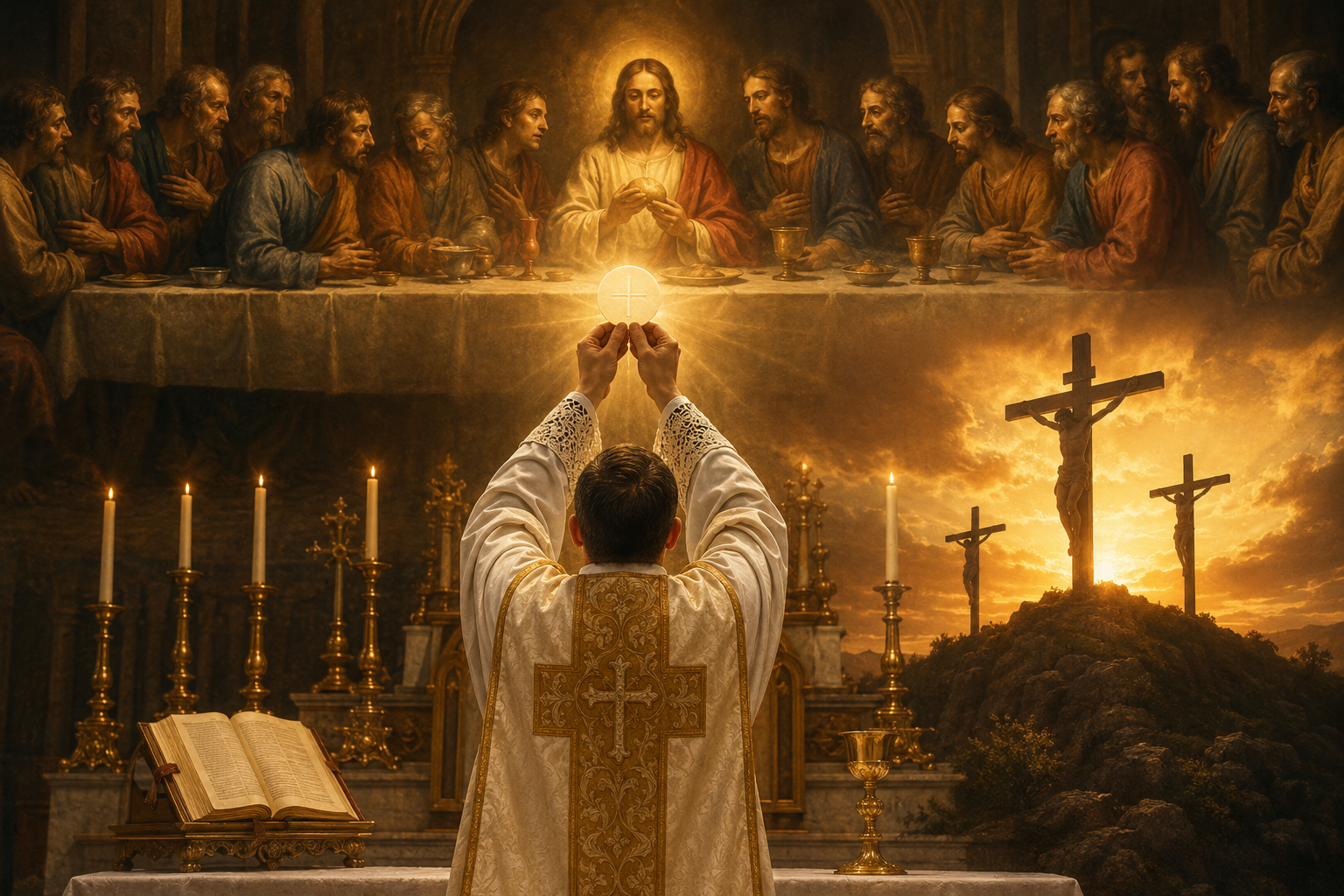
At the Last Supper, on the night before His crucifixion, Jesus institutes the Eucharist and commands His disciples:
“Take, eat; this is my body.”
The New Passover follows the pattern established in the Old.
Christ is sacrificed upon the Cross, and His followers are invited to partake of the true Passover Lamb through the Eucharist.
Old Testament and New Testament Comparison
| Old Testament | New Testament |
|---|---|
| Israel enslaved in Egypt | Humanity enslaved by sin |
| An unblemished lamb was chosen | Jesus is the spotless Lamb of God |
| The lamb was sacrificed | Christ was sacrificed on Calvary |
| The blood of the lamb saved Israel from death | Christ’s Blood saves us from sin and eternal death |
| The blood was applied with hyssop | Jesus was offered sour wine on a hyssop branch (John 19:29) |
| The lamb had to be eaten | Jesus commands us to eat His Flesh and drink His Blood |
| The Passover brought freedom from slavery | Christ brings freedom from sin and death |
The Passover was never meant to be an isolated event in Israel’s history. It was a prophetic sign pointing to the perfect sacrifice of Jesus Christ. Every detail—from the spotless lamb to the covenant meal—finds its ultimate fulfilment in Him.
The Passover Meal: From the Last Supper to the Cross
The connection between the Eucharist and the Passover becomes even more striking when we examine the final hours of Christ’s life.
Jesus did not choose an ordinary evening to institute the Eucharist. He did so in the context of the Passover, the sacred feast commemorating Israel’s deliverance from slavery in Egypt.
At the Last Supper, Jesus takes bread, blesses it, breaks it and gives it to His disciples:
“Take, eat; this is my body.”
— Matthew 26:26
Then He takes the cup:
“Drink of it, all of you; for this is my blood of the covenant, which is poured out for many for the forgiveness of sins.”
— Matthew 26:27–28
These words deliberately echo the establishment of the Old Covenant.
When Moses established the covenant at Sinai, he took the blood of the sacrifice and declared:
“Behold the blood of the covenant which the LORD has made with you.”
— Exodus 24:8
Now Jesus uses remarkably similar words—but instead of the blood of animals, He speaks of His own Blood.
The Old Covenant is giving way to the New.
The Blood of the Covenant
| Old Covenant | New Covenant |
|---|---|
| Moses mediates the covenant | Jesus mediates the New Covenant |
| Blood of sacrificed animals | Blood of Christ |
| “The blood of the covenant” (Exodus 24:8) | “My blood of the covenant” (Matthew 26:28) |
| Temporary sacrifices repeatedly offered | Christ offers the perfect sacrifice |
| Israel delivered from slavery | Humanity delivered from slavery to sin |
But something unusual happens during the Last Supper.
After giving the cup to His disciples, Jesus says:
“I tell you I shall not drink again of this fruit of the vine until that day when I drink it new with you in my Father’s kingdom.”
— Matthew 26:29
They then sing a hymn and leave for the Mount of Olives.
To understand why this matters, we need to look more closely at the Jewish Passover meal.
The Cups of Passover
In later Jewish Passover tradition, the meal is structured around four cups of wine, each marking a stage of the celebration. These are commonly associated with God’s promises of deliverance in Exodus 6:6–7:
- The Cup of Sanctification
- The Cup of Deliverance
- The Cup of Redemption
- The Cup of Praise
The Gospel accounts do not explicitly number the cups at the Last Supper, so we should be careful not to claim more than Scripture tells us.
Nevertheless, an extraordinary pattern emerges when the Last Supper and the Crucifixion are read together.
Jesus drinks wine during the meal, yet afterwards declares that He will not drink again of the fruit of the vine.
Then He leaves for Gethsemane.
The events that follow—His arrest, trial, scourging and Crucifixion—can be understood not as something disconnected from the Last Supper, but as the continuation of the sacrifice He has just instituted.
“I Thirst”
On the Cross, near the moment of His death, Jesus says:
“I thirst.”
— John 19:28
A vessel of sour wine is nearby.
Then John records a remarkable detail:
“So they put a sponge full of the vinegar on hyssop and held it to his mouth.”
— John 19:29
Hyssop.
That detail takes us directly back to the first Passover.
In Egypt, God commanded the Israelites:
“Take a bunch of hyssop and dip it in the blood which is in the basin, and touch the lintel and the two doorposts with the blood which is in the basin.”
— Exodus 12:22
At the first Passover, hyssop carried the blood of the lamb.
At Calvary, hyssop carries wine to the true Lamb of God.
John could simply have told us that Jesus was given sour wine. Instead, he records the instrument used to bring it to His lips.
For a reader familiar with Exodus, the Passover imagery is difficult to miss.
From Egypt to Calvary
| The First Passover | The Passion of Christ |
| An unblemished lamb is chosen | Jesus is the Lamb of God |
| The lamb is sacrificed | Jesus is sacrificed on Calvary |
| The lamb’s blood saves from death | Christ’s Blood brings salvation |
| Hyssop carries the lamb’s blood | Hyssop carries the wine to Christ |
| The lamb must be eaten | Christ gives His Body as food |
| Israel is freed from slavery | Christ frees humanity from slavery to sin |
| The Passover establishes Israel’s deliverance | Christ establishes the New Covenant |
And then something extraordinary happens.
Jesus receives the sour wine.
John tells us:
“When Jesus had received the vinegar, he said, ‘It is finished’; and he bowed his head and gave up his spirit.”
— John 19:30
The Greek word translated “It is finished” is:
Τετέλεσται — Tetelestai
It comes from the verb teleō, meaning to bring to completion, accomplish, or finish.
Christ’s sacrifice has reached its fulfilment.
The Last Supper and Calvary therefore should not be treated as two unrelated events. At the Last Supper Christ gives His Body and Blood sacramentally; on Calvary that same Body is offered and that same Blood is poured out.
Some Catholic biblical scholars, most famously Scott Hahn, have argued that Christ’s reception of the sour wine can be understood as completing the Passover meal—the final cup reaching its fulfilment upon the Cross. Whether or not every detail of the later four-cup Passover structure can be applied directly to the Last Supper of Jesus, the larger biblical connection is unmistakable:
The Last Supper points towards Calvary, and Calvary reveals Christ as the true Passover Lamb.
The Eucharist and the Cross are not competing sacrifices.
They are inseparably united in the one sacrifice of Jesus Christ.
Manna in the Wilderness: The True Bread from Heaven
The Passover was not the only Old Testament event that pointed towards the Eucharist.
After God delivered the Israelites from slavery in Egypt, they journeyed through the wilderness towards the Promised Land. The people became hungry and complained to Moses that there was nothing to eat.
God responded with a miracle.
“Behold, I will rain bread from heaven for you.”
— Exodus 16:4
Each morning, a mysterious bread-like substance appeared upon the ground. The Israelites looked at it and asked:
“What is it?”
— Exodus 16:15
The Hebrew expression man hu—”What is it?”—is traditionally associated with the name manna.
For forty years, God fed His people with bread from heaven.
The manna was not simply food. It was a visible sign that God Himself would sustain His people on their journey.
Centuries later, Jesus would deliberately return to this event—and make an extraordinary claim.
Jesus and the Manna
After miraculously feeding the five thousand, the crowds follow Jesus to Capernaum.
They challenge Him:
“Our fathers ate the manna in the wilderness; as it is written, ‘He gave them bread from heaven to eat.'”
— John 6:31
Jesus responds:
“Truly, truly, I say to you, it was not Moses who gave you the bread from heaven; my Father gives you the true bread from heaven.”
— John 6:32
Notice the contrast.
The Israelites received bread from heaven.
Jesus now promises the true Bread from Heaven.
He continues:
“For the bread of God is that which comes down from heaven, and gives life to the world.”
— John 6:33
The crowd responds:
“Lord, give us this bread always.”
— John 6:34
Then Jesus reveals what this new bread is:
“I am the bread of life.”
— John 6:35
The manna was therefore a sign pointing beyond itself.
Something greater was coming.
The Old Manna and the True Bread
| Manna in the Wilderness | Jesus: The True Bread from Heaven |
|---|---|
| God gave Israel bread from heaven | The Father gives the true Bread from Heaven |
| Manna sustained Israel in the wilderness | Christ sustains His people on their journey to eternal life |
| Manna gave temporary physical nourishment | Christ gives eternal life |
| The Israelites ate the manna | Christ commands His followers to eat the Bread He will give |
| Those who ate the manna eventually died | Whoever eats the Bread Christ gives will live forever |
| Manna accompanied Israel towards the Promised Land | The Eucharist nourishes God’s people on their journey towards the heavenly Promised Land |
Jesus makes the contrast even stronger:
“Your fathers ate the manna in the wilderness, and they died.”
— John 6:49
Then:
“This is the bread which comes down from heaven, that a man may eat of it and not die.”
— John 6:50
The manna was miraculous—but it could not give eternal life.
Jesus promises something greater.
And then His language becomes startlingly specific:
“I am the living bread which came down from heaven; if any one eats of this bread, he will live for ever; and the bread which I shall give for the life of the world is my flesh.“
— John 6:51
This is the turning point.
Jesus does not merely say that He will give bread.
He identifies the bread:
“The bread which I shall give… is my flesh.”
And He tells us why His flesh will be given:
“For the life of the world.”
This points directly towards Calvary, where Christ will give His flesh—His very Body—for the salvation of the world.
Greater Than the Manna
There is an important biblical principle at work here.
The fulfilment is greater than the foreshadowing.
The Old Testament manna was not imaginary or merely symbolic food. It was supernatural bread provided by God.
If the manna was a miraculous reality, then the fulfilment promised by Christ cannot reasonably be reduced to something less.
The Old manna came from heaven and sustained earthly life.
The new Bread comes down from Heaven and gives eternal life.
And Jesus identifies that Bread with His own flesh.
This leads directly to one of the most controversial moments in the Gospel of John.
The people listening to Jesus understand the seriousness of what He has just said.
They begin to argue among themselves:
“How can this man give us his flesh to eat?”
— John 6:52
At this moment Jesus has every opportunity to correct them.
If He means only that they should believe in Him, He can explain the metaphor.
If His flesh is merely symbolic, He can reassure them.
But He does neither.
Instead, Jesus intensifies His language.
And the original Greek text of John 6 makes what happens next even more remarkable.
“Unless You Eat My Flesh”: What the Greek of John 6 Actually Says
The reaction to Jesus’ words is immediate.
After Jesus declares:
“The bread which I shall give for the life of the world is my flesh.”
— John 6:51
His listeners begin to dispute among themselves:
“How can this man give us his flesh to eat?”
— John 6:52
This is a crucial moment.
They have understood Jesus to be speaking about actually eating His flesh.
If they have misunderstood Him, Jesus now has the perfect opportunity to correct them.
He does not.
Instead, He makes His teaching even more explicit.
“Truly, truly, I say to you, unless you eat the flesh of the Son of man and drink his blood, you have no life in you.”
— John 6:53
Jesus begins with the solemn declaration:
Ἀμὴν ἀμὴν — Amēn, amēn
“Truly, truly.”
In John’s Gospel, this expression introduces statements of particular importance and authority.
Jesus is not withdrawing His previous words.
He is doubling down on them.
And what follows becomes even stronger.
“My Flesh Is True Food”
Jesus continues:
“He who eats my flesh and drinks my blood has eternal life, and I will raise him up at the last day.”
— John 6:54
Then:
“For my flesh is food indeed, and my blood is drink indeed.”
— John 6:55
The Greek is striking:
ἡ γὰρ σάρξ μου ἀληθής ἐστιν βρῶσις
Hē gar sarx mou alēthēs estin brōsis
“For my flesh is true food.”
And:
τὸ αἷμά μου ἀληθής ἐστιν πόσις
To haima mou alēthēs estin posis
“My blood is true drink.”
The word σάρξ (sarx) means flesh.
Jesus does not retreat into vague language.
He speaks of His flesh and His blood, and describes them as true food and true drink.
He then says:
“He who eats my flesh and drinks my blood abides in me, and I in him.”
— John 6:56
This is no passing expression.
Jesus repeats the teaching again and again.
Jesus Changes the Word for “Eat”
Earlier in the discourse, John uses forms of the ordinary Greek verb ἐσθίω (esthiō), meaning to eat.
But beginning in John 6:54, the Gospel repeatedly uses another verb:
τρώγω — trōgō
The word can mean to eat, but carries a particularly concrete sense of eating and was also used for chewing or gnawing.
Jesus says:
“He who eats my flesh and drinks my blood has eternal life.”
— John 6:54
The verb translated “eats” here is a form of trōgō.
Again:
“He who eats my flesh and drinks my blood abides in me, and I in him.”
— John 6:56
Again:
“He who eats me will live because of me.”
— John 6:57
And again:
“He who eats this bread will live for ever.”
— John 6:58
The significance is not simply that trōgō can have the vivid sense of “chew” or “gnaw.” Words receive their precise meaning from context.
The greater point is what happens after the objection.
The crowd has just asked:
“How can this man give us his flesh to eat?”
Jesus does not respond:
“You have misunderstood Me.”
Instead, His language becomes repetitive, concrete and increasingly difficult to dismiss.
Jesus Does Not Correct Them
This matters because elsewhere in the Gospels people misunderstand Jesus’ figurative language—and He corrects them.
Nicodemus thinks being “born again” means physically entering his mother’s womb a second time.
Jesus explains what He means.
The disciples misunderstand Jesus’ warning about the “leaven of the Pharisees” and think He is talking about ordinary bread.
Jesus corrects them.
But something very different happens in John 6.
His listeners understand Him to mean that they must eat His flesh.
They object.
Jesus repeats the teaching.
And then His own disciples react.
“This Is a Hard Saying”
John tells us:
“Many of his disciples, when they heard it, said, ‘This is a hard saying; who can listen to it?'”
— John 6:60
Notice who is speaking.
These are not simply hostile Pharisees.
They are His disciples.
The Greek word translated “hard” is:
σκληρός — sklēros
It can mean hard, harsh, severe or difficult to accept.
Their problem is not simply that Jesus has used complicated language.
They are scandalised by what He has said.
Jesus knows this.
“But Jesus, knowing in himself that his disciples murmured at it, said to them, ‘Do you take offense at this?'”
— John 6:61
Again, He does not retract His teaching.
Then comes one of the most dramatic verses in the entire chapter:
“After this many of his disciples drew back and no longer went about with him.”
— John 6:66
They leave Him.
Not His enemies.
His disciples.
If Jesus were speaking only symbolically and His followers were abandoning Him because they had misunderstood Him, this would have been the obvious moment to call them back and explain.
He does not.
He lets them walk away.
“Will You Also Go Away?”
Jesus then turns to the Twelve.
He does not say:
“Go after them. They misunderstood Me.”
He asks:
“Do you also wish to go away?”
— John 6:67
Simon Peter answers:
“Lord, to whom shall we go? You have the words of eternal life.”
— John 6:68
Peter does not claim to understand how Christ can give His flesh to eat.
He trusts the One who said it.
That distinction is fundamental.
Christian faith does not require us to understand how God accomplishes everything He reveals before we believe that He can accomplish it.
The Progression of John 6
| What Jesus Says | What Happens |
|---|---|
| “I am the bread of life.” | Jesus identifies Himself as the true Bread from Heaven |
| “The bread which I shall give… is my flesh.” | His listeners question how He can give His flesh to eat |
| “Unless you eat… and drink…” | Jesus does not correct their understanding |
| “My flesh is true food and my blood is true drink.” | His language becomes increasingly explicit |
| Trōgō is repeatedly used for eating His flesh | The discourse maintains a concrete emphasis on eating |
| “He who eats my flesh… abides in me.” | Jesus connects this eating with communion with Him |
| “This is a hard saying.” | His own disciples are scandalised |
| Many disciples leave | Jesus allows them to depart |
| “Do you also wish to go away?” | Jesus challenges the Twelve rather than retracting His teaching |
| “Lord, to whom shall we go?” | Peter responds with faith in Christ’s words |
John 6 therefore presents us with a serious question.
If Jesus intended His Flesh and Blood to be understood merely as symbols, why did He allow His own disciples to abandon Him over precisely this teaching without correcting them?
Instead, He repeatedly speaks of eating His Flesh and drinking His Blood, calls His Flesh true food and His Blood true drink, and allows those who cannot accept the teaching to walk away.
But John 6 is still a promise.
Jesus has told His disciples what He will give them.
The question remains:
How will He give His Body and Blood to them?
The answer comes at the Last Supper.
There, on the night before He dies, Jesus takes bread into His hands and declares:
“This is my body.”
In John 6, Jesus promises that the bread He will give is His Flesh, and that His followers must eat His Flesh and drink His Blood.
At the Last Supper, the night before His Crucifixion, Jesus reveals how this promise will be fulfilled.
During the Passover meal, Jesus takes bread, blesses it, breaks it and gives it to His disciples:
“Take, eat; this is my body.”
— Matthew 26:26
Then He takes the cup:
“Drink of it, all of you; for this is my blood of the covenant, which is poured out for many for the forgiveness of sins.”
— Matthew 26:27–28
The words are direct.
“This is my body.”
“This is my blood.”
Jesus does not say:
“This represents my body.”
Nor does He say:
“This is merely a symbol of my blood.”
The same Jesus who had told His disciples that His Flesh was true food and His Blood true drink now takes bread and wine and identifies them with His Body and Blood.
John 6 promised the gift.
The Last Supper institutes it.
Calvary accomplishes the sacrifice.
John 6 and the Last Supper
| John 6 | The Last Supper |
|---|---|
| “I am the bread of life.” | Jesus takes bread |
| “The bread which I shall give… is my flesh.” | “This is my body.” |
| “My blood is true drink.” | “This is my blood of the covenant.” |
| His Flesh will be given “for the life of the world” | His Body is given and His Blood poured out |
| His followers must eat His Flesh | “Take, eat.” |
| His followers must drink His Blood | “Drink of it, all of you.” |
| Eating Christ brings communion with Him | The disciples receive what Christ gives them |
The language of John 6 and the Last Supper fits together remarkably.
But Jesus then gives His Apostles another command:
“Do this in remembrance of me.”
— Luke 22:19
At first glance, the word “remembrance” might sound as though Jesus is asking Christians simply to remember something that happened in the past.
The original Greek deserves a closer look.
“Do This in Remembrance of Me”
The Greek word translated “remembrance” is:
ἀνάμνησις — anamnesis
Anamnesis certainly involves remembrance, but in a biblical and liturgical setting it carries more significance than simply thinking about a past event.
The word appears in the Greek Old Testament in connection with sacrificial worship.
For example, in Leviticus the memorial portion of an offering is presented upon the altar before God.
The same sacrificial language appears in the New Testament.
Hebrews 10:3 uses anamnesis when speaking of the Old Covenant sacrifices:
“But in these sacrifices there is a reminder of sin year after year.”
— Hebrews 10:3
So when Jesus commands:
“Do this in remembrance of me,”
He is speaking within the world of Jewish covenant worship and sacrifice.
The Eucharist is therefore not merely Christians gathering together to think about something Jesus did long ago.
It is the liturgical memorial of Christ’s sacrifice.
Not Another Crucifixion
This distinction is essential.
The Catholic Church does not teach that Jesus is crucified again at every Mass.
Scripture is clear:
“We have been sanctified through the offering of the body of Jesus Christ once for all.”
— Hebrews 10:10
Christ’s sacrifice on Calvary happened once.
It is perfect.
It cannot be repeated.
The Mass does not add another sacrifice alongside Calvary.
Rather, the Eucharist makes sacramentally present the one sacrifice of Christ.
The sacrifice offered at Mass and the sacrifice offered on Calvary are not two different sacrifices.
They are the same Christ, the same offering, and the same sacrifice, made present sacramentally.
Old Covenant Memorial and New Covenant Memorial
| Old Covenant | New Covenant |
| Israel celebrated the Passover memorial | Christians celebrate the Eucharistic memorial |
| The Exodus was God’s act of deliverance | Calvary is God’s definitive act of deliverance |
| Blood established the covenant | Christ’s Blood establishes the New Covenant |
| The Passover meal included eating the sacrificial lamb | The Eucharistic meal gives us Christ, the true Passover Lamb |
| The memorial was celebrated generation after generation | “Do this in remembrance of me” |
| The old sacrifices were repeatedly offered | Christ’s sacrifice was accomplished once for all |
There is another detail that should not be missed.
Jesus does not merely tell the Apostles:
“Remember me.”
He tells them:
“Do this.”
There is an action to be continued.
Take.
Bless.
Break.
Give.
Eat.
Drink.
And this is exactly what we find the earliest Christians doing.
The Breaking of Bread
After Christ’s Resurrection and Ascension, the first Christians do not treat the Eucharist as an optional devotion.
Acts tells us:
“And they devoted themselves to the apostles’ teaching and fellowship, to the breaking of bread and the prayers.”
— Acts 2:42
The “breaking of bread” becomes one of the defining practices of the earliest Christian community.
We see it again on the road to Emmaus.
The risen Christ walks with two disciples, but they do not recognise Him.
Later, at the table:
“When he was at table with them, he took the bread and blessed, and broke it, and gave it to them.”
— Luke 24:30
Then:
“And their eyes were opened and they recognized him.”
— Luke 24:31
Luke later tells us that Jesus:
“was known to them in the breaking of the bread.”
— Luke 24:35
There is a beautiful progression.
Christ teaches them the Scriptures on the road.
Their hearts burn within them.
But they recognise Him in the breaking of the bread.
From Promise to Fulfilment
| Promise | Fulfilment |
| “I am the bread of life.” | Christ gives the Eucharistic bread |
| “The bread… is my flesh.” | “This is my body.” |
| “My blood is true drink.” | “This is my blood.” |
| “He who eats my flesh… abides in me.” | The Apostles receive Communion |
| “Do this in remembrance of me.” | The early Church devotes itself to the breaking of bread |
| Christ gives Himself for the life of the world | Christ offers Himself once for all upon Calvary |
The pattern is becoming increasingly difficult to dismiss.
The Passover foreshadows Christ.
The manna foreshadows Christ.
John 6 promises His Flesh as true food.
The Last Supper identifies the bread with His Body and the wine with His Blood.
Calvary accomplishes the sacrifice.
And the Apostles continue the breaking of bread after the Resurrection.
Yet there is still another witness we must examine.
St. Paul writes about the Eucharist only a few decades after the Crucifixion—and what he says presents a serious difficulty for the idea that the Eucharist is merely symbolic.
If the Eucharist is only ordinary bread and wine, we must ask:
How could receiving it unworthily make someone guilty of the Body and Blood of the Lord?
St. Paul and the Eucharist: Participation in the Body and Blood of Christ
The evidence for the Real Presence does not end with John 6 or the Last Supper.
St. Paul’s First Letter to the Corinthians gives us some of the earliest written testimony concerning Christian belief in the Eucharist.
Paul writes:
“The cup of blessing which we bless, is it not a participation in the blood of Christ? The bread which we break, is it not a participation in the body of Christ?”
— 1 Corinthians 10:16
The original Greek contains an important word:
κοινωνία — koinōnia
Koinōnia means communion, participation, sharing or fellowship.
Paul does not describe the Eucharist merely as something that reminds Christians of Christ.
He describes the cup as a participation in the Blood of Christ and the bread as a participation in the Body of Christ.
This is where our English word Communion comes into focus.
Holy Communion is not simply remembering Christ from a distance.
It is participation in Him.
Paul continues:
“Because there is one bread, we who are many are one body, for we all partake of the one bread.”
— 1 Corinthians 10:17
The Eucharist therefore does something.
It unites Christians with Christ and, through Christ, with one another.
Participation — Not Merely Representation
| If the Eucharist Were Merely Symbolic | What St. Paul Actually Says |
|---|---|
| The cup represents Christ’s Blood | The cup is a koinōnia — participation — in Christ’s Blood |
| The bread represents Christ’s Body | The bread is a koinōnia — participation — in Christ’s Body |
| Communion primarily recalls an absent event | Paul describes actual participation in Christ |
| The meal is primarily an individual act of remembrance | Those who partake become one body |
But Paul’s argument becomes even stronger in the following chapter.
Guilty of the Body and Blood of the Lord
In 1 Corinthians 11, Paul recounts the institution of the Eucharist.
He tells the Corinthians that this teaching was not something he invented:
“For I received from the Lord what I also delivered to you.”
— 1 Corinthians 11:23
He then repeats Christ’s words:
“This is my body which is for you. Do this in remembrance of me.”
— 1 Corinthians 11:24
And concerning the cup:
“This cup is the new covenant in my blood. Do this, as often as you drink it, in remembrance of me.”
— 1 Corinthians 11:25
Paul then gives an extraordinary warning:
“Whoever, therefore, eats the bread or drinks the cup of the Lord in an unworthy manner will be guilty of profaning the body and blood of the Lord.”
— 1 Corinthians 11:27
Read that carefully.
Paul does not say that the person is guilty of disrespecting a symbol of Christ.
He says that the person becomes guilty concerning:
the Body and Blood of the Lord.
That raises a serious question for a purely symbolic interpretation of Communion.
If the bread and wine are nothing more than representations, why does abusing them make someone answerable for the Body and Blood of Christ Himself?
Paul goes further:
“Let a man examine himself, and so eat of the bread and drink of the cup.”
— 1 Corinthians 11:28
Then:
“For any one who eats and drinks without discerning the body eats and drinks judgment upon himself.”
— 1 Corinthians 11:29
The Greek word translated “discerning” comes from:
διακρίνω — diakrinō
It carries the sense of distinguishing, discerning or recognising a difference.
Paul therefore demands that Christians approach the Eucharist with discernment.
This is not ordinary food.
Something sacred is before them.
“That Is Why Some of You Have Died”
Then Paul says something even more startling:
“That is why many of you are weak and ill, and some have died.”
— 1 Corinthians 11:30
Paul believes that receiving the Eucharist unworthily is so serious that he connects the Corinthians’ irreverence with divine judgment.
Weakness.
Illness.
Even death.
Whatever interpretation one adopts, it is extremely difficult to reconcile the severity of Paul’s warning with the idea that Communion is nothing more than ordinary bread and wine used as a symbolic reminder.
Paul treats the Eucharist as holy.
St. Paul’s Eucharistic Teaching
| St. Paul’s Words | What They Tell Us |
| “Participation in the blood of Christ” | Communion truly participates in Christ’s Blood |
| “Participation in the body of Christ” | Communion truly participates in Christ’s Body |
| “This is my body” | Paul preserves Christ’s words from the Last Supper |
| “The new covenant in my blood” | The Eucharist belongs to the New Covenant |
| “Guilty… of the body and blood of the Lord” | Unworthy reception is an offence against Christ Himself |
| “Discerning the body” | Christians must recognise the sacred reality they receive |
| “Weak and ill, and some have died” | Paul regards abuse of the Eucharist with extraordinary seriousness |
Sacrifice and Communion
Paul then makes another connection that takes us directly back to the Old Testament.
Immediately after speaking about participation in Christ’s Body and Blood, he tells the Corinthians:
“Consider the people of Israel; are not those who eat the sacrifices partners in the altar?”
— 1 Corinthians 10:18
This is enormously significant.
Paul places three things beside one another:
The Eucharist.
Sacrifice.
The altar.
In the Old Covenant, those who ate from the sacrifice participated in what was offered upon the altar.
This takes us straight back to the Passover.
The lamb was sacrificed.
Its blood was shed.
And then the people ate the sacrificial victim.
Now Paul describes Christians drinking the cup and breaking the bread as participation in Christ’s Body and Blood, and immediately compares this with Israel eating from its sacrifices.
The biblical pattern has returned.
Old Covenant Sacrifice and the Eucharist
| Old Covenant | The Eucharist |
| A sacrificial victim was offered | Christ offers Himself |
| Blood was shed | Christ’s Blood is poured out |
| There was an altar | Paul speaks of participation in the altar |
| The sacrificial victim could be eaten | Christians receive Christ in Communion |
| Eating meant participation in the sacrifice | Paul calls the Eucharist koinōnia — participation |
| Passover required Israel to eat the lamb | Christians receive Christ, our Passover Lamb |
We began with Exodus.
God commanded Israel to sacrifice an unblemished lamb and eat its flesh.
We then heard Jesus identified as:
“The Lamb of God.”
Christ Himself declared:
“The bread which I shall give… is my flesh.”
At the Last Supper:
“This is my body.”
And now St. Paul tells the first Christians:
The bread is participation in Christ’s Body.
The cup is participation in Christ’s Blood.
And those who receive unworthily are:
“Guilty… of the body and blood of the Lord.”
The evidence is no longer coming from a single verse.
It is a pattern running throughout Scripture.
Passover → Manna → John 6 → Last Supper → Calvary → St. Paul.
But an important historical question remains.
How did the Christians who learned the faith directly from the Apostles understand the Eucharist?
Did they believe it was merely symbolic?
Or did the earliest Church understand Christ’s words in the same way the Catholic Church does today?
For that, we must turn to the Christians who lived immediately after the Apostolic age.
The Early Church and the Eucharist
If the Eucharist were merely symbolic, we should expect the Christians closest to the Apostles to speak of it as ordinary bread and wine used only as a memorial.
But that is not what we find.
From the earliest surviving Christian writings outside the New Testament, Christians speak of the Eucharist in strikingly realistic terms.
This matters because these writers lived centuries before the medieval period and, in some cases, within living memory of the Apostles themselves.
St. Ignatius of Antioch — c. AD 107
St. Ignatius was Bishop of Antioch and was martyred in the early second century.
In his Letter to the Smyrnaeans, he condemns a group who rejected the true humanity of Christ.
Why does this matter for the Eucharist?
Because Ignatius identifies their rejection of the Eucharist with their rejection of Christ’s real flesh.
He writes that they abstain from the Eucharist because they do not confess it to be:
“the flesh of our Savior Jesus Christ”
This is an extraordinary statement.
Ignatius does not describe the Eucharist merely as a symbol of Christ’s Flesh.
He explicitly calls it the Flesh of Jesus Christ.
And this testimony comes from approximately AD 107 — only a few generations after the Crucifixion.
John 6 and St. Ignatius
| Jesus in John 6 | St. Ignatius — c. AD 107 |
|---|---|
| “The bread which I shall give… is my flesh.” | The Eucharist is “the flesh of our Savior Jesus Christ” |
| Christ insists upon the reality of His Flesh | Ignatius condemns those who refuse to confess the Eucharist as Christ’s Flesh |
| Some disciples reject the teaching | Ignatius confronts Christians who reject the same reality |
The language is remarkably consistent.
The Christians immediately following the Apostolic age were not speaking about the Eucharist as ordinary bread.
They were speaking about the Flesh of Christ.
St. Justin Martyr — c. AD 155
Around the middle of the second century, St. Justin Martyr wrote a defence of Christianity addressed to the Roman emperor.
Because he was explaining Christian worship to outsiders, his description of the Eucharist is extremely valuable.
Justin writes:
“Not as common bread and common drink do we receive these.”
He then explains that Christians had been taught that the Eucharistic food:
“is the flesh and blood of that Jesus who was made flesh.”
— First Apology, 66
Justin could hardly be clearer.
The Eucharist is not common bread.
It is not common drink.
Christians receive it as the Flesh and Blood of Jesus Christ.
What Justin Describes
| Modern Catholic Practice | Justin Martyr — c. AD 155 |
| Christians gather on Sunday | Justin describes Christians assembling together |
| Scripture is read | The writings of the Apostles and prophets are read |
| Prayers are offered | The community rises and prays |
| Bread and wine are brought forward | Bread, wine and water are presented |
| Thanksgiving is offered | The presider offers prayers and thanksgiving |
| The people respond “Amen” | Justin explicitly records the congregation saying “Amen” |
| Communion is distributed | Deacons distribute the Eucharist |
| Eucharist is taken to the absent | Deacons carry it to those unable to attend |
| The Eucharist is not ordinary food | Justin says it is not received as common bread and drink |
| It is Christ’s Body and Blood | Justin calls it the Flesh and Blood of Jesus |
By the middle of the second century, the structure of Christian worship is already recognisably Eucharistic.
There is no evidence here of a Christianity that regarded Communion as nothing more than a symbolic snack.
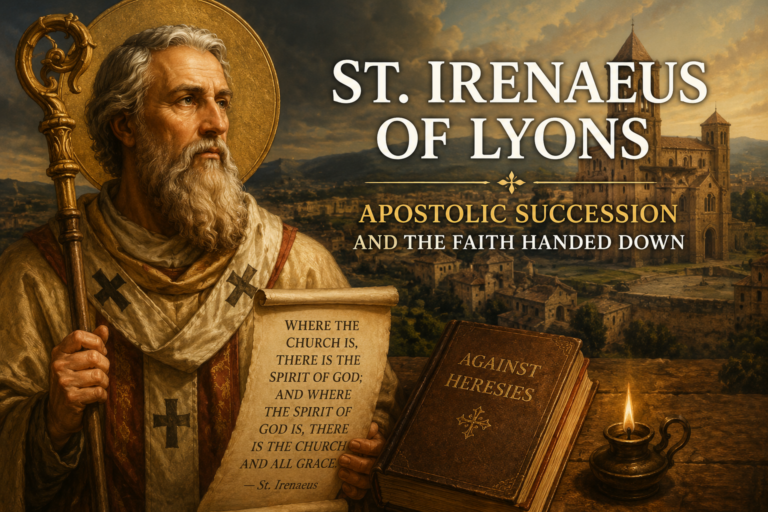
St. Irenaeus of Lyons — c. AD 180
St. Irenaeus provides another powerful witness.
He had a particularly important connection with the Apostolic age.
Irenaeus had known St. Polycarp, Bishop of Smyrna, who in turn had known Christians from the generation of the Apostles.
When Irenaeus writes about the Eucharist, his language is unmistakable.
He says that the bread:
“becomes the Eucharist, which is the body and blood of Christ”
He also states that our flesh is nourished by:
“the cup which is His blood”
and by:
“the bread which is His body.”
— Against Heresies, Book V, Chapter 2
Irenaeus is arguing against people who denied the future resurrection of the human body.
His argument depends upon the reality of the Eucharist.
How, he asks, could the body be incapable of resurrection when it is already being nourished by the Body and Blood of Christ?
The Apostolic Chain
This historical connection is worth seeing clearly:
The Apostles
↓
St. Polycarp
↓
St. Irenaeus
And Irenaeus speaks openly of the Eucharist as the Body and Blood of Christ.
That makes the theory that the Real Presence appeared many centuries later extraordinarily difficult to defend.
St. Cyril of Jerusalem — Fourth Century
By the fourth century, Eucharistic language becomes even more explicit.
St. Cyril of Jerusalem instructs newly baptised Christians not to judge the Eucharist merely by what their senses perceive.
He teaches that because Christ declared:
“This is my body,”
Christians should trust His word.
The point is the same one we saw with Peter in John 6.
Faith rests upon the authority of Christ.
Our senses perceive bread and wine.
Christ tells us what they have become.
The Christian response is not:
“How can this be?”
It is:
“Lord, to whom shall we go? You have the words of eternal life.”
Was the Real Presence a Medieval Invention?
The historical evidence presents a serious problem for that claim.
Consider the timeline:
| Date | Witness | Teaching |
| c. AD 30–33 | Jesus Christ | “My flesh is true food and my blood is true drink.” |
| c. AD 50s | St. Paul | The Eucharist is participation in Christ’s Body and Blood |
| c. AD 107 | St. Ignatius of Antioch | The Eucharist is “the flesh of our Savior Jesus Christ” |
| c. AD 155 | St. Justin Martyr | Christians do not receive common bread; it is Christ’s Flesh and Blood |
| c. AD 180 | St. Irenaeus | The Eucharist is the Body and Blood of Christ |
| Fourth century | St. Cyril of Jerusalem | Christians are instructed to trust Christ’s words over appearances |
The pattern is continuous.
There is no sudden medieval invention.
There is no point where Christians move from a universally symbolic Eucharist to belief in the Real Presence.
Instead, the earliest Christian testimony fits naturally with what we have already seen in Scripture.
John 6.
The Last Supper.
St. Paul.
St. Ignatius.
St. Justin Martyr.
St. Irenaeus.
The same belief appears again and again:
The Eucharist is truly the Body and Blood of Jesus Christ.
And this raises an important question for anyone who claims that the early Church believed otherwise:
If the disciples of the Apostles themselves understood the Eucharist this way, when exactly did the Church supposedly abandon the symbolic teaching and invent the Real Presence?
The historical record gives no clear moment when such a change occurred.
Instead, the Real Presence is already there at the beginning.
Common Objections to the Eucharist
The biblical case for the Eucharist is strong, but several objections are commonly raised against the Catholic understanding of the Real Presence.
These objections deserve to be answered carefully.
The goal is not simply to win an argument, but to ask which interpretation best fits the whole of Scripture.
“The Flesh Profits Nothing”
One of the most common objections comes from John 6:63:
“It is the spirit that gives life, the flesh is of no avail.”
At first glance, this can sound as though Jesus is denying everything He has just said about eating His Flesh.
But that interpretation creates a serious problem.
Only moments earlier Jesus had declared:
“The bread which I shall give for the life of the world is my flesh.”
— John 6:51
And:
“My flesh is true food, and my blood is true drink.”
— John 6:55
Jesus cannot mean in verse 63 that His own Flesh is useless.
His Flesh is the very Flesh He will offer upon the Cross for the salvation of the world.
So what does “the flesh is of no avail” mean?
In Scripture, “flesh” can refer not only to the physical body, but also to human understanding apart from the grace of God.
Jesus is contrasting merely human reasoning with the life-giving action of the Spirit.
In other words:
Human reasoning alone cannot grasp this mystery.
The Spirit gives life.
This fits perfectly with what happens in the chapter.
The disciples hear Christ’s teaching and judge it according to ordinary human understanding:
“How can this man give us his flesh to eat?”
Jesus does not tell them His Flesh is symbolic.
He tells them that they need to see with the eyes of faith.
John 6:63 in Context
| Misreading | What the Context Shows |
|---|---|
| “The flesh is useless, therefore the Eucharist is symbolic” | Jesus had just called His Flesh “true food” |
| Physical flesh has no value | Christ’s Flesh is offered for the life of the world |
| Jesus retracts His earlier teaching | He never retracts it |
| The disciples misunderstood | Jesus allows them to leave rather than correct them |
| Verse 63 cancels verses 51–58 | Verse 63 must be understood consistently with the entire discourse |
“Jesus Was Speaking Symbolically”
Jesus certainly uses symbolic language elsewhere.
He says:
“I am the door.”
— John 10:9
And:
“I am the vine.”
— John 15:5
So why not understand:
“This is my body”
in the same way?
The difference is the context.
When Jesus calls Himself a door or a vine, nobody thinks He is claiming to be made of wood or branches.
There is no dispute.
No one walks away because they think Jesus is literally a plant.
John 6 is completely different.
Jesus says His Flesh must be eaten.
The listeners object specifically to the literal implications of His words.
Jesus then repeats and strengthens the teaching.
His own disciples declare:
“This is a hard saying.”
Many of them abandon Him.
And Jesus lets them go.
The reaction of His audience is therefore part of the evidence.
Symbolic Language Compared with John 6
| Clearly Figurative Saying | John 6 |
| “I am the door” | “The bread which I shall give… is my flesh” |
| No one misunderstands Him literally | The listeners immediately ask how He can give His Flesh to eat |
| No scandal follows | His own disciples are scandalised |
| No followers leave | Many disciples abandon Him |
| No need for repeated clarification | Jesus repeatedly speaks of eating His Flesh and drinking His Blood |
The question is not whether Jesus can speak symbolically.
Of course He can.
The question is whether the evidence of John 6 suggests that He is speaking only symbolically in this particular passage.
The text strongly suggests otherwise.
“Do This in Remembrance of Me”
Another common objection is:
“Jesus said to do it in remembrance of Him. That means Communion is only a memorial.”
But the Greek word used by Jesus is:
ἀνάμνησις — anamnesis
It means remembrance or memorial, but in the biblical world a memorial is more than simply thinking about a past event.
The Passover itself was a memorial.
Every generation of Israel entered liturgically into God’s saving act of deliverance.
Likewise, the Eucharist is not a second Crucifixion.
It is the sacramental memorial of the one sacrifice of Christ.
Jesus does not merely say:
“Remember me.”
He says:
“Do this in remembrance of me.”
An action is commanded.
The Eucharistic action is to continue in the Church.
Remembering vs Biblical Memorial
| Ordinary Memory | Biblical Memorial — Anamnesis |
| Thinking about something in the past | Liturgical remembrance of God’s saving action |
| Primarily mental | Involves worship and sacred action |
| Event remains entirely past | God’s saving act is proclaimed and participated in |
| “Remember what happened” | “Do this in remembrance of me” |
“Jesus Was Sacrificed Once for All”
This objection usually comes from Hebrews:
“We have been sanctified through the offering of the body of Jesus Christ once for all.”
— Hebrews 10:10
Catholics completely agree.
Jesus died once.
His sacrifice is perfect and cannot be repeated.
The Mass is not another Crucifixion.
Christ is not killed again.
The Catholic claim is that the one sacrifice of Calvary is made sacramentally present in the Eucharist.
This distinction is crucial.
The sacrifice is not repeated.
The Church participates in the one sacrifice that Christ completed once for all.
Calvary and the Mass
| Calvary | The Mass |
| Christ offers Himself once for all | The same sacrifice is made sacramentally present |
| Christ dies | Christ does not die again |
| Blood is physically shed | No new shedding of blood occurs |
| Historical event | Sacramental participation in that event |
| Perfect and complete sacrifice | Nothing is added to Christ’s sacrifice |
The Mass does not compete with Calvary.
It depends entirely upon Calvary.
Without the Cross, there is no Eucharist.
“It’s Still Bread”
Another objection is that St. Paul continues to call the Eucharist “bread”:
“Whoever, therefore, eats the bread or drinks the cup of the Lord…”
— 1 Corinthians 11:27
Therefore, it is argued, the substance must still be ordinary bread.
But Scripture frequently describes things according to their outward appearance or according to what they once were.
The important question is what Paul says about that bread.
He says receiving it unworthily makes a person:
“guilty of profaning the body and blood of the Lord.”
And he warns against receiving without:
“discerning the body.”
So the fact that Paul uses the word “bread” does not weaken the Catholic argument.
The same passage identifies this Eucharistic bread so closely with Christ that abusing it becomes an offence against the Body and Blood of the Lord.
“Isn’t This Cannibalism?”
The charge of cannibalism misunderstands what Catholics believe.
Cannibalism involves eating the dead flesh of another human being in the ordinary biological manner.
That is not the Eucharist.
Christ is risen.
He is alive and glorified.
In the Eucharist, Catholics receive the whole living Christ:
Body, Blood, Soul and Divinity.
Christ is not divided into pieces.
Receiving even a small portion of the consecrated Host means receiving the whole Christ.
The Eucharistic manner of Christ’s presence is sacramental, not ordinary biological eating.
This is why the Church has never understood the Eucharist as cannibalism.
“But It Still Looks and Tastes Like Bread”
This leads to the Catholic teaching known as transubstantiation.
The term was developed to describe something the Church already believed:
After consecration, what the Eucharist is changes, while the appearances remain.
The appearances of bread and wine remain:
- taste
- colour
- texture
- weight
- smell
But the underlying reality becomes the Body and Blood of Christ.
The Church uses the philosophical terms:
Substance — what something truly is.
Accidents — its observable properties.
So after consecration:
The accidents of bread and wine remain.
The substance becomes Christ.
This doctrine was not invented to replace Scripture.
It was developed to explain philosophically what Christians had already confessed for centuries:
“This is my body.”
One Teaching, Many Witnesses
When each passage is considered separately, objections can appear possible.
But when the entire biblical pattern is placed together, the case becomes much stronger.
| Scripture | Teaching |
| Exodus 12 | The Passover lamb must be sacrificed and eaten |
| Exodus 16 | God gives bread from heaven |
| John 6:51 | Christ says the bread He will give is His Flesh |
| John 6:54–56 | His Flesh must be eaten and His Blood drunk |
| John 6:60–66 | Disciples reject the teaching and leave |
| Matthew 26:26 | “This is my body” |
| Matthew 26:28 | “This is my blood of the covenant” |
| Luke 22:19 | “Do this in remembrance of me” |
| 1 Corinthians 10:16 | Eucharist is participation in Christ’s Body and Blood |
| 1 Corinthians 11:27 | Unworthy reception makes one guilty of Christ’s Body and Blood |
| Early Church | Christians consistently identify the Eucharist with Christ’s Flesh and Blood |
No single verse stands alone.
The evidence forms one continuous biblical story.
Passover.
Manna.
John 6.
The Last Supper.
Calvary.
St. Paul.
The Early Church.
All point in the same direction:
The Eucharist is not merely a symbol pointing towards an absent Christ.
It is the sacramental gift of Christ Himself.
Conclusion: Behold the Lamb of God
The biblical story of the Eucharist does not begin in the Upper Room.
It begins much earlier.
It begins with sacrifice.
With covenant.
With blood.
With bread from heaven.
With a lamb that had to be eaten.
From the first Passover in Egypt, God was preparing His people to understand what Christ would one day accomplish.
The lamb was without blemish.
Its blood saved from death.
Its flesh was eaten.
Israel was delivered from slavery.
Centuries later, John the Baptist sees Jesus approaching and declares:
“Behold, the Lamb of God, who takes away the sin of the world!”
— John 1:29
Jesus is not simply compared with the Passover lamb.
He is its fulfilment.
St. Paul makes this explicit:
“For Christ, our Paschal Lamb, has been sacrificed.”
— 1 Corinthians 5:7
The true Lamb has been offered.
The true Blood has been poured out.
The true Exodus has begun.
Not an escape from Pharaoh, but liberation from sin and death.
And just as the Old Covenant Passover was not complete with the death of the lamb alone, the New Covenant also contains a sacred meal.
Christ does not merely say:
Look upon My sacrifice.
He says:
“Take, eat; this is my body.”
And:
“Drink of it, all of you; for this is my blood of the covenant.”
The pattern is unmistakable.
The Old Passover and the New Passover
| Old Covenant Passover | New Covenant Fulfilment |
|---|---|
| An unblemished lamb is chosen | Jesus is the spotless Lamb of God |
| The lamb is sacrificed | Christ is sacrificed on Calvary |
| The lamb’s blood saves from death | Christ’s Blood saves from sin and eternal death |
| Hyssop is used at Passover | Hyssop appears again at the Cross |
| The lamb must be eaten | Christ commands His followers to eat His Flesh |
| Israel is freed from slavery | Humanity is freed from slavery to sin |
| Manna sustains Israel in the wilderness | Christ gives the true Bread from Heaven |
| The Passover is celebrated as a covenant memorial | The Eucharist is celebrated in remembrance of Christ |
| Israel participates in the sacrificial meal | Christians participate in Christ’s Body and Blood |
| The old covenant points forward | The New Covenant is fulfilled in Christ |
Jesus had already prepared His disciples for this mystery.
He told them:
“The bread which I shall give for the life of the world is my flesh.”
He told them:
“My flesh is true food, and my blood is true drink.”
He told them:
“He who eats my flesh and drinks my blood abides in me, and I in him.”
Some could not accept it.
They walked away.
Jesus did not call them back and say that they had misunderstood.
He turned instead to the Twelve and asked:
“Do you also wish to go away?”
Peter answered:
“Lord, to whom shall we go? You have the words of eternal life.”
That remains the Christian response.
We may not fully understand how Christ accomplishes this mystery.
But the question is not whether we can explain every detail.
The question is whether we trust the One who said:
“This is my body.”
The Eucharist is therefore not an isolated Catholic doctrine.
It is woven throughout salvation history.
The Passover points to it.
The manna points to it.
John 6 promises it.
The Last Supper institutes it.
Calvary accomplishes the sacrifice.
St. Paul teaches it.
The earliest Christians testify to it.
And the Church continues to celebrate it.
At every Mass, the Church stands before the same mystery that confronted the disciples in Capernaum.
Christ gives Himself.
Not merely an idea.
Not merely a memory.
Not merely a symbol.
Himself.
The Lamb has been sacrificed.
The covenant has been established.
The Bread from Heaven has come down.
And Christ continues to invite His people to the wedding supper of the Lamb.
“Behold the Lamb of God.”