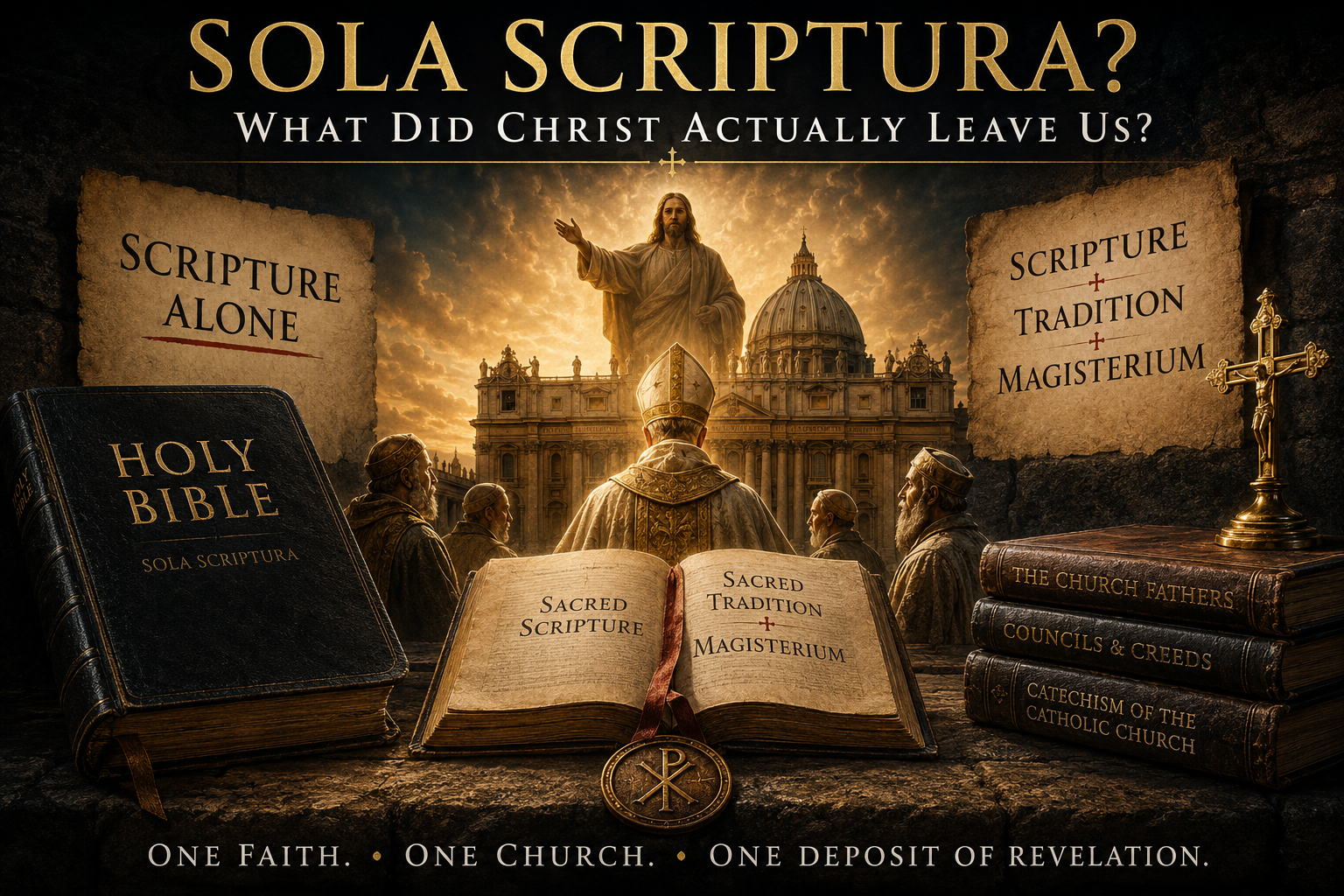
Does the Bible Teach Sola Scriptura?
The Catholic Church has always held Sacred Scripture in the highest regard.
The Bible is inspired by God. It is the Word of God written under the inspiration of the Holy Spirit, and everything asserted by the inspired authors is asserted by the Holy Spirit.
The question between Catholics and Protestants, therefore, is not:
“Is the Bible authoritative?”
Catholics answer emphatically:
Yes.
The real question is:
Did Christ intend Scripture to be the sole infallible rule of faith for the Christian Church?
This distinction is essential.
Catholicism does not reject the authority of Scripture. It rejects Sola Scriptura — the doctrine that Scripture alone is the Church’s sole infallible rule of faith.
So before examining the biblical evidence, we must understand exactly what is being claimed.
What Is Sola Scriptura?
Sola Scriptura is Latin for:
“Scripture Alone”
Properly understood, Sola Scriptura does not necessarily mean that Protestants reject pastors, teachers, creeds, councils or Christian tradition.
Many Protestants value all of these.
The claim is more specific:
Only Sacred Scripture is an infallible rule of faith, and every other Christian authority must ultimately be judged by Scripture.
That gives us a very important apologetic question:
Where does Scripture itself teach this?
If God intended every Christian to accept Scripture alone as the sole infallible rule of faith, we should reasonably expect such a foundational doctrine to be taught in Scripture.
But when we examine the New Testament, we find something different.
We find:
Sacred Scripture.
Apostolic Tradition.
A visible teaching Church.
And all three are presented as authoritative.
The Catholic Position
The Catholic Church teaches that God’s revelation was entrusted by Christ to the Apostles and transmitted in two closely connected ways:
Sacred Scripture — the Word of God committed to writing under the inspiration of the Holy Spirit.
Sacred Tradition — the Apostolic teaching handed on in the life, worship and teaching of the Church.
This deposit of faith is authentically interpreted by the Church’s Magisterium — its teaching authority.
The Second Vatican Council explains:
“Sacred tradition and Sacred Scripture form one sacred deposit of the word of God.”
— Dei Verbum, 10
This does not mean that the Catholic Church places itself above Scripture.
In fact, Dei Verbum explicitly teaches the opposite:
“This teaching office is not above the word of God, but serves it.”
— Dei Verbum, 10
That distinction is crucial.
The Catholic model is not:
Church versus Bible.
Nor is it:
Tradition versus Bible.
It is:
Scripture + Apostolic Tradition + Magisterium
All serve the same revealed faith entrusted by Christ to His Church.
Two Different Models
| Sola Scriptura | Catholic Understanding |
|---|---|
| Scripture is the sole infallible rule of faith | God’s revelation is transmitted through Sacred Scripture and Apostolic Tradition |
| Other authorities are subordinate and fallible | Christ gave His Church genuine teaching authority |
| Scripture is the final infallible standard for doctrine | The Magisterium authentically interprets the deposit of faith |
| Apostolic oral teaching was authoritative while the Apostles lived, but is not an independent infallible rule today | Apostolic Tradition continues to be handed on within the Church |
| The Church recognises Scripture | The Church receives, safeguards and authentically interprets the apostolic deposit |
The question is:
Which model do we actually find in the New Testament?
“All Scripture Is Inspired by God”
One of the most frequently cited passages in defence of Sola Scriptura is St. Paul’s Second Letter to Timothy:
“All scripture is inspired by God and profitable for teaching, for reproof, for correction, and for training in righteousness, that the man of God may be complete, equipped for every good work.”
— 2 Timothy 3:16–17
This passage teaches something enormously important.
Scripture is:
Inspired by God.
Profitable for teaching.
Profitable for correction.
Profitable for training in righteousness.
And capable of thoroughly equipping the man of God.
Catholics affirm every word of this.
But notice what Paul does not say.
He does not say:
“Only Scripture is inspired and therefore Scripture is the sole infallible authority.”
Nor does he say:
“Scripture alone is sufficient as the Christian’s sole rule of faith.”
The passage establishes the inspiration and profound usefulness of Scripture.
It does not establish Sola Scriptura.
There is an important logical distinction:
“Scripture is sufficient to equip” does not automatically mean “Only Scripture has authority.”
Consider what Paul had written immediately before these famous verses:
“But as for you, continue in what you have learned and have firmly believed, knowing from whom you learned it.”
— 2 Timothy 3:14
Timothy’s faith was not received simply by being handed a completed New Testament.
He had been taught.
And throughout Paul’s letters, Timothy is repeatedly instructed to preserve and transmit what he had received from Paul.
This becomes extremely important when we look at another command from St. Paul.
“By Word of Mouth or by Letter”
Paul writes to the Thessalonians:
“So then, brethren, stand firm and hold to the traditions which you were taught by us, either by word of mouth or by letter.”
— 2 Thessalonians 2:15
This verse deserves careful attention.
Paul identifies two ways in which the Thessalonians received Apostolic teaching:
| By Word of Mouth | By Letter |
| Oral Apostolic teaching | Written Apostolic teaching |
| Personally preached and taught | Communicated through Apostolic writings |
| Christians are commanded to hold fast to it | Christians are commanded to hold fast to it |
Paul does not tell them:
“Hold to what we wrote, but disregard what we taught orally.”
He commands them to hold firmly to both.
The Greek word translated “traditions” is:
παράδοσις — paradosis
It means something handed down or transmitted.
The word itself does not mean “human invention.”
A tradition can be good or bad depending upon its source.
Jesus condemns traditions of men when they contradict God’s commands.
But Paul commands Christians to preserve Apostolic Tradition because its source is the Apostles themselves.
That distinction is fundamental.
Human Tradition vs Apostolic Tradition
| Human Tradition Condemned | Apostolic Tradition Commanded |
| Originates merely from men | Comes from the Apostles |
| Can contradict God’s revelation | Transmits the Apostolic faith |
| Jesus condemns traditions that nullify God’s commandments | Paul commands Christians to “stand firm and hold” Apostolic traditions |
| Must be rejected when contrary to God | Must be faithfully preserved |
Therefore, the biblical argument cannot simply be:
“The Bible condemns tradition.”
It does not.
The Bible condemns false human traditions while explicitly commanding Christians to preserve Apostolic Tradition.
And Paul goes even further.
He tells Timothy:
“What you have heard from me before many witnesses entrust to faithful men who will be able to teach others also.”
— 2 Timothy 2:2
Notice the chain:
Paul → Timothy → Faithful Men → Others
Paul does not say:
“Write everything down and give everyone a Bible.”
He tells Timothy to take what he has heard and entrust it to other reliable teachers, who will then teach still others.
Already within the New Testament itself we see a pattern of Apostolic transmission.
The faith is received.
The faith is guarded.
The faith is handed on.
And the next question becomes unavoidable:
Did Christ leave Christians with Scripture alone — or did He establish a Church with authority to preserve, teach and defend that Apostolic faith?
For the answer, we must look at what St. Paul calls:
“The pillar and foundation of the truth.”
If Scripture alone were intended to function as Christianity’s sole infallible rule of faith, we might expect the New Testament to describe Scripture in those terms.
Yet St. Paul makes a remarkable statement about the Church.
Writing to Timothy, he calls it:
“The church of the living God, the pillar and bulwark of the truth.”
— 1 Timothy 3:15
Paul certainly believes Scripture is inspired by God.
Yet when he describes the pillar and foundation of the truth, he points to the Church.
This does not diminish Scripture.
It tells us something about the role Christ gave His Church.
The Church is not merely an invisible collection of individual believers independently interpreting Scripture.
From the beginning it possesses leaders, offices, discipline and teaching authority.
And this is exactly what we would expect from the words of Jesus Himself.
“Whatever You Bind on Earth”
Jesus tells Peter:
“You are Peter, and on this rock I will build my church, and the powers of death shall not prevail against it.”
— Matthew 16:18
Then He says:
“I will give you the keys of the kingdom of heaven, and whatever you bind on earth shall be bound in heaven, and whatever you loose on earth shall be loosed in heaven.”
— Matthew 16:19
There are several important elements here.
Christ establishes His Church.
Christ promises that the powers of death will not overcome it.
Christ gives Peter the keys of the kingdom.
And Christ grants authority to bind and loose.
This language has deep Old Testament roots.
The Keys of the Kingdom
In Isaiah 22, we find the office of the royal steward in the kingdom of David.
God says concerning Eliakim:
“And I will place on his shoulder the key of the house of David.”
— Isaiah 22:22
And then:
“He shall open, and none shall shut; and he shall shut, and none shall open.”
Compare this with Christ’s words to Peter.
| Isaiah 22 | Matthew 16 |
|---|---|
| Kingdom of David | Kingdom of Heaven |
| A chief steward serves under the king | Peter serves under Christ the King |
| The steward receives a key | Peter receives “the keys of the kingdom” |
| Authority is delegated by the king | Authority is delegated by Christ |
| “He shall open, and none shall shut” | “Whatever you bind… whatever you loose” |
Jesus is the Son of David — the true King.
Peter is not replacing Christ.
His authority exists because Christ gives it to him.
The image is therefore not of Christians left without visible authority after Christ’s Ascension.
Christ establishes a kingdom and entrusts real authority within it.
“Tell It to the Church”
Jesus later extends the language of binding and loosing to the Apostles.
When discussing serious disputes among believers, Jesus says:
“If he refuses to listen to them, tell it to the church.”
— Matthew 18:17
Then:
“Truly, I say to you, whatever you bind on earth shall be bound in heaven, and whatever you loose on earth shall be loosed in heaven.”
— Matthew 18:18
Notice Christ’s solution to a dispute.
He does not say:
“Let each believer consult Scripture and decide the matter for himself.”
He says:
“Tell it to the Church.”
And the Church is capable of rendering a judgment that Christians are expected to obey.
That makes sense only if the Church possesses genuine authority.
“He Who Hears You Hears Me”
Jesus makes this authority even clearer when He sends His representatives to teach.
He tells them:
“He who hears you hears me, and he who rejects you rejects me, and he who rejects me rejects him who sent me.”
— Luke 10:16
Consider the force of those words.
“He who hears you hears me.”
Christ identifies the authoritative teaching of those He sends with hearing Christ Himself.
Their authority does not originate in themselves.
It comes from the One who sent them.
This pattern runs throughout Scripture:
The Father sends the Son.
The Son sends the Apostles.
The Apostles transmit what they received.
And this is exactly what we saw when Paul instructed Timothy:
Paul → Timothy → Faithful Men → Others
Christianity therefore begins not with a book falling from heaven, but with Christ commissioning men to preach, teach, baptise and govern His Church.
“Teach All Nations”
Immediately before His Ascension, Jesus gives the Apostles the Great Commission:
“Go therefore and make disciples of all nations, baptizing them… teaching them to observe all that I have commanded you.”
— Matthew 28:19–20
Then He makes an extraordinary promise:
“And behold, I am with you always, to the close of the age.”
Christ commands His Apostles to teach.
And His promise extends to the end of the age.
The Apostles themselves would eventually die.
Therefore, the teaching mission Christ established necessarily continues beyond their individual lifetimes.
The Gospel must continue to be transmitted.
Teachers must teach other teachers.
Bishops must succeed the Apostles in governing local churches.
The faith must be preserved.
This is exactly the pattern we begin to see within the New Testament itself.
The Biblical Pattern of Authority
| Christ Establishes | What Scripture Shows |
| A Church | “I will build my church” — Matthew 16:18 |
| Authority | “Whatever you bind…” — Matthew 16:19 |
| A final point of appeal | “Tell it to the church” — Matthew 18:17 |
| Authoritative teachers | “He who hears you hears me” — Luke 10:16 |
| A worldwide teaching mission | “Teach all nations” — Matthew 28:19–20 |
| Continuing transmission | Paul → Timothy → faithful men → others — 2 Timothy 2:2 |
| A guardian of truth | “The pillar and foundation of the truth” — 1 Timothy 3:15 |
The New Testament therefore presents something much richer than:
Bible → Individual Christian
Instead, we repeatedly find:
Christ → Apostles → Church → Successors → Faithful
with Sacred Scripture existing within that Apostolic Church, not independently from it.
And we do not have to speculate about how this system worked when Christians disagreed over doctrine.
The Book of Acts gives us an actual example.
A major theological controversy threatened the early Church.
Christians disagreed.
Scripture was discussed.
Apostles and elders assembled.
A decision was reached.
And that decision was imposed upon churches far beyond Jerusalem.
The result is one of the most important passages in the entire discussion of Sola Scriptura:
The Council of Jerusalem — Acts 15
The controversy concerned whether Gentile converts had to be circumcised and observe the Mosaic Law in order to be saved.
This was not a minor disagreement.
Luke tells us:
“There arose no small dissension and debate.”
— Acts 15:2
So how did the early Christians resolve the doctrinal crisis?
They did not simply tell every Christian to read the Old Testament and determine the answer independently.
Instead:
“The apostles and the elders were gathered together to consider this matter.”
— Acts 15:6
There is debate.
Peter speaks.
Paul and Barnabas testify.
James gives his judgment.
Scripture is cited.
And then the Church makes a decision.
A letter containing the ruling is sent to the churches.
But notice how that letter describes the decision:
“For it has seemed good to the Holy Spirit and to us…”
— Acts 15:28
Those words are extraordinary.
“The Holy Spirit and us.”
The Apostles and elders understand their authoritative judgment as being made under the guidance of the Holy Spirit.
How the First Doctrinal Crisis Was Settled
| What Happens in Acts 15 | Why It Matters |
| A doctrinal dispute arises | Christians genuinely disagree |
| Apostles and elders gather | The matter is brought before Church authority |
| There is debate | The answer is not treated as obvious |
| Peter speaks | Apostolic authority is exercised |
| Scripture is considered | Scripture is essential to the deliberation |
| James gives judgment | The council reaches a conclusion |
| A binding letter is issued | The decision is communicated to other churches |
| “The Holy Spirit and us” | The council claims divine guidance |
| Churches receive the decision | Individual congregations do not independently reopen the question |
This is enormously important.
Acts 15 does not show Scripture being ignored.
Quite the opposite.
Scripture forms part of the Church’s discernment.
But Scripture is interpreted and applied within the authoritative Apostolic Church.
The model is therefore not:
Scripture OR Church.
It is:
Scripture within the teaching life of the Church.
And Acts tells us what happened after the council.
Paul and Timothy travelled from city to city:
“They delivered to them for observance the decisions which had been reached by the apostles and elders who were at Jerusalem.”
— Acts 16:4
The churches were expected to observe the decisions.
They were not invited to decide individually whether the Council of Jerusalem had interpreted Scripture correctly.
An authoritative doctrinal judgment had been made.
It was handed on to the churches.
And Christians were expected to obey it.
That leaves us with another major difficulty for Sola Scriptura.
Even if we assume that Scripture is supposed to be the sole infallible rule of faith, we immediately encounter another question:
Which books belong in Scripture?
The Bible does not contain an inspired table of contents.
So how did Christians know that Matthew belonged in the New Testament…
but the Gospel of Thomas did not?
Why Hebrews…
but not the Shepherd of Hermas?
Why Revelation…
but not the Apocalypse of Peter?
To answer that, we must examine one of the most important historical questions in Christian apologetics:
Where Did the Bible Come From?
Where Did the Bible Come From?
Every Christian who believes the Bible is the inspired Word of God must answer an important question:
How do we know which books belong in the Bible?
Today, opening a Bible makes the answer seem obvious.
There is a table of contents.
Matthew belongs in the New Testament.
Mark belongs.
Luke belongs.
John belongs.
Romans belongs.
Revelation belongs.
But the inspired books themselves do not contain an inspired table of contents identifying the complete canon.
Nowhere does Scripture provide a list saying:
“These are the 27 books of the New Testament.”
This creates an important question for Sola Scriptura.
If Scripture alone is the sole infallible rule of faith, how can Scripture alone tell us which writings constitute Scripture?
The question is not whether the Church created Scripture.
She did not.
A book is inspired because God inspired it, not because a council later made it inspired.
The real question is:
How did Christians recognise with certainty which books God had inspired?
Before There Was a Complete New Testament
Christianity did not begin with the Apostles distributing completed Bibles.
Christ died and rose from the dead.
The Apostles preached.
People were baptised.
Churches were established.
The Eucharist was celebrated.
Bishops, presbyters and deacons served Christian communities.
And the Gospel spread throughout the Roman world.
All of this was happening while the books that would eventually constitute the New Testament were still being written.
St. Paul himself tells us:
“So then, brethren, stand firm and hold to the traditions which you were taught by us, either by word of mouth or by letter.”
— 2 Thessalonians 2:15
The earliest Christians therefore received the Apostolic faith through both oral teaching and written teaching.
The New Testament emerged from within this already-existing Apostolic Church.
The Order Matters
| What Happened | Approximate Period |
|---|---|
| Death and Resurrection of Christ | c. AD 30–33 |
| Apostolic preaching begins | Immediately afterward |
| Christian communities are established | AD 30s onward |
| New Testament books begin to be written | Mainly mid-to-late first century |
| Individual writings circulate among churches | First and second centuries |
| Discussion continues concerning some books | Second through fourth centuries |
| Complete 27-book New Testament lists become explicit | Fourth century |
The Church therefore existed before the New Testament existed as a complete collection of 27 books.
This does not diminish Scripture.
It tells us the historical context in which Scripture was received.
Not Every Book Was Immediately Undisputed
The four Gospels, many of Paul’s letters and other writings were widely recognised very early.
But several books generated questions in parts of the early Church.
Among them were:
Hebrews
James
2 Peter
2 John
3 John
Jude
Revelation
At the same time, other early Christian writings were highly respected and sometimes read in churches.
These included works such as:
The Shepherd of Hermas
1 Clement
The Didache
The Epistle of Barnabas
These writings are historically valuable.
Some are beautiful witnesses to early Christianity.
But they are not Scripture.
So how was the distinction made?
The early Church considered matters such as Apostolic origin, conformity with the faith received from the Apostles, and widespread use in the churches.
This was a process of discernment and recognition, not invention.
St. Athanasius — AD 367
A major landmark appears in the fourth century.
In his 39th Festal Letter, written in AD 367, St. Athanasius of Alexandria gives a list of the New Testament books.
His list contains the same 27 New Testament books Christians use today.
This is extremely important historically.
But notice the date:
AD 367
That is more than three centuries after Christ.
This does not mean Christians had no Scripture before AD 367.
Of course they did.
Nor does it mean nobody recognised these books earlier.
Many were accepted from very early times.
The point is that the history of the canon was a process, and the complete collection was not simply handed to the Church as a bound New Testament on Pentecost.
Rome, Hippo and Carthage
During the late fourth century, regional Church councils also addressed the books to be received as Sacred Scripture.
Important landmarks include:
Rome — AD 382
A list associated with the Roman Church in the late fourth century corresponds substantially to the Catholic canon.
Hippo — AD 393
The Council of Hippo listed the books to be received as Scripture.
Carthage — AD 397
The Council of Carthage likewise gave a canonical list.
Carthage — AD 419
The canon was reaffirmed again in North Africa.
These councils did not suddenly make Matthew inspired.
They did not make Romans inspired.
They did not make Revelation inspired.
God is the author of inspiration.
Rather, the Church was discerning and identifying the books she had received as inspired Scripture.
Created or Recognised?
This distinction is crucial.
| The Church Did NOT | The Church DID |
| Give Scripture its inspiration | Recognise writings as inspired |
| Make Matthew the Word of God | Receive Matthew as the Word of God |
| Invent the New Testament | Preserve and discern Apostolic writings |
| Stand above God’s Word | Serve and safeguard God’s Word |
| Create divine revelation | Receive the deposit entrusted by Christ and the Apostles |
The Catholic argument is therefore not:
“The Church created the Bible, therefore the Church is greater than the Bible.”
That would be incorrect.
The argument is subtler.
The historical existence of the canon shows that Christians depend upon something outside the text of Scripture itself to know with certainty which books belong inside Scripture.
The Canon and Sola Scriptura
Here we encounter a fundamental difficulty.
Consider these two questions:
1. Is Scripture inspired?
Yes.
Catholics and Protestants agree.
2. Which books constitute inspired Scripture?
That question cannot be answered simply by quoting a verse from Scripture, because no biblical passage provides the complete canon.
For example:
How do we know Hebrews is inspired?
Hebrews does not identify its human author.
How do we know 2 Peter belongs?
How do we know Revelation belongs?
How do we know the Shepherd of Hermas does not?
How do we know 1 Clement does not?
The books cannot simply authenticate the complete collection by themselves.
And that creates the apologetic question:
If Scripture is the sole infallible rule of faith, how do we know infallibly what Scripture is?
A Fair Protestant Response
A serious Protestant response should not be caricatured.
Many Protestants do not claim that a fourth-century council magically created the canon.
They may argue that inspired Scripture possesses divine qualities by which God’s people can recognise it.
They may appeal to:
Apostolic authorship
Consistency with previously revealed truth
Widespread reception among Christians
The internal testimony of the Holy Spirit
And Catholics can agree that several of these considerations played an important role in recognising inspired books.
But another question remains:
What happens when sincere Christians disagree?
The early Christians did disagree over certain books.
Some accepted Revelation while others questioned it.
Some questioned Hebrews.
Some questioned James.
Some valued writings that ultimately were not included in Scripture.
If individual recognition alone were sufficient, the historical disputes over the canon become difficult to explain.
At some point, the Church had to say:
These books are received as Sacred Scripture.
An Important Historical Irony
There is another dimension to the canon question.
Catholic and Protestant Old Testaments do not contain exactly the same books.
Catholic Bibles contain books commonly called the Deuterocanonical books, including:
Tobit
Judith
Wisdom
Sirach
Baruch
1 Maccabees
2 Maccabees
and portions of Esther and Daniel.
These books were included in the biblical tradition used by much of early Christianity and were included in the canonical lists affirmed by councils such as Hippo and Carthage.
More than a thousand years later, during the Reformation, their canonical status became a major point of controversy.
This deserves its own careful treatment rather than a quick argument, because the history of the Septuagint, the Hebrew Scriptures and the Old Testament canon is complicated.
But one fact is unavoidable:
The question “Which books are in the Bible?” is itself a question of authority.
And Scripture alone does not contain the complete answer.
Scripture, Tradition and Church
Now the Catholic model begins to make greater sense.
Christ entrusted the Apostolic faith to His Church.
That faith was transmitted through Apostolic preaching and writing.
The Church received those writings.
She preserved them.
She read them in worship.
She distinguished Apostolic Scripture from other Christian writings.
And she handed those Scriptures down through the centuries.
This is why the Second Vatican Council teaches:
“Sacred tradition and Sacred Scripture form one sacred deposit of the word of God.”
— Dei Verbum, 10
Scripture and Tradition are therefore not enemies.
Both belong to the transmission of the Apostolic faith.
And the Magisterium does not stand above them.
As Dei Verbum immediately explains:
“This teaching office is not above the word of God, but serves it.”
The Catholic position therefore avoids two opposite errors.
The Church does not create revelation.
But neither did Christ leave Christianity as a collection of texts without an authoritative Church to preserve and interpret them.
The same Church that preached the Gospel before the New Testament was complete…
the same Church that copied and preserved the Apostolic writings…
the same Church that discerned the canon…
continued to teach the faith she had received.
And that leads to another historical question.
If Sola Scriptura was the original Christian rule of faith:
Where do we find it in the earliest centuries of Christianity?
To answer that, we must leave the twenty-first century behind and listen to the Christians who lived closest to the Apostles themselves.
What Did the Early Church Believe?
If Sola Scriptura was the rule of faith established by Christ and practised by the Apostles, we should expect to find evidence of it among the Christians who lived immediately after them.
This is an important historical test.
The Early Church Fathers are not inspired Scripture.
Catholics do not believe every individual Father was infallible.
They sometimes disagreed with one another.
But their writings provide invaluable historical evidence of how the earliest Christians understood the Church, Scripture, Tradition and Apostolic authority.
And what we find is not a Church operating according to the principle of Scripture alone.
We find Christians who profoundly revered Scripture while also appealing to:
Apostolic Tradition.
The authority of bishops.
Apostolic succession.
The teaching of the universal Church.
This becomes particularly clear in the writings of St. Irenaeus.
St. Irenaeus of Lyons — c. AD 180
St. Irenaeus lived remarkably close to the Apostolic age.
As a young man, he had heard St. Polycarp of Smyrna, who belonged to the generation immediately following the Apostles.
Irenaeus later became Bishop of Lyons and wrote his great work Against Heresies in the second century.
The context is important.
Irenaeus was confronting the Gnostics.
These groups claimed to possess secret teachings and attempted to interpret Christian revelation according to their own doctrines.
How does Irenaeus answer them?
Certainly, he uses Scripture extensively.
But he does not argue that Scripture should be separated from the Church that received and preserved it.
Instead, he points Christians towards the public Apostolic faith preserved in the churches.
He writes that anyone wishing to know the truth can examine:
“the tradition of the apostles manifested throughout the whole world”
He then points directly to those whom the Apostles appointed as bishops and to:
“the succession of these men to our own times.”
— Against Heresies, III, 3
This is extraordinarily early.
Around AD 180, Irenaeus is already appealing to:
Apostles → Bishops → Successors
as a means of identifying authentic Christian teaching.
Irenaeus’ Test
| Gnostic Claim | Irenaeus’ Response |
|---|---|
| We possess hidden teachings | Apostolic Tradition is publicly known |
| We possess the true interpretation | Look to the churches founded by the Apostles |
| Our doctrine came secretly from the Apostles | Examine the succession of bishops from the Apostles |
| Scripture supports our teaching | Scripture must be understood within the Apostolic faith preserved by the Church |
This is particularly significant because Irenaeus is dealing with people who also attempted to appeal to Scripture.
The problem was not simply:
Who possesses a Bible?
The problem was:
Who possesses the authentic Apostolic faith by which Scripture is rightly understood?
For Irenaeus, the answer is found in the Church whose teaching can be traced publicly back to the Apostles.
Why Apostolic Succession Matters
Apostolic succession does not mean that every bishop is personally holy.
Nor does it mean that bishops receive new revelation.
It means that the teaching office established by Christ did not simply disappear when the Apostles died.
The Apostles appointed others.
Those men appointed successors.
The Apostolic faith was handed down.
We already saw the principle within Scripture itself:
“What you have heard from me before many witnesses entrust to faithful men who will be able to teach others also.”
— 2 Timothy 2:2
Notice again the succession:
Paul
↓
Timothy
↓
Faithful Men
↓
Others
What we see historically in Irenaeus is exactly the kind of transmission Paul describes biblically.
Scripture Within the Church
Irenaeus certainly does not diminish Scripture.
Quite the opposite.
His writings are saturated with Scripture.
But he does not separate Scripture from the Church.
Elsewhere he describes the faithful reading Scripture with the presbyters of the Church, within the faith received from the Apostles.
This gives us an important distinction.
The Catholic argument is not:
“Tradition instead of Scripture.”
It is:
“Scripture within Apostolic Tradition.”
This is remarkably close to what the Catholic Church continues to teach.
Dei Verbum explains that Sacred Scripture and Sacred Tradition are closely connected, flowing from the same divine source and tending toward the same end.
The Church therefore receives Scripture inside the living Apostolic faith, rather than treating Scripture as something detached from that faith.
St. Ignatius of Antioch — c. AD 107
Even earlier than Irenaeus, we encounter St. Ignatius of Antioch.
Ignatius was Bishop of Antioch and was taken to Rome to be martyred early in the second century.
His letters give us an extraordinary glimpse of Christianity immediately after the Apostolic age.
What kind of Church does Ignatius describe?
A loose collection of independent Christians interpreting Scripture individually?
No.
Ignatius repeatedly speaks of:
Bishops.
Presbyters.
Deacons.
The Eucharist.
Visible Church unity.
In his Letter to the Smyrnaeans, Ignatius tells Christians to follow their bishop and speaks of the Church gathered around its legitimate shepherds.
And in this same early document appears one of the earliest surviving uses of the expression:
“The Catholic Church.”
The Greek word katholikos means universal or according to the whole.
This is around the beginning of the second century.
Whatever later developments would occur in Christian history, the Christianity of Ignatius is already visibly structured and sacramental.
This is extremely difficult to reconcile with the idea that early Christianity operated simply according to:
Bible + individual believer.
The earliest post-Apostolic evidence shows a visible Church with ordained authority.
St. Augustine — c. AD 397
More than two centuries later, St. Augustine makes one of the most famous statements concerning Scripture and the authority of the Church.
Augustine was arguing against the Manichaeans.
The Manichaeans attempted to appeal selectively to Christian writings while rejecting the authority of the Catholic Church.
Augustine responds:
“I should not believe the gospel except as moved by the authority of the Catholic Church.”
— Against the Fundamental Epistle of Manichaeus, 5
This sentence is sometimes misunderstood.
Augustine is not saying:
“The Church makes the Gospel true.”
Nor is he saying:
“The Church is greater than God’s Word.”
His argument concerns how we recognise the Gospel as authoritative Scripture in the first place.
The Manichaean wants Augustine to accept the Gospel when it appears useful to his argument while simultaneously rejecting the Catholic Church through which Augustine received that Gospel.
Augustine exposes the inconsistency.
In effect:
You cannot appeal to the Gospel’s authority while simply dismissing the historical authority through which Christians received the Gospel.
That connects directly with the canon question we have already examined.
Scripture Did Not Fall from Heaven as a Completed Book
Consider the historical progression:
| Period | What We Find |
| Christ | Establishes and commissions His Apostles |
| Apostolic Church | Gospel preached orally and in writing |
| St. Paul | Commands Christians to preserve oral and written Apostolic Tradition |
| c. AD 107 — Ignatius | Visible Church governed by bishops, presbyters and deacons |
| c. AD 180 — Irenaeus | Appeals to Apostolic Tradition and succession of bishops against heresy |
| Fourth century | Canon of Scripture increasingly formally identified |
| c. AD 397 — Augustine | Appeals to the authority of the Catholic Church in recognising the Gospel |
This does not look like Christianity abandoning an original system of Sola Scriptura.
Rather, from the beginning we see:
Scripture
Apostolic Tradition
Church authority
working together.
The Fathers Are Not Above Scripture
An important qualification must be made.
Catholics do not treat the Church Fathers as another Bible.
A statement does not become infallible simply because Augustine said it.
Nor does the opinion of one Father automatically establish Catholic doctrine.
The Fathers are important because they are historical witnesses.
They allow us to ask:
How did Christians closest to the Apostles understand the faith they had received?
When Fathers from different places and periods repeatedly testify to bishops, Apostolic succession, Tradition, sacramental worship and the authority of the Church, that evidence must be taken seriously.
It becomes increasingly difficult to argue that Christianity originally operated according to Sola Scriptura and that Catholic ideas of Tradition and Church authority appeared only centuries later.
The Same Pattern Appears Again
We have now approached the question from several directions.
| Evidence | What We Found |
| 2 Thessalonians 2:15 | Christians must hold Apostolic teaching transmitted orally and in writing |
| 2 Timothy 2:2 | Oral teaching is transmitted from Paul to Timothy to future teachers |
| 1 Timothy 3:15 | The Church is the pillar and foundation of truth |
| Matthew 16 | Christ establishes His Church and gives the keys |
| Matthew 18 | Christians are told to “tell it to the Church” |
| Luke 10:16 | “He who hears you hears me” |
| Acts 15 | Doctrinal controversy is settled authoritatively by Apostles and elders |
| The Canon | Scripture does not contain its own inspired table of contents |
| Ignatius | Early Christianity possesses visible episcopal authority |
| Irenaeus | Apostolic Tradition is preserved through succession |
| Augustine | Recognition of the Gospel is inseparable historically from the authority of the Catholic Church |
The cumulative case matters.
No single passage must carry the entire argument.
Instead, the same pattern appears repeatedly:
Christ did not leave us Scripture isolated from His Church.
He established a Church.
He commissioned Apostles.
They preached.
They wrote.
They appointed successors.
The Apostolic faith was handed down.
And the Scriptures were preserved, proclaimed and interpreted within that Church.
This brings us back to the central question of this article:
Does 2 Timothy 3 Actually Teach “Scripture Alone”?
We began with the passage most frequently offered in defence of Sola Scriptura.
Now that we have seen the wider biblical and historical evidence, we can return to it and examine the argument more closely.
Because there is a crucial difference between saying:
“Scripture is inspired, authoritative and able to equip the Christian”
and saying:
“Scripture is the sole infallible rule of Christian faith.”
The first statement is explicitly biblical.
The second must still be demonstrated.
Does 2 Timothy 3 Teach Scripture Alone?
We now return to perhaps the most frequently quoted passage in support of Sola Scriptura:
“All scripture is inspired by God and profitable for teaching, for reproof, for correction, and for training in righteousness, that the man of God may be complete, equipped for every good work.”
— 2 Timothy 3:16–17
Catholics accept this passage completely.
Every book of Sacred Scripture is inspired by God.
The question is not whether Scripture is inspired.
The question is:
Does this passage say that Scripture is the only infallible authority Christ gave His Church?
It does not.
“God-Breathed” — Theopneustos
The Greek word translated “inspired by God” is:
θεόπνευστος — theopneustos
It is formed from words referring to God (theos) and breathing (pneō).
The force of Paul’s language is powerful:
Scripture is God-breathed.
The Catholic Church does not weaken this claim.
The Second Vatican Council teaches that the books of Scripture:
“have God as their author”
— Dei Verbum, 11
So Catholics and Protestants begin on substantial common ground.
Scripture is not merely an ancient collection of religious reflections.
It is the inspired Word of God.
But inspiration and exclusivity are two different claims.
Paul says Scripture is God-breathed.
He does not say:
“Only Scripture is God-breathed, therefore only Scripture can function as an infallible rule of faith.”
That conclusion has been added to the passage.
What Does Paul Actually Say?
Look carefully at Paul’s words.
Scripture is:
| Paul Says Scripture Is | Paul Does Not Say |
|---|---|
| Inspired by God | Scripture is the only authority |
| Profitable for teaching | Only Scripture may teach authoritatively |
| Profitable for reproof | Apostolic Tradition has ceased |
| Profitable for correction | The Church has no binding teaching authority |
| Profitable for training in righteousness | Every doctrine must be derived from Scripture alone |
| Able to equip the man of God | Scripture is the sole infallible rule of faith |
Everything in the left column is Catholic doctrine.
The dispute concerns the claims in the right column.
And those claims are simply not stated in the passage.
“Complete, Equipped for Every Good Work”
The strongest Sola Scriptura argument comes from verse 17.
Paul says Scripture can make the man of God:
“complete, equipped for every good work.”
At first glance, that can sound like a statement of total sufficiency.
But consider the logic carefully.
If something equips a person completely for a task, it does not necessarily follow that nothing else has authority or usefulness.
In fact, the same New Testament speaks in similarly strong terms about other things.
St. James writes:
“Let steadfastness have its full effect, that you may be perfect and complete, lacking in nothing.”
— James 1:4
If the words “complete, lacking in nothing” proved exclusivity, we could argue:
Steadfastness alone is sufficient.
But James obviously does not mean that Christians need nothing else.
Likewise, Paul can say Scripture thoroughly equips the servant of God without thereby teaching:
Scripture is the only authority God has given.
The passage teaches the power and sufficiency of Scripture for its God-given purpose.
It does not establish the doctrine of Sola Scriptura.
Read the Passage in Context
There is an even bigger problem with using 2 Timothy 3 as a proof of Scripture alone.
Paul begins the thought before verses 16–17.
He tells Timothy:
“But as for you, continue in what you have learned and have firmly believed, knowing from whom you learned it.”
— 2 Timothy 3:14
Then:
“and how from childhood you have been acquainted with the sacred writings…”
— 2 Timothy 3:15
Timothy had known the sacred writings from childhood.
But when Timothy was a child, the complete New Testament did not yet exist.
Paul’s reference therefore points primarily to the Old Testament Scriptures Timothy had known from his youth.
This creates an obvious difficulty.
If Paul’s statement that Scripture equips the man of God for every good work proves Sola Scriptura, then the immediate context could seemingly prove:
Old Testament alone.
But no Christian believes that.
The New Testament is also inspired Scripture.
Therefore the passage cannot mean:
“The Scriptures Timothy possessed as a child constitute the entirety of the Christian rule of faith.”
Paul’s point is the divine inspiration and usefulness of Scripture — not an inspired definition of the complete future Christian canon or an exclusion of every other authority.
Paul Had Already Commanded Timothy to Preserve Oral Teaching
The context becomes even stronger when we look at the same letter.
Only one chapter earlier Paul told Timothy:
“What you have heard from me before many witnesses entrust to faithful men who will be able to teach others also.”
— 2 Timothy 2:2
Notice the word:
“heard.”
Paul’s Apostolic teaching is being transmitted orally.
And it does not stop with Timothy.
Once again:
Paul → Timothy → Faithful Men → Others
Therefore, it would be extraordinary to interpret Paul in chapter 3 as teaching:
“Scripture alone is now the rule of faith”
when in chapter 2 he explicitly commands Timothy to transmit what he had heard from Paul to another generation of teachers.
The written and oral forms of Apostolic teaching are not opponents.
They belong to the same Apostolic deposit.
Paul Says the Same Thing Elsewhere
This is not an isolated verse.
Recall Paul’s command:
“Stand firm and hold to the traditions which you were taught by us, either by word of mouth or by letter.”
— 2 Thessalonians 2:15
Again we have:
| Apostolic Teaching | How It Was Received |
| Tradition | By word of mouth |
| Tradition | By letter |
And Paul’s command concerning both is identical:
“Hold” to them.
If Paul believed that written Scripture was intended to replace authoritative Apostolic Tradition as the sole infallible rule of Christianity, this would be a remarkable place to say so.
Instead, he commands Christians to preserve both.
What About Jesus Condemning Tradition?
A common objection immediately follows:
“Didn’t Jesus condemn tradition?”
Yes — Jesus condemned human traditions that contradicted the commands of God.
He tells the Pharisees:
“You leave the commandment of God and hold fast the tradition of men.”
— Mark 7:8
But notice the distinction.
Jesus condemns:
Tradition of men
Paul commands:
Apostolic Tradition
These cannot simply be treated as the same thing.
Otherwise Scripture would contradict itself.
Not All Tradition Is the Same
| Mark 7 | 2 Thessalonians 2 |
| Tradition originates from men | Tradition originates from Apostolic teaching |
| It nullifies God’s command | It transmits Christian teaching |
| Jesus condemns it | Paul commands Christians to preserve it |
| Must be rejected | Must be held firmly |
The Catholic Church agrees completely with Jesus:
Any merely human tradition that contradicts God’s revelation must be rejected.
Sacred Tradition means something entirely different.
It refers to the Apostolic faith handed down to the Church.
Scripture Warns Against Private Interpretation
There is another passage worth considering.
St. Peter writes:
“First of all you must understand this, that no prophecy of scripture is a matter of one’s own interpretation.”
— 2 Peter 1:20
Peter then warns that Paul’s letters contain:
“some things in them hard to understand, which the ignorant and unstable twist to their own destruction, as they do the other scriptures.”
— 2 Peter 3:16
Notice something remarkable.
Peter explicitly recognises Paul’s writings alongside “the other Scriptures.”
Yet he simultaneously warns that Scripture can be twisted.
The existence of an inspired text does not guarantee an infallible interpretation by every reader.
This raises a practical problem.
What Happens When Christians Disagree?
Two sincere Christians can read the same Bible.
Both can pray.
Both can believe Scripture is inspired.
And yet they can reach opposite conclusions concerning:
Baptism
The Eucharist
Salvation
Predestination
Church government
Divorce and remarriage
Whether baptism can be given to infants
Whether Christians can lose salvation
Which books belong in Scripture
Scripture itself cannot physically step into the dispute and announce which interpretation is correct.
That does not reveal a defect in Scripture.
The problem lies with human interpretation.
The question therefore becomes:
Did Christ provide an authoritative means of resolving doctrinal disputes?
Acts 15 has already given us the biblical answer.
When the first major doctrinal controversy threatened the Church, the Apostles and elders gathered, deliberated and issued an authoritative judgment.
And they could say:
“It has seemed good to the Holy Spirit and to us.”
— Acts 15:28
The Catholic Position Is Not “Bible vs Church”
This point cannot be repeated enough.
Catholics do not believe:
Church instead of Scripture.
Nor:
Tradition instead of Scripture.
The Catholic position is:
Sacred Scripture
Sacred Tradition
Magisterium
These are not three separate revelations.
They serve the one deposit of faith entrusted by Christ to His Church.
As Dei Verbum teaches:
“Sacred tradition and Sacred Scripture form one sacred deposit of the word of God.”
— Dei Verbum, 10
And concerning the Magisterium:
“This teaching office is not above the word of God, but serves it.”
The Church therefore cannot legitimately contradict God’s Word.
Her task is to guard, transmit and authentically interpret the revelation entrusted to the Apostles.
The Question Sola Scriptura Must Answer
We can now sharpen the central question.
The issue is not:
“Can Catholics prove that Scripture is authoritative?”
Of course we can.
Scripture is inspired by God.
The question is:
Where does Scripture teach that only Scripture is the Christian’s infallible rule of faith?
2 Timothy 3:16–17 does not say it.
2 Thessalonians 2:15 explicitly commands Christians to preserve Apostolic teaching transmitted orally and in writing.
1 Timothy 3:15 calls the Church the pillar and foundation of truth.
Christ tells His followers to “tell it to the Church.”
Christ gives His Apostles authority to bind and loose.
Christ says, “He who hears you hears me.”
Acts 15 shows that authority operating in practice.
And the earliest Christians continue to speak of Apostolic Tradition, bishops and succession.
The evidence points repeatedly in the same direction.
The Bible teaches the authority of Scripture.
The Bible does not teach Scripture alone.
And this leads us to the final question:
What Did Christ Actually Leave Us?
Did Christ ascend into Heaven leaving behind a completed New Testament and instructions for every Christian to interpret it independently?
Or did He leave something else?
A Church.
A teaching authority.
A sacramental life.
An Apostolic Tradition.
And eventually, through that Apostolic Church, a recognised canon of inspired Scripture.
The answer takes us to the heart of the Catholic understanding of revelation.
What Did Christ Actually Leave Us?
We began with a simple question:
Does the Bible teach Sola Scriptura?
The answer requires an important distinction.
The Bible unquestionably teaches the inspiration, authority and unique character of Sacred Scripture.
Catholics affirm this completely.
But that is not the same as teaching:
Scripture alone is the sole infallible rule of Christian faith.
When we examine the New Testament as a whole, we find a different model.
Christ establishes a Church.
He gives His Apostles authority to teach.
The Apostles transmit the faith both orally and in writing.
They appoint others to continue their ministry.
Doctrinal disputes are settled by the authoritative Church.
And the inspired writings of the Apostles are received, preserved and eventually recognised as a complete canon within that same Church.
The Biblical Pattern
The evidence we have examined can now be placed side by side.
| What We Find | Biblical Evidence | What It Shows |
|---|---|---|
| Inspired Scripture | 2 Timothy 3:16–17 | Scripture is God-breathed and authoritative |
| Oral Apostolic Tradition | 2 Thessalonians 2:15 | Christians must hold what the Apostles taught orally and in writing |
| Transmission to successors | 2 Timothy 2:2 | Apostolic teaching passes from Paul → Timothy → faithful men → others |
| A visible Church | Matthew 16:18 | Christ establishes His Church |
| Authority to bind and loose | Matthew 16:19; 18:18 | Christ delegates genuine authority |
| A Church capable of judgment | Matthew 18:17 | “Tell it to the Church” |
| Authoritative teachers | Luke 10:16 | “He who hears you hears me” |
| The Church as guardian of truth | 1 Timothy 3:15 | The Church is the “pillar and foundation of the truth” |
| Council authority | Acts 15 | Apostles and elders settle a doctrinal controversy |
| Divine guidance of the Church | Acts 15:28 | “It has seemed good to the Holy Spirit and to us” |
| Binding doctrinal decisions | Acts 16:4 | Churches are instructed to observe the council’s decisions |
None of this diminishes Scripture.
It places Scripture within the very Church Christ established.
Scripture, Tradition and Magisterium
The Catholic understanding can therefore be expressed simply:
Sacred Scripture
The inspired Word of God committed to writing.
Sacred Tradition
The Apostolic faith handed on from the Apostles within the Church.
Magisterium
The teaching authority entrusted to the Church to authentically interpret and safeguard the deposit of faith.
These are not three competing sources of revelation.
They belong together.
The Second Vatican Council teaches:
“Sacred tradition and Sacred Scripture form one sacred deposit of the word of God.”
— Dei Verbum, 10
And concerning the Magisterium:
“This teaching office is not above the word of God, but serves it.”
— Dei Verbum, 10
This is crucial to understanding Catholicism.
The Catholic Church does not claim the authority to rewrite Scripture.
She cannot legitimately contradict Scripture.
She did not create divine revelation.
Her responsibility is to receive, preserve, teach and defend what was entrusted to the Apostles.
But Isn’t Tradition Just Man-Made?
This objection disappears once we use the biblical definition.
Scripture itself distinguishes between:
Human traditions that contradict God’s commands
and
Apostolic Tradition that Christians are commanded to preserve.
Jesus condemns the first.
Paul commands the second.
“Stand firm and hold to the traditions which you were taught by us, either by word of mouth or by letter.”
— 2 Thessalonians 2:15
Therefore the question cannot simply be:
“Bible or Tradition?”
The biblical question is:
Is this merely human tradition — or is it part of the Apostolic faith handed down to the Church?
That is a completely different question.
And What About the Bible?
Catholicism does not ask Christians to trust Scripture less.
It asks Christians to recognise Scripture for what it truly is:
The inspired Word of God.
Read within the Apostolic faith from which the New Testament itself emerged.
The Catholic Church encourages Christians to read Scripture, study Scripture, pray with Scripture and proclaim Scripture.
The Mass itself is saturated with Scripture.
But Scripture was never intended to be separated from the Church Christ established.
The New Testament itself emerged from the life of that Church.
The Canon Forces the Question
There remains a question that every Christian must eventually confront:
How do I know which books constitute the Bible?
Scripture does not contain an inspired table of contents.
The early Church had to distinguish inspired Apostolic writings from other Christian writings.
Some books were disputed.
Others were widely accepted.
Over time, the Church recognised the canon she had received.
Again, the Church did not make Scripture inspired.
God did that.
But historically, Christians received the canon through the life and judgment of the Church.
This makes it difficult to maintain that the Bible was intended to function completely independently of that Church.
The Earliest Christians
When we looked beyond the New Testament into the earliest Christian writings, the same pattern continued.
St. Ignatius of Antioch gives us a visible Church organised around bishops, presbyters and deacons shortly after the Apostolic age.
St. Irenaeus appeals to the Apostolic Tradition publicly preserved through the succession of bishops when combating heresy.
St. Augustine later speaks explicitly of the authority of the Catholic Church in connection with his reception of the Gospel.
These men are not Scripture.
They are not individually infallible.
But they are historical witnesses.
And their testimony makes one thing extremely difficult to maintain:
That the earliest Christians understood Christianity according to the later principle of Sola Scriptura.
One Faith Handed Down
The biblical picture is instead one of transmission.
Christ teaches the Apostles.
The Apostles teach the Church.
They preach.
They write.
They appoint others.
Those men teach another generation.
The Scriptures are preserved.
The faith continues.
This is precisely the pattern described by St. Paul:
“What you have heard from me before many witnesses entrust to faithful men who will be able to teach others also.”
— 2 Timothy 2:2
The Christian faith is something received and handed on.
It does not begin again with every generation.
So, Does the Bible Teach Sola Scriptura?
Sacred Scripture teaches that Scripture is:
Inspired.
God-breathed.
Authoritative.
Profitable for teaching.
Capable of thoroughly equipping the servant of God.
Catholics affirm all of this.
But Scripture also teaches Christians to hold to Apostolic Tradition.
It presents the Church as the pillar and foundation of truth.
It gives us Apostles exercising real teaching authority.
It shows doctrinal disputes being settled authoritatively.
And it gives us a pattern of Apostolic teaching being transmitted to successive generations.
Therefore:
The Bible teaches the authority of Scripture.
It does not teach the authority of Scripture alone.
The Catholic position is not:
Bible versus Church.
It is not:
Bible versus Tradition.
It is:
Scripture + Apostolic Tradition + Magisterium
—all serving the one revelation entrusted by Christ to His Church.
And perhaps the most important question is not:
“Where does the Catholic Church get the authority to teach?”
but:
“What authority did Jesus Christ actually establish?”
When we allow Scripture itself to answer that question, we find not Scripture isolated from the Church…
but Scripture at the heart of the Apostolic Church Christ founded.