The Early Church Fathers: What Did the First Christians Actually Believe?
When Christians disagree about doctrine today, one of the most useful questions we can ask is:
What did the Christians closest to the Apostles believe?
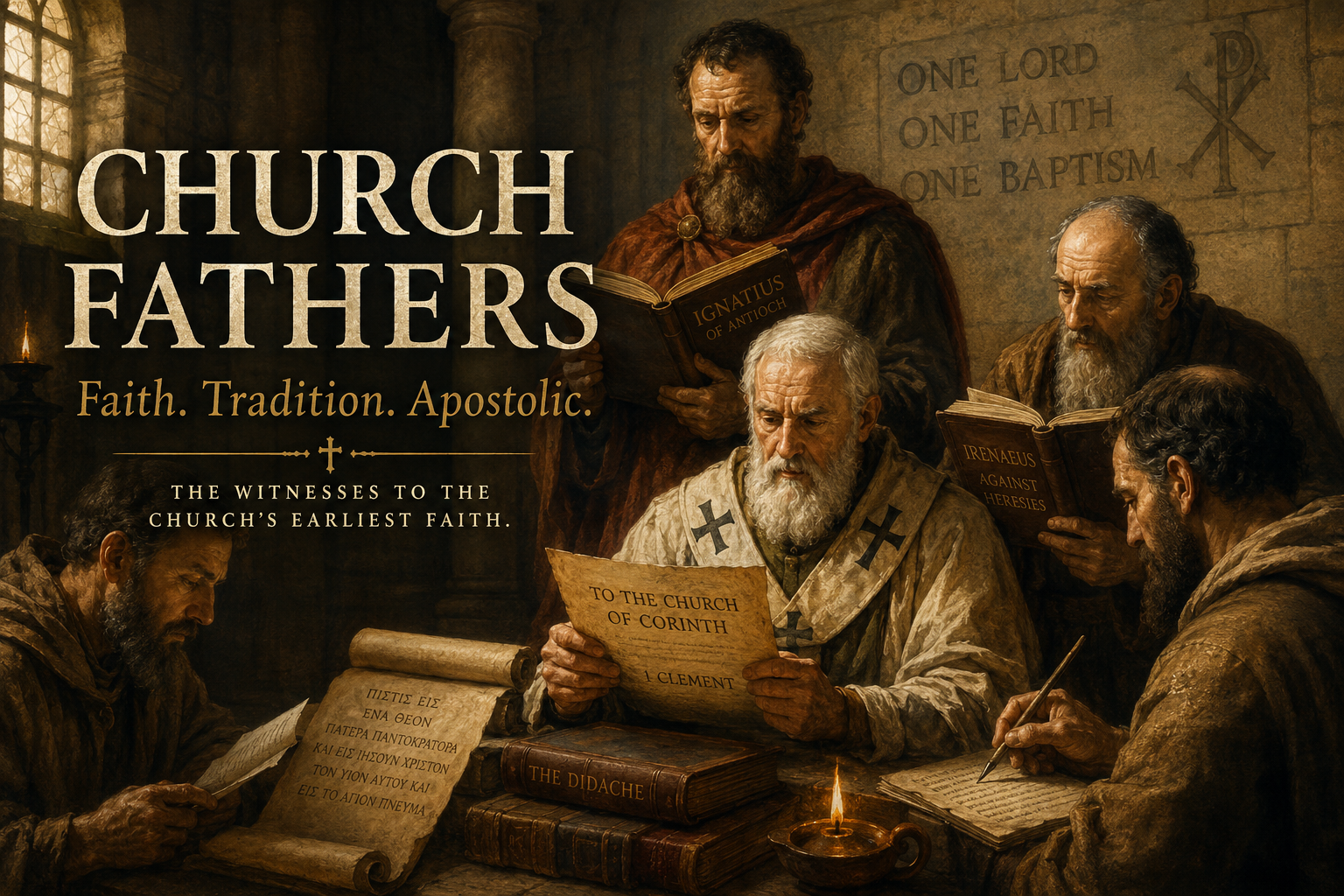
The Early Church Fathers were bishops, priests, theologians, martyrs and Christian writers from the first centuries of the Church.
Their writings are not Sacred Scripture.
They were not individually infallible.
But they are enormously important historical witnesses.
They show us how Christianity was understood and practised by those living much closer to the Apostolic age than we are today.
This matters because many modern debates concern doctrines such as:
The Eucharist
Baptism
Church authority
Apostolic succession
Sacred Tradition
The role of bishops
The structure of Christian worship
If these beliefs were later Catholic inventions, we should expect the earliest Christian writings to look very different from Catholic Christianity.
But when we examine the historical record, something striking emerges.
We find a Church that is:
Sacramental.
Hierarchical.
Eucharistic.
Apostolic.
Governed by bishops.
Conscious of having received a faith that must be handed on.
This does not prove every Catholic doctrine by itself.
But it raises a serious historical question:
How early do recognisably Catholic beliefs actually appear?
The answer is:
Very early.
From the Apostles to the Fathers
Christianity did not begin in the fourth century.
It did not begin with Constantine.
It did not begin with medieval Catholicism.
It began with Jesus Christ and the Apostles.
The Apostles preached the Gospel, established churches and appointed leaders.
St. Paul describes this process when he tells Timothy:
“What you have heard from me before many witnesses entrust to faithful men who will be able to teach others also.”
— 2 Timothy 2:2
The pattern is clear:
Paul
↓
Timothy
↓
Faithful Men
↓
Others
The faith is received.
Then it is handed on.
That living transmission is what the Catholic Church calls Apostolic Tradition.
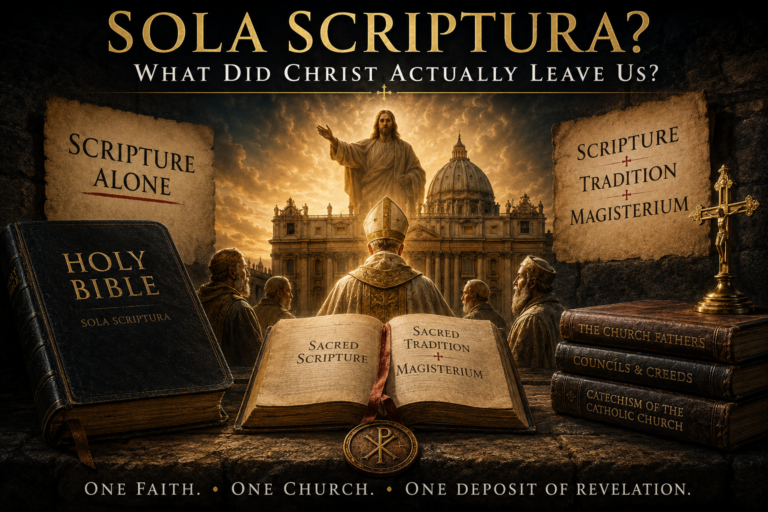
The Catechism explains that this transmission takes place in the Holy Spirit and remains closely united to Sacred Scripture.
The earliest Fathers give us historical evidence of this process continuing after the deaths of the Apostles.
Who Were the Apostolic Fathers?
The term Apostolic Fathers is generally used for some of the earliest Christian writers immediately following the New Testament period.
They include figures such as:
| Early Christian WitnessApproximate Period | |
| St. Clement of Rome | Late first century |
| St. Ignatius of Antioch | Early second century |
| St. Polycarp of Smyrna | Early-to-mid second century |
| The Didache | First/early second century |
| The Shepherd of Hermas | Second century |
These writings are valuable precisely because they are so early.
They allow us to look into the life of Christianity shortly after the Apostolic age.
And one of the clearest witnesses is St. Ignatius of Antioch.
St. Ignatius of Antioch
Ignatius was Bishop of Antioch and was taken to Rome to be martyred in the early second century.
While travelling under guard, he wrote letters to several Christian churches.
These letters are extraordinary because they show us what Christianity looked like at an extremely early date.
Ignatius speaks repeatedly about:
The bishop
Presbyters
Deacons
The Eucharist
Unity of the Church
The Flesh and Blood of Christ
In his Letter to the Smyrnaeans, Ignatius tells Christians:
“See that you all follow the bishop”
and describes the Eucharist as properly celebrated under the bishop or someone authorised by him.
This is not Christianity organised as a loose collection of independent believers.
It is a visible Church with recognised authority.
One Bishop, One Eucharist
Ignatius’ Letter to the Philadelphians is equally striking.
He tells Christians to maintain:
“one Eucharist”
because there is one Flesh of Christ, one cup, one altar, and one bishop with the presbytery and deacons.
Look at the structure:
| Ignatius — Early Second Century | What We See |
| One Eucharist | Sacramental unity |
| One altar | Liturgical worship |
| One bishop | Visible Church authority |
| Presbytery | Priestly leadership |
| Deacons | Ordered ministry |
| One Flesh of Christ | Realistic Eucharistic language |
This is remarkably early evidence.
Ignatius is not describing a medieval Church.
He is describing Christianity shortly after the Apostolic period.
The Church Is Not Invisible
Modern Christians sometimes speak of the Church primarily as an invisible spiritual fellowship.
There is certainly a spiritual dimension to the Church.
But the earliest Christian evidence also presents something very concrete.
The Church has:
Leaders.
Sacraments.
Discipline.
Worship.
Authority.
Visible unity.
Ignatius even insists that Christians should not act independently of the bishop in matters concerning the Church.
This does not mean every bishop is automatically holy or incapable of error.
It means the structure of early Christianity was clearly ecclesial and hierarchical.
And that leads to the next major witness.
St. Irenaeus of Lyons
By the late second century, Christianity was confronting serious heresies.
One of the most important defenders of the faith was St. Irenaeus of Lyons.
His great work Against Heresies was written against Gnostic groups who claimed to possess secret Apostolic teachings.
Irenaeus responds by pointing Christians toward something public and verifiable:
The Apostolic Tradition preserved in the churches.
He argues that Christians can look at the churches founded by the Apostles and examine the succession of their bishops.
This is crucial.
Irenaeus does not tell Christians:
“Find the hidden truth for yourself.”
He tells them to look to the Church’s public Apostolic succession.
Apostolic Succession
Irenaeus argues that the Apostolic teaching was not lost when the Apostles died.
It was entrusted to those who succeeded them.
In another passage, he explains that Christians should learn the truth from those who possess:
“that succession of the Church which is from the apostles”
— Against Heresies, IV.26.
This gives us the same pattern we already saw in Scripture:
Apostles
↓
Bishops
↓
Successors
↓
Church
The Catholic doctrine of Apostolic succession did not simply appear in the Middle Ages.
Its basic structure is explicitly visible in the second century.
A Church That Remembers Where It Came From
Irenaeus’ argument against the heretics is historical.
The Gnostics claimed secret revelation.
Irenaeus responds:
Show us your succession.
Show us where your teaching came from.
Show us its connection to the Apostles.
The Catholic instinct is already present:
Authentic Christianity must be Apostolic.
It must be traceable back to what Christ entrusted to the Apostles.
That is why succession matters.
It is not merely a chain of offices.
It is about preserving the Apostolic faith.
Scripture and Tradition Together
Irenaeus uses Scripture constantly.
He clearly regards it as authoritative.
But he does not separate Scripture from the Apostolic Tradition preserved in the Church.
His method is not:
Scripture against Tradition.
It is:
Scripture within the Apostolic faith of the Church.
This is strikingly similar to the Catholic understanding today.
Sacred Scripture and Apostolic Tradition do not compete with each other.
They belong to the same deposit of faith entrusted to the Church.
And the evidence becomes even more interesting when we turn to another second-century writer.
St. Justin Martyr
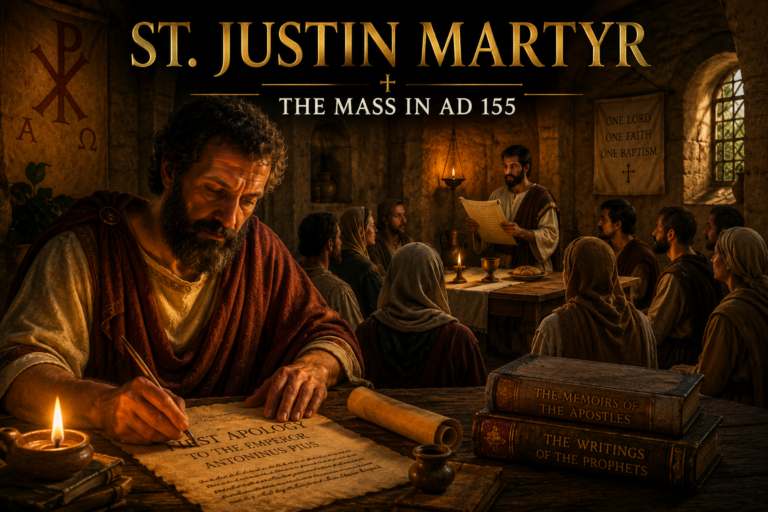
Around the middle of the second century, St. Justin Martyr wrote a defence of Christianity explaining Christian beliefs and worship to the Roman world.
His testimony is particularly valuable because he describes what Christians actually did when they gathered for worship.
Justin tells us that on Sunday Christians assembled together.
The writings of the Apostles and the prophets were read.
Prayers were offered.
Bread, wine and water were brought forward.
Thanksgiving was offered.
And the Eucharist was distributed to those present and carried by deacons to those who were absent.
This description is extraordinary.
Christian Worship — c. AD 150
| Justin’s Description | What It Resembles Today |
| Christians gather on Sunday | Sunday Mass |
| Apostles and prophets are read | Liturgy of the Word |
| The leader gives instruction | Homily |
| Christians pray together | Prayers of the faithful |
| Bread and wine are brought forward | Offertory |
| Thanksgiving is offered | Eucharistic prayer |
| The people respond | Liturgical participation |
| Eucharist is distributed | Holy Communion |
| Deacons take it to the absent | Communion to the sick/absent |
We should be careful not to pretend every detail of the modern Mass existed in identical form in the second century.
It did not.
The liturgy developed over time.
But the basic structure is unmistakably recognisable.
Christianity was already Eucharistic and liturgical.
The Sunday gathering was not simply a Bible study or sermon service.
It centred on Word, prayer and Eucharist.
And this is only the beginning.
The deeper we go into the earliest Christian writings, the harder it becomes to maintain the idea that Catholic sacramental and ecclesial Christianity appeared many centuries after the Apostles.
The Early Church and the Eucharist
One of the clearest tests of continuity between the early Church and Catholic Christianity concerns the Eucharist.
Today, Christians disagree profoundly over Christ’s words:
“This is my body.”
Some understand the Eucharist primarily as a symbol or memorial.
The Catholic Church teaches that Christ is truly present — Body, Blood, Soul and Divinity — under the appearances of bread and wine.
So an important historical question arises:
How did the Christians closest to the Apostles understand the Eucharist?
The evidence appears remarkably early.
St. Ignatius: “The Flesh of Our Saviour Jesus Christ”
Around the beginning of the second century, St. Ignatius of Antioch was being transported to Rome for martyrdom.
In his Letter to the Smyrnaeans, Ignatius warns Christians about those who held false beliefs concerning Christ.
He writes that they:
“abstain from the Eucharist and from prayer”
because they do not confess the Eucharist to be:
“the flesh of our Saviour Jesus Christ”
— St. Ignatius of Antioch, Letter to the Smyrnaeans, 7
Consider how early this testimony is.
We are not reading a medieval theologian.
We are reading a Christian bishop at the beginning of the second century, within living memory of the Apostolic age.
And Ignatius does not describe the Eucharist merely as a symbol representing Christ’s flesh.
His argument depends upon the opposite.
The people he condemns refuse the Eucharist precisely because they do not believe it is Christ’s flesh.
What Ignatius Tells Us
| Ignatius Says | What It Shows |
|---|---|
| Christians celebrate the Eucharist | Eucharistic worship is already established |
| Heretics avoid the Eucharist | Eucharistic belief is connected with orthodox Christian faith |
| The Eucharist is “the flesh of our Saviour Jesus Christ” | Strong belief in Christ’s real presence |
| Eucharistic worship belongs with the bishop | Sacrament and Church authority are connected |
This testimony is particularly significant because Ignatius is not trying to explain a newly developed doctrine of the Eucharist.
He speaks as though his readers already understand what he means.
“One Eucharist”
Ignatius makes the same connection elsewhere.
Writing to the Philadelphians, he urges Christians to remain united:
“Take heed, then, to have but one Eucharist.”
He continues by speaking of:
One Flesh of Jesus Christ.
One cup.
One altar.
One bishop.
The Eucharist and the visible unity of the Church belong together.
For Ignatius, Christianity is not merely a collection of individuals united by similar beliefs.
Christians gather around one Eucharist, one altar and one legitimate Church authority.
Already, at the beginning of the second century, we find a Christianity that looks unmistakably sacramental.
St. Justin Martyr: “Not as Common Bread”
Several decades later, St. Justin Martyr provides even more explicit evidence.
Writing around AD 150, Justin explains Christian worship and belief to the Roman authorities.
After describing the prayers and thanksgiving offered over bread and wine, Justin explains what Christians believe about the Eucharist.
He says:
“We do not receive these as common bread and common drink.”
— St. Justin Martyr, First Apology, 66
Why not?
Justin explains that just as Jesus Christ truly became flesh, Christians had been taught that the Eucharistic food is the flesh and blood of that Jesus who was made flesh.
This is extraordinary testimony.
Justin is not writing centuries after Constantine.
He is writing approximately 120 years after the Crucifixion.
And he presents this teaching not as his personal theological theory but as something:
Christians “have been taught.”
Justin’s Description of the Eucharist
| What Justin Describes — c. AD 150 | Catholic Parallel |
| Bread and wine are brought forward | Presentation of the gifts |
| Thanksgiving is offered | Eucharistic Prayer |
| The people respond “Amen” | The congregation’s liturgical response |
| Deacons distribute the Eucharist | Holy Communion |
| Eucharist is taken to the absent | Communion brought to those unable to attend |
| It is not “common bread” | Consecrated Eucharist is no longer ordinary bread |
| It is identified with Christ’s flesh and blood | Real Presence |
Again, we should not pretend that every detail of the twenty-first-century Roman Mass existed unchanged in AD 150.
Liturgical forms developed.
But the essential elements are already clearly visible.
St. Irenaeus: Bread Becomes Eucharist
Toward the end of the second century, St. Irenaeus also speaks explicitly about the Eucharist.
His argument is especially interesting because he uses the Eucharist to defend the Christian belief in the resurrection of the body.
Against those who denied the goodness and future resurrection of the flesh, Irenaeus points to the Eucharist.
He explains that bread from the earth, after receiving the invocation of God:
“is no longer common bread, but the Eucharist”
— St. Irenaeus, Against Heresies, IV.18.5
He then connects our reception of Christ’s Body and Blood with the hope of bodily resurrection.
His reasoning only makes sense because the Eucharist is more than ordinary food or a merely mental symbol.
The physical body matters.
The Incarnation matters.
The Eucharist matters.
And the resurrection of our bodies matters.
From St. Paul to the Fathers
None of this appears out of nowhere.
The Fathers are continuing a pattern already present in the New Testament.
St. Paul writes:
“The cup of blessing which we bless, is it not a participation in the blood of Christ?”
“The bread which we break, is it not a participation in the body of Christ?”
— 1 Corinthians 10:16
And concerning receiving the Eucharist unworthily:
“Whoever, therefore, eats the bread or drinks the cup of the Lord in an unworthy manner will be guilty of profaning the body and blood of the Lord.”
— 1 Corinthians 11:27
Paul then gives an extraordinary warning:
“That is why many of you are weak and ill, and some have died.”
— 1 Corinthians 11:30
This is extremely strong language if the Eucharist were merely symbolic bread and wine.
Paul treats the Eucharist as something sacred enough that receiving it unworthily can make a Christian guilty concerning the Body and Blood of Christ.
Then, only decades later, Ignatius calls the Eucharist:
“The flesh of our Saviour Jesus Christ.”
Justin says:
“Not as common bread.”
Irenaeus says:
“No longer common bread, but the Eucharist.”
There is a remarkable continuity.
The Timeline
| Witness | Approximate Date | Testimony |
| St. Paul | c. AD 55 | Bread and cup are participation in Christ’s Body and Blood |
| St. Ignatius | Early second century | Eucharist is “the flesh of our Saviour Jesus Christ” |
| St. Justin Martyr | c. AD 150 | Eucharist is not received as “common bread and common drink” |
| St. Irenaeus | c. AD 180 | Consecrated bread is “no longer common bread, but the Eucharist” |
This creates a serious historical problem for the claim that belief in the Real Presence was a medieval Catholic invention.
If it were an invention, where is the earlier Christianity that believed the Eucharist was merely symbolic?
Instead, as soon as we leave the pages of the New Testament and enter the surviving writings of the earliest Christians, we encounter strikingly realistic Eucharistic language.
Not a Medieval Invention
The Catholic Church did develop increasingly precise theological language to explain the mystery of the Eucharist.
Terms such as transubstantiation came later.
But the later development of terminology does not mean the underlying belief was invented later.
Christians believed in Christ’s true presence in the Eucharist long before they possessed the philosophical vocabulary later used to explain how that presence occurs.
The distinction is important:
The terminology developed.
The underlying belief is ancient.
The Fathers do not give us every later theological definition.
But they provide compelling historical evidence that the earliest Christians did not regard the Eucharist as ordinary bread serving only as a symbolic reminder.
They believed they were encountering Jesus Christ Himself.
And if that belief can be found so close to the Apostles, another question naturally follows:
What else did these early Christians believe?
The answer takes us to another sacrament at the heart of Christian life:
Baptism and the New Birth
The Eucharist is not the only place where the beliefs of the early Christians sound strikingly Catholic.
The same pattern appears with Baptism.
Today, many Christians understand Baptism primarily as an outward symbol — a public declaration of faith representing a salvation that has already taken place.
The Catholic Church teaches something stronger.
Baptism is certainly a sign, but it is not merely a sign.
It is a sacrament through which God actually acts: sins are forgiven, the believer is reborn in Christ and incorporated into His Church.
So once again we can ask:
Is this a later Catholic invention — or does it reach back to the earliest Christianity?
We begin not with the Fathers, but with Scripture.
“Born of Water and the Spirit”
Jesus tells Nicodemus:
“Unless one is born of water and the Spirit, he cannot enter the kingdom of God.”
— John 3:5
The language is striking.
Jesus does not describe the new birth merely as an intellectual acceptance of certain beliefs.
He speaks of:
Water + Spirit + New Birth
This connection continues throughout the New Testament.
At Pentecost, after Peter proclaims Christ, the crowd asks:
“Brethren, what shall we do?”
Peter answers:
“Repent, and be baptized every one of you in the name of Jesus Christ for the forgiveness of your sins; and you shall receive the gift of the Holy Spirit.”
— Acts 2:37–38
Notice the elements:
Repentance.
Baptism.
Forgiveness of sins.
The Holy Spirit.
They are closely connected.
“Wash Away Your Sins”
When Ananias speaks to Saul — the future St. Paul — he tells him:
“Rise and be baptized, and wash away your sins, calling on his name.”
— Acts 22:16
Again, Scripture uses language stronger than Baptism being merely a public symbol of something that has already happened.
Baptism is connected with the washing away of sin.
St. Paul later describes Christian Baptism in terms of death and resurrection:
“We were buried therefore with him by baptism into death.”
— Romans 6:4
Through Baptism, the Christian is sacramentally united to Christ’s death and resurrection.
“The Washing of Regeneration”
St. Paul writes to Titus:
“He saved us… by the washing of regeneration and renewal in the Holy Spirit.”
— Titus 3:5
The Greek word translated regeneration is:
παλιγγενεσία — palingenesia
It refers to rebirth or regeneration.
Again we encounter the same biblical pattern:
Washing + Regeneration + Holy Spirit
Compare the passages:
| Scripture | What Baptism Is Connected With |
|---|---|
| John 3:5 | Birth of water and Spirit |
| Acts 2:38 | Forgiveness of sins and reception of the Holy Spirit |
| Acts 22:16 | Washing away sins |
| Romans 6:3–4 | Union with Christ’s death and resurrection |
| Titus 3:5 | Washing of regeneration |
| 1 Peter 3:21 | “Baptism… now saves you” |
That final passage is particularly direct.
St. Peter writes:
“Baptism… now saves you.”
— 1 Peter 3:21
Peter immediately makes clear that he is not talking about simply washing dirt from the body.
The power does not come from ordinary water.
It comes from God, through the saving work of Jesus Christ.
What Did the Earliest Christians Think?
If Catholics misunderstood these passages centuries later, we might expect the Christians closest to the Apostles to interpret Baptism primarily as an outward symbol.
But that is not what we find.
One of our earliest witnesses is the Didache.
The Didache — An Extremely Early Christian Witness
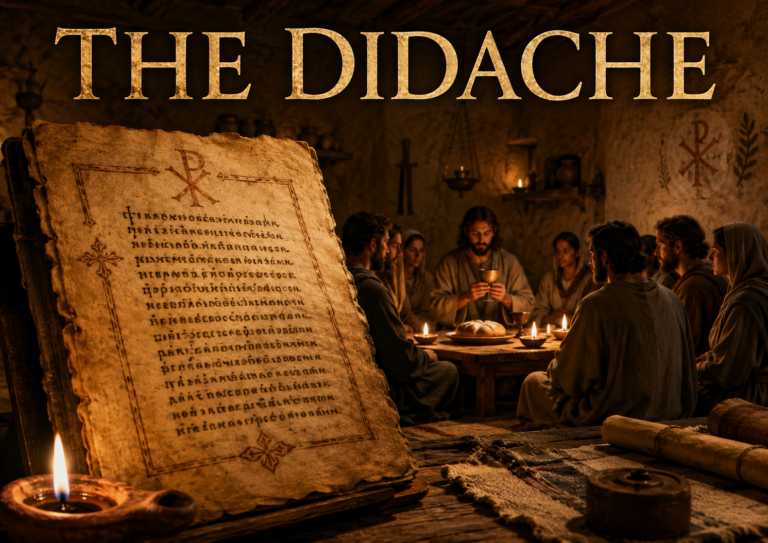
The Didache, or Teaching of the Twelve Apostles, is one of the earliest Christian writings outside the New Testament.
Its precise date is debated, but it is commonly placed around the late first or early second century.
That makes it extraordinarily valuable.
The Didache gives practical instructions for Baptism:
“Baptize into the name of the Father, and of the Son, and of the Holy Spirit”
— Didache, 7
This immediately echoes Christ’s command in Matthew 28:19.
The Didache prefers baptism in living — that is, running — water, but allows other water when necessary.
If sufficient water is unavailable for immersion, it instructs Christians to pour water three times upon the head:
In the name of the Father,
and of the Son,
and of the Holy Spirit.
This is important historically.
Already at this extremely early stage, we see an established Christian baptismal practice explicitly connected to the Trinitarian command of Christ.
St. Justin Martyr — Baptism and Regeneration
Around AD 150, St. Justin Martyr describes Christian Baptism.
He explains that converts are brought to water and:
“are regenerated in the same manner in which we were ourselves regenerated.”
— First Apology, 61
Justin then explicitly connects this with Jesus’ teaching that a person must be born again.
He also connects Baptism with the:
“washing with water”
and the remission of sins.
Again, this is not medieval Catholicism.
This is Christianity in the middle of the second century.
Justin’s Understanding of Baptism
| Justin — c. AD 150 | Biblical Connection |
| Water | John 3:5 |
| Regeneration | Titus 3:5 |
| New birth | John 3:3–5 |
| Forgiveness of sins | Acts 2:38 |
| Trinitarian Baptism | Matthew 28:19 |
Justin’s description sounds remarkably similar to the sacramental understanding of Baptism preserved by the Catholic Church.
Baptism Is God’s Work
This point is essential.
Catholic teaching does not mean that water possesses magical power.
The sacrament has power because Christ acts through it.
God is the one who saves.
God gives grace.
God forgives sin.
God gives new life.
Baptism is the means Christ established through which that grace is sacramentally given.
That is why St. Peter can say:
“Baptism… now saves you”
without suggesting that ordinary water somehow saves apart from Christ.
The saving power belongs to God.
What About Faith?
Another misunderstanding should be avoided.
Catholicism does not teach:
“Baptism instead of faith.”
For an adult convert, faith, repentance and Baptism belong together.
That is exactly what we see at Pentecost.
Peter preaches Christ.
The people believe his message and are cut to the heart.
They ask what they must do.
Peter answers:
“Repent and be baptized.”
The biblical model is not:
Faith OR Baptism.
It is the response of faith leading to the sacramental new birth Christ established.
What About Infant Baptism?
This raises another major question.
If Baptism gives new birth and incorporates a person into Christ, should it be withheld from children?
The New Testament records several examples of entire households being baptised.
Lydia:
“she was baptized, with her household”
— Acts 16:15
The Philippian jailer:
“he was baptized at once, with all his family.”
— Acts 16:33
St. Paul also tells us:
“I did baptize also the household of Stephanas.”
— 1 Corinthians 1:16
These passages do not explicitly tell us the ages of everyone involved.
Therefore we should not pretend they prove infant Baptism by themselves.
But they show that Baptism was understood corporately as families entered the Christian covenant.
And when we move into the early centuries, explicit evidence for the Baptism of children begins to appear.
Origen and Infant Baptism
In the third century, Origen makes a remarkable statement.
He says that:
“the Church received from the apostles the tradition of baptizing infants also.”
— Origen, Commentary on Romans, 5.9
Notice his claim.
Origen does not describe infant Baptism as a recent innovation.
He says the Church received the practice from the Apostles.
Whether one accepts Origen’s claim or not, it is extremely important historical evidence.
By the early third century, Christians were not treating infant Baptism as a new invention.
They regarded it as something inherited.
St. Cyprian of Carthage
Around AD 253, a council of bishops under St. Cyprian of Carthage considered an interesting question.
The debate was not:
“Should infants be baptized?”
The question was whether Baptism should be delayed until the eighth day after birth, following the Old Covenant pattern of circumcision.
The bishops rejected the delay.
They concluded that God’s grace should not be withheld from a newborn child.
That tells us something important.
By the middle of the third century, infant Baptism was already sufficiently established that bishops were debating how soon an infant should receive it — not whether infants could receive it at all.
The Pattern Is Becoming Clear
Once again, compare Scripture with the early Christian witnesses:
| New Testament | Early Church |
| Born of water and Spirit | Justin speaks of baptismal regeneration |
| Baptism for forgiveness of sins | Fathers connect Baptism with remission of sins |
| “Baptism… now saves you” | Baptism understood as an instrument of saving grace |
| Entire households baptised | Infant Baptism becomes explicitly attested |
| Trinitarian baptism commanded | Didache gives Trinitarian baptismal instructions |
| Washing of regeneration | Justin explicitly calls Baptism regeneration |
The early Church does not speak about Baptism as merely an optional public symbol.
It speaks about:
New birth.
Forgiveness.
Regeneration.
Grace.
Entry into Christian life.
Once again, the Catholic sacramental understanding does not suddenly appear in medieval Europe.
Its roots extend directly into Scripture and the earliest centuries of Christianity.
And Baptism raises an even larger question.
If the early Church believed Christ actually worked through visible sacraments…
What kind of Church did those sacraments belong to?
Was Christianity a collection of independent congregations?
Or did the earliest Christians believe in one visible, universal Church united through bishops in succession from the Apostles?
That takes us to one of the strongest historical cases of all:
The Early Church, Bishops and Apostolic Succession
We have already seen that the earliest Christians believed in a sacramental Church.
They celebrated the Eucharist.
They baptised for regeneration and the forgiveness of sins.
But who possessed authority within this Church?
Did every Christian congregation exist independently?
Did authority rest solely with individual believers reading Scripture?
Or did Christ establish a visible ministry that continued after the deaths of the Apostles?
Once again, the evidence begins in the New Testament itself.
The Apostles Appointed Leaders
The Apostles did not simply preach the Gospel and then leave Christian communities without leadership.
The Book of Acts tells us:
“And when they had appointed elders for them in every church, with prayer and fasting they committed them to the Lord.”
— Acts 14:23
St. Paul later tells Titus:
“This is why I left you in Crete, that you might amend what was defective, and appoint elders in every town as I directed you.”
— Titus 1:5
Timothy likewise receives instructions concerning bishops and deacons.
Already within Scripture we see an organised Church possessing recognised offices.
But Paul gives us something even more important.
He commands Timothy:
“What you have heard from me before many witnesses entrust to faithful men who will be able to teach others also.”
— 2 Timothy 2:2
Again, notice the chain:
Paul
↓
Timothy
↓
Faithful Men
↓
Others
The Apostolic ministry is already being transmitted beyond the original Apostles.
St. Clement of Rome — First Century
One of the earliest and most important witnesses comes from St. Clement of Rome.
His Letter to the Corinthians, usually called 1 Clement, was written near the end of the first century — commonly dated around AD 96.
This is extraordinarily early.
The Church at Corinth had experienced a serious internal dispute.
Some presbyters had been removed from their ministry.
Clement writes from the Church of Rome urging the Corinthians to restore proper order.
While explaining the origins of Christian ministry, Clement tells us something remarkable.
He says that Christ was sent by God and the Apostles were sent by Christ.
The Apostles then:
“appointed the first-fruits… to be bishops and deacons”
— 1 Clement, 42
Clement then goes further.
The Apostles knew that disputes would arise concerning Church leadership.
Therefore, he explains, they made provision so that after those appointed ministers died:
“other approved men should succeed them in their ministry.”
— 1 Clement, 44
This is before the second century had properly begun.
A Chain of Authority
Clement presents a clear pattern:
God the Father
↓
Jesus Christ
↓
Apostles
↓
Bishops and Deacons
↓
Successors
This is not medieval Catholic theology being projected backwards.
It appears in one of the earliest Christian writings outside the New Testament.
And Clement presents succession as something deliberately provided for by the Apostles.
Clement — c. AD 96
| What Clement Says | Why It Matters |
|---|---|
| Christ was sent by God | Authority originates with God |
| Apostles were sent by Christ | Christ commissions the Apostles |
| Apostles appointed ministers | Church office is not self-appointed |
| Provision was made for the future | Ministry was intended to continue |
| Other approved men succeed them | Succession continues beyond the first generation |
The concept underlying Apostolic succession is therefore visible while Christians who had lived during the Apostolic era were still within recent memory.
St. Ignatius — The Bishop at the Centre of Church Unity
Only a short time later, St. Ignatius of Antioch gives us an even clearer picture.
Ignatius repeatedly speaks of three recognised ministries:
Bishop
Presbyters
Deacons
Writing to the Trallians, he tells Christians to respect these offices and insists that Christian life cannot be separated from the Church’s visible order.
In his Letter to the Smyrnaeans, he writes:
“Wherever the bishop shall appear, there let the multitude also be.”
Then comes one of the most famous sentences in early Christianity:
“Wherever Jesus Christ is, there is the Catholic Church.”
— St. Ignatius, Letter to the Smyrnaeans, 8
This is around the beginning of the second century.
The phrase Catholic Church is therefore not a medieval invention.
The Greek word katholikos conveys the idea of the universal or whole Church.
By the time of Ignatius, Christians could already speak of the worldwide Church as the Catholic Church.
Bishop, Presbyters and Deacons
Ignatius’ letters repeatedly describe a recognisable hierarchy.
| Early Church Office | Role Visible in Ignatius |
| Bishop | Oversees the local Church and its unity |
| Presbyters | Council of elders surrounding the bishop |
| Deacons | Ministers serving the Church |
| Faithful | Remain united with their legitimate shepherds |
This does not mean every detail of later Church administration was already fully developed.
Church structures developed organically.
But the essential fact is unmistakable:
Christianity possessed visible, ordained leadership extremely early.
The Church was not merely an invisible spiritual association.
St. Irenaeus — Follow the Succession
By around AD 180, St. Irenaeus makes the argument even more explicit.
The Gnostics claimed to possess secret teachings supposedly handed down from Jesus or the Apostles.
Irenaeus answers them by pointing to the churches whose bishops could trace their teaching publicly back to the Apostles.
He writes that the Apostolic Tradition is:
“manifested throughout the whole world”
and can be known through those whom the Apostles appointed bishops and through:
“the succession of these men to our own times.”
— Against Heresies, III.3.1
The contrast is powerful.
The Gnostics claim:
Secret teaching.
Irenaeus answers:
Public Apostolic Tradition.
The Gnostics claim:
Hidden succession.
Irenaeus answers:
Known churches with identifiable bishops.
The question becomes:
Where did your teaching come from?
Why Irenaeus Points to Rome
Irenaeus then gives a particularly important example.
Rather than listing the succession of every Apostolic church, he chooses the Church of Rome, which he describes as founded and organised by the Apostles Peter and Paul.
He then provides a succession of Roman bishops.
He names:
Peter and Paul
↓
Linus
↓
Anacletus
↓
Clement
↓
Evaristus
↓
Alexander
↓
Sixtus
↓
Telesphorus
↓
Hyginus
↓
Pius
↓
Anicetus
↓
Soter
↓
Eleutherius
Irenaeus was writing during the episcopate of Eleutherius.
His point is not merely to produce an interesting historical list.
He is making an argument about doctrinal continuity.
The faith taught in his own day can be traced through an identifiable succession back toward the Apostolic Church.
Rome and the Apostolic Faith
Irenaeus’ treatment of Rome is especially significant because Rome was not his own local church.
He was Bishop of Lyons in Gaul.
Yet when demonstrating Apostolic continuity against the heretics, Rome becomes his principal example.
We should be careful here.
The exact implications of Irenaeus’ language concerning the Roman Church are debated between Catholics, Orthodox and Protestants.
We do not need to claim that Irenaeus wrote a complete fourth- or twenty-first-century theology of the papacy.
He did not.
The historical point is already powerful enough:
By the second century, the Church of Rome possessed exceptional importance as a public witness to the Apostolic faith associated with Peter and Paul.
And the succession of its bishops mattered to Irenaeus’ argument.
Apostolic Succession Is More Than a List of Bishops
There is an important distinction.
Apostolic succession is not simply:
“This bishop was ordained by that bishop.”
Physical succession alone is not enough.
For Irenaeus, succession and Apostolic teaching belong together.
A bishop who abandons the Apostolic faith cannot justify false teaching simply by pointing to his office.
The purpose of succession is the faithful transmission of what the Apostles received from Christ.
That is why the Catholic understanding involves both:
Succession of ministry
and
Continuity of Apostolic faith.
Christ Did Not Abandon His Church
This structure makes sense when we return to the promises of Jesus.
Christ said:
“I will build my church, and the powers of death shall not prevail against it.”
— Matthew 16:18
He commanded the Apostles:
“Go therefore and make disciples of all nations… teaching them to observe all that I have commanded you.”
— Matthew 28:19–20
And then promised:
“I am with you always, to the close of the age.”
The original Apostles would die.
Yet Christ’s teaching mission was to continue until the end of the age.
That requires continuity.
The Gospel continues.
The sacraments continue.
The Church continues.
And the Apostolic ministry continues.
From Scripture Into History
Look at how naturally the evidence flows:
| Witness | What We Find |
| Acts 14:23 | Elders appointed in the churches |
| Titus 1:5 | Titus instructed to appoint elders |
| 2 Timothy 2:2 | Apostolic teaching entrusted to successive teachers |
| c. AD 96 — Clement | Apostles make provision for successors in ministry |
| Early second century — Ignatius | Bishop, presbyters and deacons clearly visible |
| c. AD 180 — Irenaeus | Apostolic Tradition demonstrated through episcopal succession |
There is no enormous historical gap.
The New Testament gives way to the earliest Christian writings, and the same basic structure continues.
Was the Catholic Church Invented by Constantine?
This evidence also exposes one of the most persistent myths about Christian history:
“Constantine created the Catholic Church in the fourth century.”
Constantine was born more than a century after Irenaeus wrote Against Heresies.
Yet before Constantine we already find:
The term “Catholic Church.”
Bishops.
Presbyters.
Deacons.
Apostolic succession.
Sacramental Baptism.
Belief in the Eucharist as Christ’s Flesh and Blood.
Sunday liturgical worship.
Appeals to Apostolic Tradition.
Whatever influence Constantine later had upon the political circumstances of Christianity, he plainly did not invent these beliefs or structures.
They existed generations before him.
A Difficult Historical Question
This leaves the Christian who rejects Catholicism with an important historical question.
If the Church emerging directly from the Apostolic period was already:
Eucharistic,
sacramental,
episcopal,
liturgical,
conscious of Apostolic Tradition,
and organised through succession…
then when exactly did Christianity supposedly cease to be the Church Christ founded?
Was it AD 100?
AD 150?
AD 200?
And where, during that period, can we find the alternative Church that possessed the original faith but rejected these supposedly later Catholic ideas?
The closer we move toward the Apostles, the more difficult that theory becomes.
Instead, we see remarkable continuity:
Christ → Apostles → Bishops → Successors → Church.
And this brings us to another subject where the historical evidence becomes especially revealing.
Because the early Christians did not only believe that Christ established a visible Church.
They also believed that this Church possessed authority to teach, settle disputes and preserve the Apostolic faith.
That leads directly to:
The Early Church and Authority
The early Christian evidence presents a Church with bishops, sacraments and Apostolic succession.
But another question follows:
Did this visible Church possess authority to correct error and preserve unity?
And within that Church, did the Church of Rome possess any particular significance?
The historical evidence is fascinating — but it must be handled carefully.
The earliest Christians did not leave us a complete first-century theological treatise explaining the papacy as it would later be defined.
What they did leave us are events and writings that show how authority actually functioned.
One of the earliest examples comes from the Church of Rome itself.
Clement of Rome and the Church at Corinth
Near the end of the first century, the Church at Corinth experienced a serious internal crisis.
Certain presbyters had been removed from their ministry.
What happened next is significant.
The Church of Rome sent a lengthy letter to the Christians at Corinth calling for repentance, reconciliation and the restoration of proper Church order.
The letter is traditionally associated with St. Clement of Rome and is generally dated to the late first century.
What makes this noteworthy is geography.
Rome was intervening in a dispute at Corinth.
Corinth was not a suburb of Rome.
It was a Christian community across the sea in Greece.
Yet the Roman Church addresses the situation directly and expects its instruction to be taken seriously.
The Tone of Clement’s Letter
The letter is not written merely as friendly advice.
Toward its conclusion, the Roman Church warns:
“If, however, any shall disobey the words spoken by Him through us…”
— 1 Clement, 59
And later urges the Corinthians to:
“render obedience unto what we have written”
— 1 Clement, 63
The language is striking.
The Church of Rome clearly believes it has grounds for intervening in this serious dispute.
At the same time, we should not make the evidence say more than it does.
What can we safely conclude?
| The Evidence Shows | The Evidence Does Not By Itself Prove |
|---|---|
| Rome intervened in a serious dispute at Corinth | Every later definition concerning papal authority |
| The letter speaks with considerable authority | That first-century Christians possessed a fully developed theology of papal primacy |
| Corinth is expected to respond obediently | That every detail of later papal jurisdiction was already explicitly formulated |
| Rome was concerned with order beyond its own local community | That no development in the understanding of the papal office occurred |
That distinction matters.
Catholic doctrine can develop in its expression and theological precision without being invented from nothing centuries later.
The historical question is whether the underlying reality is present.
And already in the first century, Rome is acting beyond Rome.
Was St. John Still Alive?
A popular Catholic apologetic argument sometimes goes further.
It is often pointed out that St. John the Apostle may still have been alive when Clement’s letter was written.
The argument then asks:
If an Apostle was still alive, why did Corinth turn to Rome?
This is interesting — but we need to be careful.
We do not know enough about the circumstances to claim with certainty that Corinth formally appealed to Rome instead of approaching John.
Nor can we prove precisely where John was or what role he could have played at that moment.
Therefore we should not build the argument on speculation.
We do not need to.
The established historical fact is already significant:
Near the end of the first century, the Roman Church intervened authoritatively in a major dispute in another Christian community.
That fact stands on its own.
Ignatius and the Church of Rome
A short time later, St. Ignatius of Antioch wrote letters to several churches while travelling toward martyrdom in Rome.
His letter to the Romans is noticeably different from several of his other letters.
When writing to other churches, Ignatius frequently instructs Christians concerning obedience to their bishops.
But when addressing Rome, his language is particularly respectful.
He describes the Roman Church with unusual expressions of honour and famously speaks of it as:
“presiding in love”
— St. Ignatius of Antioch, Letter to the Romans
The exact meaning and implications of this expression have been debated.
Catholics have seen it as evidence of a special Roman primacy.
Other Christians interpret it more cautiously as an expression of honour.
Again, we should not pretend that one phrase settles the entire later debate over the papacy.
But it does contribute to a developing historical picture:
Rome already possesses unusual prominence very early in Christian history.
Irenaeus and Rome
By approximately AD 180, the evidence becomes even more explicit.
As we have already seen, St. Irenaeus combats the Gnostics by appealing to the public Apostolic Tradition preserved through the succession of bishops.
He could, he says, list the succession of many churches founded by the Apostles.
Instead, he chooses Rome as his principal example.
He describes it as:
“the very great, the very ancient, and universally known Church”
founded and organised at Rome by:
Peter and Paul.
— St. Irenaeus, Against Heresies, III.3.2
He then makes a famous statement concerning the relationship between other churches and Rome.
The underlying Latin translation traditionally speaks of other churches agreeing with Rome because of its “preeminent authority” — potentior principalitas.
The precise translation and interpretation of this passage have been debated extensively.
That debate should be acknowledged.
But something remains clear regardless of how the disputed phrase is rendered:
Irenaeus chooses Rome as his outstanding example of Apostolic continuity.
And remember who Irenaeus was.
He was not Bishop of Rome.
He was Bishop of Lyons in Gaul.
Yet when demonstrating the public Apostolic faith against heresy, he points his readers toward the succession of the Roman Church.
Why Rome?
Why did Rome acquire this importance?
For early Christians, Rome was associated particularly with two towering Apostles:
St. Peter
and
St. Paul.
Both were traditionally understood to have suffered martyrdom there.
The Roman Church therefore possessed a uniquely powerful Apostolic pedigree.
But for Catholics, Peter’s role raises a deeper biblical question.
Christ says to Peter:
“You are Peter, and on this rock I will build my church.”
— Matthew 16:18
Then:
“I will give you the keys of the kingdom of heaven.”
— Matthew 16:19
Peter alone receives the keys in this passage.
Christ also tells Peter:
“I have prayed for you that your faith may not fail; and when you have turned again, strengthen your brethren.”
— Luke 22:32
And after the Resurrection, Christ tells Peter three times:
“Feed my lambs.”
“Tend my sheep.”
“Feed my sheep.”
— John 21:15–17
The Catholic understanding of Peter’s ministry does not begin with later popes.
It begins with these biblical texts.
Peter Among the Apostles
The Book of Acts then shows Peter repeatedly exercising a prominent role.
Peter leads the selection of a replacement for Judas.
Peter preaches the first great sermon at Pentecost.
Peter speaks concerning Ananias and Sapphira.
Peter receives the revelation opening the Church explicitly to the Gentiles through Cornelius.
And at the Council of Jerusalem, Peter gives decisive testimony concerning the Gentile question.
None of this means the other Apostles possessed no authority.
They clearly did.
Nor does Catholic teaching claim that Peter replaced Christ.
Christ remains the Head of His Church.
Peter’s authority is entirely received from Christ.
The question is whether Christ established a particular pastoral office within the Apostolic college.
Catholicism answers:
Yes.
From Peter to Rome
Here we must make another important distinction.
The New Testament establishes Peter’s distinctive role.
The early historical evidence associates Peter’s final ministry and martyrdom with Rome.
The early Church then increasingly witnesses to a special significance attached to the Roman See.
These pieces belong together in the Catholic argument.
But we should not pretend that every step was expressed with the same terminology from the beginning.
The doctrine becomes increasingly explicit over time.
That is development, not necessarily invention.
An acorn does not look identical to a mature oak tree.
Yet there must be genuine continuity between the two.
The relevant historical question is therefore:
Can the later Catholic understanding of Roman primacy be traced organically back toward earlier Christian evidence?
Clement, Ignatius and Irenaeus make it extremely difficult to argue that Rome suddenly became important only after Constantine.
Rome’s prominence is visible long before Constantine was born.
Authority Does Not Mean Personal Perfection
Another misconception should be avoided.
Catholic teaching concerning Church authority does not mean that every pope or bishop is:
Sinless.
Personally holy.
Always prudent.
Infallible in every statement.
Peter himself provides the biblical example.
He confesses Christ correctly in Matthew 16.
Yet shortly afterward Christ rebukes him severely.
Peter later denies Jesus three times.
And Paul rebukes Peter’s conduct at Antioch in Galatians 2.
None of this removes the authority Christ entrusted to Peter.
It demonstrates something profoundly Catholic:
God can exercise His authority through weak and sinful human beings.
The authority belongs ultimately to Christ, not to the personal virtue of the officeholder.
Authority Exists to Protect the Faith
The purpose of Church authority is not to create new revelation.
Christ has already given the Apostolic deposit.
The purpose of authority is to:
Preserve it.
Teach it.
Defend it.
Resolve disputes concerning it.
That is exactly what we saw in Acts 15.
A major doctrinal controversy arises.
The Apostles and elders gather.
There is debate.
Scripture is considered.
Peter speaks.
James gives judgment.
And the Church sends its decision to other Christian communities with the remarkable words:
“It has seemed good to the Holy Spirit and to us…”
— Acts 15:28
The Church understands herself as possessing genuine authority under the guidance of the Holy Spirit.
The Historical Pattern
Put the evidence together:
| Period | Evidence |
|---|---|
| New Testament | Peter receives the keys and a distinctive pastoral commission |
| Acts | Peter repeatedly exercises a leading Apostolic role |
| Late first century | The Roman Church intervenes in the Corinthian crisis |
| Early second century | Ignatius addresses Rome with distinctive honour |
| c. AD 180 | Irenaeus points to Rome as a major witness of Apostolic Tradition |
| Following centuries | Rome’s role becomes increasingly explicit in controversies and councils |
This does not mean every question about papal authority was settled in AD 100.
It was not.
Christians would continue to debate the precise extent and exercise of Roman authority — and those debates remain important between Catholics and Orthodox Christians today.
But the evidence rules out a much simpler claim:
“The papacy and Roman authority simply appeared centuries later.”
The historical record is far more complicated — and far earlier — than that.
A Church With Memory
Once again we see the same pattern.
Early Christianity knows where it came from.
It remembers the Apostles.
It preserves their writings.
It guards their teaching.
It traces the succession of its bishops.
And when heresy appears, Christians ask:
What did the Apostles teach?
What have the churches preserved?
Where is the Apostolic succession?
The Christian faith is not reinvented by every generation.
It is something received.
Something guarded.
Something handed on.
And that brings us to one of the most remarkable pieces of evidence of all.
Long before Christianity became legal in the Roman Empire, Christians had already described their worship, their sacraments, their bishops and their Apostolic faith.
So we can now put the question directly:
Was Catholic Christianity Created by Constantine?
The historical evidence allows us to test that claim against what Christians actually believed before Constantine was even born.
Was Catholic Christianity Created by Constantine?
One of the most common claims made against the Catholic Church is that:
“Constantine created Catholicism in the fourth century.”
The idea usually goes something like this:
Before Constantine, Christianity was supposedly simple, biblical and non-sacramental.
Then, after Constantine converted and Christianity gained legal status in the Roman Empire, pagan ideas were allegedly mixed into the faith.
From this perspective, bishops, liturgy, Catholic sacraments, Church hierarchy and other recognisably Catholic features are treated as later additions.
But when we compare that claim with the actual historical evidence, it collapses very quickly.
The reason is simple:
The features commonly labelled “later Catholic inventions” are already visible long before Constantine.
Constantine Came Later
Constantine was born around AD 272 and became the dominant Roman emperor in the early fourth century.
Christianity had already existed for nearly three centuries before that.
During those centuries, Christians had already written extensively about:
The Eucharist
Baptism
Bishops
Presbyters
Deacons
Apostolic succession
Sunday worship
The Catholic Church
The authority of Rome
The transmission of Apostolic Tradition
Constantine did not create these things.
The historical record places them long before him.
Before Constantine: The Evidence
Look at the timeline:
| Date | Christian Witness | What We Already Find |
|---|---|---|
| c. AD 55 | St. Paul | Eucharist as participation in Christ’s Body and Blood |
| c. AD 96 | St. Clement of Rome | Apostles appoint ministers and provide for successors |
| Early second century | St. Ignatius of Antioch | Bishops, presbyters, deacons, Eucharist, “Catholic Church” |
| c. AD 150 | St. Justin Martyr | Sunday liturgy, Scripture readings, Eucharistic worship |
| c. AD 180 | St. Irenaeus | Apostolic succession, Tradition, Roman Church, Eucharist |
| Third century | Origen, Cyprian and others | Baptismal regeneration, infant Baptism, bishops and councils |
| AD 272 | Constantine is born | All of the above already exists |
That makes the problem obvious.
How could Constantine invent beliefs and structures that Christians had already described generations before he was born?
The Word “Catholic” Predates Constantine
St. Ignatius of Antioch writes:
“Wherever Jesus Christ is, there is the Catholic Church.”
— Letter to the Smyrnaeans, 8
This comes from the beginning of the second century.
That is roughly 150 years before Constantine’s birth.
So even the use of the term Catholic Church cannot reasonably be attributed to Constantine.
Bishops Predate Constantine
Ignatius also writes repeatedly about the authority of the bishop, presbyters and deacons.
He treats this structure as ordinary Christian life.
By the early second century, the Church already has a visible hierarchy.
Constantine did not create bishops.
Bishops are already present in the New Testament and are clearly established in the earliest Christian writings.
The Eucharist Predates Constantine
St. Ignatius calls the Eucharist:
“the flesh of our Saviour Jesus Christ.”
St. Justin Martyr says Christians do not receive it as:
“common bread and common drink.”
St. Irenaeus says the consecrated bread is:
“no longer common bread, but the Eucharist.”
All of these statements come before Constantine.
The Real Presence was not imposed upon Christianity by a Roman emperor.
Christians already believed it.
Catholic Worship Predates Constantine
Justin Martyr describes Christian worship around AD 150.
Christians gather on Sunday.
Scripture is read.
A leader gives instruction.
Prayers are offered.
Bread and wine are presented.
Thanksgiving is offered.
The people respond.
The Eucharist is distributed.
That is recognisably liturgical Christianity more than a century before Constantine.
Apostolic Succession Predates Constantine
St. Clement of Rome, writing near the end of the first century, tells us that the Apostles appointed ministers and made provision for successors.
St. Irenaeus later points directly to the succession of bishops as evidence of authentic Apostolic teaching.
Again:
Constantine did not create Apostolic succession.
Christians were already appealing to it against heresy.
So What Did Constantine Actually Do?
This is where accuracy matters.
Constantine certainly had an enormous impact on the political circumstances of Christianity.
After centuries in which Christians periodically faced persecution, the early fourth century brought a dramatic change.
The imperial policy associated with Constantine and Licinius in AD 313 granted Christians legal toleration and restored confiscated property.
Christianity could now exist openly with far greater security.
Church buildings could be constructed publicly.
Bishops could meet more freely.
Christian institutions gained imperial favour.
That is a major historical development.
But:
Legalising Christianity is not the same as inventing Christianity.
Constantine changed Christianity’s relationship with the Roman state.
He did not create its fundamental beliefs.
What About the Council of Nicaea?
Another common claim is:
“Constantine decided what Christians should believe at Nicaea.”
The Council of Nicaea met in AD 325.
Its central theological controversy concerned the identity of Jesus Christ and the teaching of Arius.
Arius taught that the Son was not eternal in the same way as the Father but was a created being.
This controversy did not begin because Constantine invented a doctrine.
Christians were already debating the issue intensely.
Constantine wanted unity within the Empire and encouraged the bishops to resolve the dispute.
But the theological decision was made by bishops of the Church, not by Constantine personally inventing Christian doctrine.
The council confessed that the Son is:
“of one substance” with the Father.
The Greek term is:
ὁμοούσιος — homoousios
meaning of the same substance or essence.
The council was attempting to defend the Church’s existing belief in the full divinity of Christ against Arian teaching.
Constantine Was Not the Pope
This point is also worth stating plainly.
Constantine was:
an emperor.
He was not:
a bishop.
a priest.
the pope.
an Apostle.
He exercised enormous political influence, sometimes for good and sometimes in ways that later Christians would rightly question.
But imperial power and Church teaching authority were not the same thing.
In fact, the relationship between emperors and bishops would often become tense.
Christian bishops sometimes resisted emperors when political pressure conflicted with Church teaching.
Christianity Before and After Constantine
| Before Constantine | After Constantine |
|---|---|
| Christianity often persecuted | Christianity legally tolerated and increasingly favoured |
| Christians worship largely without state support | Public churches increasingly possible |
| Bishops already exist | Bishops continue to govern |
| Eucharistic belief already established | Eucharistic belief continues |
| Apostolic succession already taught | Apostolic succession continues |
| Catholic Church terminology already used | Catholic terminology continues |
| Baptismal regeneration already taught | Baptismal theology continues |
| Sunday worship already established | Sunday worship becomes more public |
The political setting changed dramatically.
The underlying Christian faith did not suddenly appear.
Did Christianity Change After Constantine?
Of course Christianity developed historically after Constantine.
Church buildings became larger.
Public liturgy became more elaborate.
Councils could be organised on a much larger scale.
Christian art flourished.
The relationship between Church and state became far more complicated.
Theological terminology became increasingly precise as new controversies arose.
But development is not the same as invention.
The question is whether the roots of those later developments existed earlier.
And they clearly did.
The Constantine Theory Fails the Historical Test
If Catholic Christianity had really been invented in the fourth century, we should expect the pre-Constantinian Church to look substantially different.
Instead we find, before Constantine:
Bishops.
Presbyters.
Deacons.
Apostolic succession.
Eucharistic worship.
Baptismal regeneration.
Sunday liturgy.
Sacred Tradition.
A visible Catholic Church.
A prominent Roman Church.
Those features cannot be blamed on Constantine because the Christians who described them lived long before him.
The better historical explanation is much simpler:
Constantine did not create Catholic Christianity.
He encountered a Church that already existed.
A Church that could trace its life and teaching back through bishops and martyrs to the Apostolic age.
And once that point is established, the broader question becomes unavoidable:
What Did the Early Christians Actually Look Like?
When we compare the earliest Christian writings with modern forms of Christianity, which communities most closely preserve the sacramental, episcopal and Apostolic structure they describe?
That is not a question answered by slogans.
It must be answered by history.
What Did the Early Christians Actually Look Like?
We began with a simple historical question:
What did the Christians closest to the Apostles actually believe?
After examining the earliest surviving Christian writings, a remarkably consistent picture emerges.
The early Church was not merely a collection of individuals united by a private reading of Scripture.
It was a visible community with:
Bishops.
Presbyters.
Deacons.
Sacraments.
Liturgical worship.
Apostolic Tradition.
Apostolic succession.
A profound belief in the Eucharist.
Baptism understood as regeneration and new birth.
All of these features appear before Christianity received imperial favour.
Many appear centuries before the Middle Ages.
Some appear within only a generation or two of the Apostles themselves.
The Evidence Side by Side
| Christian Witness | Approximate Date | What We Find |
|---|---|---|
| New Testament | First century | Apostles, bishops, deacons, Eucharist, Baptism, authoritative teaching |
| St. Clement of Rome | c. AD 96 | Ministers appointed by the Apostles and provision for successors |
| St. Ignatius of Antioch | Early second century | Bishop, presbyters, deacons, one Eucharist, one altar, “Catholic Church” |
| Didache | Late first/early second century | Trinitarian Baptism, fasting, Eucharistic worship |
| St. Justin Martyr | c. AD 150 | Sunday worship, Scripture readings, prayers, Eucharist and Baptismal regeneration |
| St. Irenaeus | c. AD 180 | Apostolic Tradition, episcopal succession, Eucharistic realism |
| Origen | Third century | Testimony to infant Baptism as an inherited Church practice |
| St. Cyprian | Third century | Bishops, councils, sacramental Church life |
| Constantine | Born c. AD 272 | Enters a Christian world where all of these things already exist |
The point is not that every later Catholic doctrine had already been expressed in its final theological vocabulary.
It had not.
Christian theology developed as the Church confronted new questions and controversies.
But the basic shape of Catholic Christianity is already visible extremely early.
Development Is Not the Same as Invention
This distinction is crucial.
Christians in the first century did not use every theological term employed today.
The word Trinity, for example, is not found in Scripture.
The technical term transubstantiation developed much later.
Precise language concerning the relationship between Christ’s divine and human natures also developed through centuries of controversy.
Yet Christians do not conclude that the Trinity or the divinity of Christ were therefore invented when the terminology became more precise.
The underlying belief existed first.
The language developed to express and defend it.
The same principle must be applied fairly to Catholic doctrine.
Development asks:
How did an existing Apostolic belief become more precisely understood and expressed?
Invention asks:
When was an entirely new belief introduced that was absent from the Apostolic faith?
Those are very different claims.
The Early Church Was Not Identical to the Modern Church
Historical honesty also requires another qualification.
If we walked into a Christian gathering in AD 100 or AD 150, it would not look identical in every external detail to a Catholic Mass today.
Languages changed.
Liturgical prayers developed.
Church buildings changed.
Vestments developed.
Canon law became more detailed.
Theological terminology became more precise.
The Church grew from a persecuted minority into a worldwide institution.
But beneath those developments, the essential structures are recognisable.
Justin Martyr describes Christians gathering on Sunday, hearing the writings of the Apostles and prophets, receiving instruction, praying together, presenting bread and wine, offering thanksgiving and receiving the Eucharist.
The Didache gives Christians explicit Trinitarian instructions for Baptism and even permits pouring water when circumstances require it.
Ignatius speaks of the Eucharist as the Flesh of Jesus Christ and insists upon visible unity around the bishop.
These are not later reconstructions.
They are early Christian texts.
Scripture and the Fathers
The Church Fathers should never replace Scripture.
Their importance lies somewhere else.
They show us how Christians living close to the Apostolic age received and understood the faith.
When Ignatius reads Christianity sacramentally…
when Clement speaks of succession…
when Justin describes Eucharistic Sunday worship…
when Irenaeus appeals to Apostolic Tradition preserved through bishops…
we are seeing Christianity through the eyes of men separated from the Apostles by decades rather than millennia.
Their testimony cannot simply be ignored when modern interpretations claim:
“The earliest Christians believed what I believe today.”
That is a historical claim.
And historical claims must be tested against historical evidence.
The Apostolic Pattern
The pattern we have repeatedly encountered can be summarised simply:
Christ
↓
Apostles
↓
Bishops and Apostolic ministers
↓
Successors
↓
The Church throughout the world
This is precisely why the Catholic Church describes herself as apostolic.
The Catechism teaches that the Apostles left bishops as successors so that the Gospel would continue to be preserved within the Church.
Apostolic succession therefore does not mean simply maintaining an old institution for tradition’s sake.
Its purpose is the preservation of the mission and teaching entrusted by Christ to the Apostles.
One, Holy, Catholic and Apostolic
The Nicene Creed eventually expresses four characteristics of Christ’s Church:
One.
Holy.
Catholic.
Apostolic.
These words were not chosen accidentally.
The Church is one because Christ has one Body and one faith.
She is holy because Christ sanctifies His people.
She is Catholic because the Gospel is given for the whole world.
She is apostolic because her faith and ministry are rooted in the Apostles.
The Catholic Church continues to understand these characteristics as belonging together.
And remarkably, long before the Nicene Creed took its final form, we can already see these realities taking shape in the earliest Christian writings.
The Question History Forces Us to Ask
The purpose of studying the Fathers is not simply to prove that Catholics can find old quotations supporting Catholic doctrines.
The larger question is much more important:
What kind of Christianity emerges when we move backward toward the Apostolic age?
Does it become less sacramental?
Less hierarchical?
Less Eucharistic?
Less concerned with bishops and Apostolic succession?
The surviving evidence suggests the opposite.
The closer we move toward the earliest centuries, we still find Christians speaking of:
One Church.
One Eucharist.
Baptismal regeneration.
Bishops and ordained ministry.
Apostolic Tradition.
Succession from the Apostles.
The authority of the visible Church.
This does not mean that every theological controversy disappears.
The early Church had disagreements.
There were heresies.
There were sinful bishops.
There were serious disputes.
But the answer to those disputes was repeatedly sought by asking:
What did the Apostles hand down?
What have the churches preserved?
What is the faith received from the beginning?
Christianity Is a Faith Received
St. Paul gives us perhaps the simplest expression of the principle:
“What you have heard from me before many witnesses entrust to faithful men who will be able to teach others also.”
— 2 Timothy 2:2
Christianity is not recreated by each generation.
It is received.
Then guarded.
Then taught.
Then handed on.
The early Fathers stand within that process of transmission.
They are not substitutes for the Apostles.
They are witnesses to what happened after the Apostles.
And their testimony presents a serious challenge to the claim that sacramental, hierarchical and Apostolic Christianity was created centuries later.
The historical evidence instead points toward continuity.
From Christ.
To the Apostles.
From the Apostles to the early Church.
And from that Church through the centuries.
The question for every Christian is therefore worth asking: