Mary at the Cross — “Behold Your Mother”
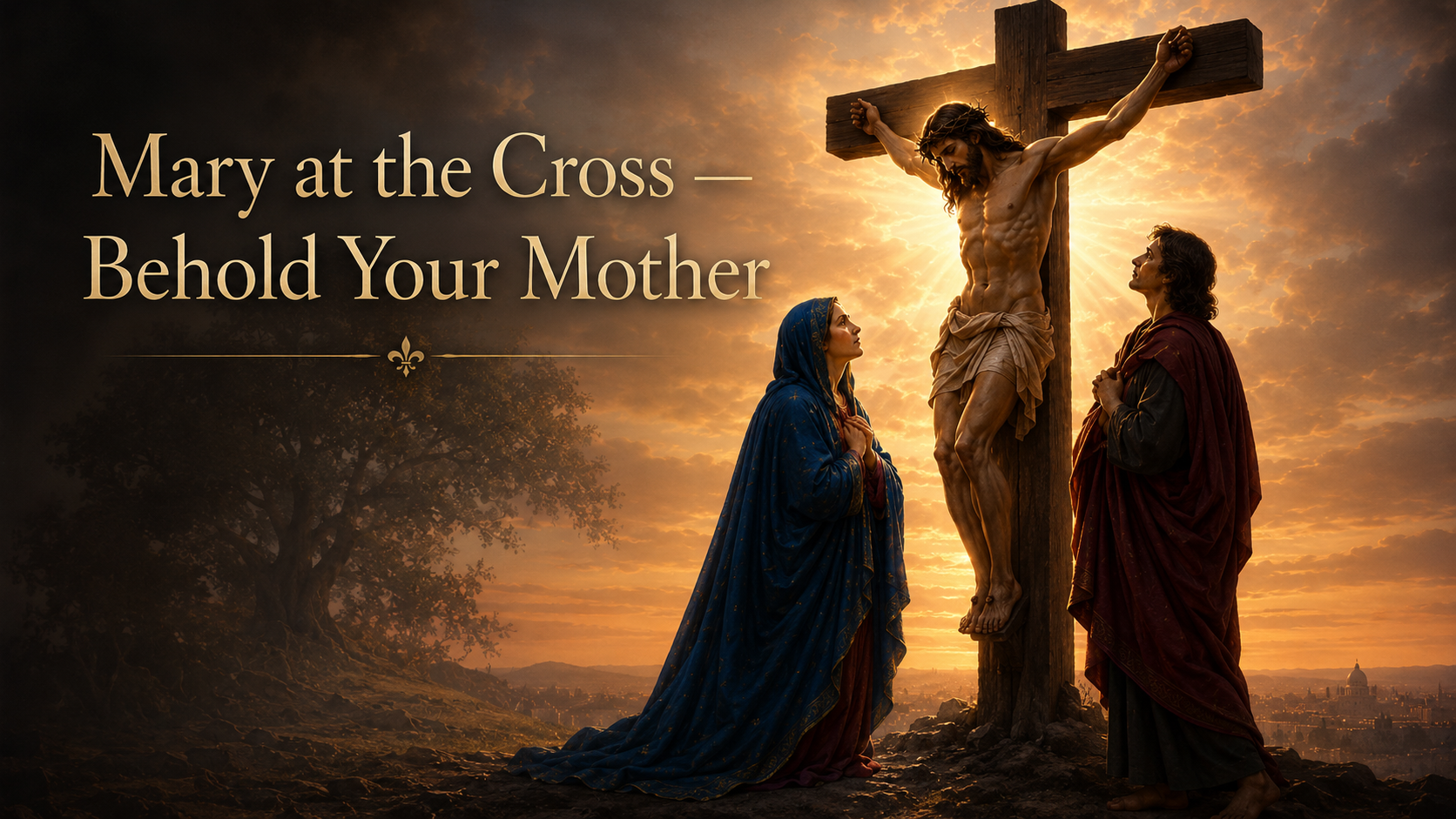
When Jesus looked down from the Cross and said, “Woman, behold your son,” He was not suddenly changing the subject to Mary’s living arrangements.
He was completing a biblical story that began in the opening chapters of Genesis.
The scene at Calvary is filled with typology: a Woman, a Son, a tree, the defeat of the serpent, and the beginning of a new family.
To understand what Jesus is doing in John 19, we need to go back to the beginning.
The Woman at the Cross
St John tells us:
“When Jesus saw his mother, and the disciple whom he loved standing near, he said to his mother, ‘Woman, behold, your son!’ Then he said to the disciple, ‘Behold, your mother!’ And from that hour the disciple took her to his own home.”
— John 19:26–27
At first glance, this can sound like Jesus is simply making sure His mother will be cared for after His death.
There is certainly a practical dimension to the passage.
But St John’s Gospel is rarely that simple.
Why does Jesus call His mother “Woman”?
Why does John identify himself not simply by name, but as “the disciple whom Jesus loved”?
Why does this happen at the very moment Christ is completing His saving work?
And why does the language echo a story that began thousands of years earlier?
The answer begins in Genesis.
Eve and Mary — The First Woman and the New Woman
At the beginning of Scripture, we encounter Adam and Eve.
St Paul later explicitly describes Jesus as the New Adam:
“The first man Adam became a living being; the last Adam became a life-giving spirit.”
— 1 Corinthians 15:45
If Christ is the New Adam, the early Christians naturally recognised Mary as the New Eve.
The parallels are striking.
| Eve — The First Woman | Mary — The New Woman |
|---|---|
| Eve is called “woman.” — Genesis 2:23 | Jesus repeatedly calls Mary “Woman.” — John 2:4; John 19:26 |
| Eve is described as “the mother of all living.” — Genesis 3:20 | Mary receives a new motherhood at the Cross: “Behold your mother.” — John 19:27 |
| Eve is present at the tree associated with mankind’s fall. | Mary stands beside the Cross — the tree upon which Christ reverses Adam’s fall. |
| Eve responds to the serpent in disobedience. | Mary responds to God in obedience: “Let it be done to me according to your word.” — Luke 1:38 |
| Through Adam and Eve, sin enters the human story. | Through Mary comes Jesus Christ, the New Adam, who conquers sin. |
| Genesis foretells conflict between the serpent, the Woman and her offspring. — Genesis 3:15 | At Calvary, the Woman stands beside her Son as His victory over sin and Satan is accomplished. |
| Eve becomes mother within fallen humanity. | Mary becomes mother within the family of the redeemed. |
This is why the title “Woman” matters.
Jesus is not disrespecting Mary.
He is identifying her within the biblical story.
The First Prophecy — Genesis 3:15
After the fall, God speaks to the serpent:
“I will put enmity between you and the woman, and between your offspring and her offspring.”
— Genesis 3:15
This verse has traditionally been called the Protoevangelium — the First Gospel — because it is the first announcement of the coming victory over the serpent.
Notice the characters:
- the serpent
- the Woman
- the Woman’s offspring
- a final conflict and victory
Those same characters appear again near the end of Scripture.
Genesis, Calvary and Revelation
The Bible begins with a Woman and a serpent.
At Calvary, Jesus again addresses His mother as Woman.
And in Revelation, St John once again sees a Woman in conflict with the ancient serpent.
| Genesis | Calvary | Revelation |
| A Woman appears in the conflict with the serpent. — Genesis 3:15 | Jesus says to Mary: “Woman, behold your son.” — John 19:26 | John sees “a woman clothed with the sun.” — Revelation 12:1 |
| The Woman has offspring. | Mary’s Son is Jesus Christ. | The Woman gives birth to a male child who is to rule all nations. — Revelation 12:5 |
| The enemy is the serpent. | Christ confronts the powers of sin and death. | The dragon is identified as “that ancient serpent.” — Revelation 12:9 |
| The serpent is at war with the Woman and her offspring. | Christ’s sacrifice breaks the power of sin. | The dragon goes to make war on “the rest of her offspring.” — Revelation 12:17 |
| The serpent will ultimately be defeated. | Christ wins the decisive victory through His death and Resurrection. | The serpent’s final defeat unfolds in the closing chapters of Revelation. |
This is not accidental imagery.
Genesis introduces the conflict.
Calvary is where Christ wins the decisive victory.
Revelation shows the battle in its cosmic fulfilment.
Who Are “The Rest of Her Offspring”?
Revelation 12 ends with a remarkable description:
“Then the dragon was angry with the woman, and went off to make war on the rest of her offspring, on those who keep the commandments of God and bear testimony to Jesus.”
— Revelation 12:17
The Woman has a Son — the Messiah.
But she also has “the rest of her offspring.”
And Revelation describes them as:
those who keep God’s commandments and bear witness to Jesus.
In other words: Christians.
This fits beautifully with what happens at Calvary.
Jesus looks at His mother.
He looks at the beloved disciple.
Then He creates a new relationship:
“Woman, behold your son.”
And:
“Behold your mother.”
Mary’s motherhood is no longer presented only in relation to Jesus according to the flesh.
A disciple of Jesus is now given Mary as mother.
Why Does John Call Himself “The Beloved Disciple”?
Something important is happening in the way John tells the story.
He could simply have written:
Jesus said to John…
But he does not.
Instead, he repeatedly describes himself as:
“the disciple whom Jesus loved.”
This gives the passage a wider significance.
John is a real historical person.
But he also stands there as a disciple.
Jesus does not say:
“John, take care of My mother.”
He says:
“Behold your mother.”
The language is personal.
Mary is not simply placed under John’s protection.
John is placed into a relationship with Mary.
Cana and Calvary — The Two Appearances of “Woman”
There is another major connection in John’s Gospel.
Jesus calls Mary “Woman” only twice.
The first time is at the wedding feast of Cana.
The second time is at the Cross.
These two scenes form a deliberate biblical frame around Jesus’ ministry.
| Cana — John 2 | Calvary — John 19 |
| Mary is present with Jesus. | Mary is present with Jesus. |
| Jesus calls her “Woman.” | Jesus calls her “Woman.” |
| Mary presents the people’s need to Christ. | Mary stands beside Christ in His Passion. |
| Jesus speaks about “My hour.” — John 2:4 | The hour toward which Jesus’ ministry has been moving has arrived. |
| Jesus performs His first public sign. | Jesus completes the saving work to which His signs pointed. |
| Water becomes wine. | Blood and water flow from Christ’s pierced side. — John 19:34 |
| The disciples begin to believe in Him. — John 2:11 | The beloved disciple receives Mary as mother. |
| Mary says: “Do whatever He tells you.” — John 2:5 | Mary remains faithful beside Him until the end. |
Cana begins the journey toward the hour.
Calvary is the fulfilment of that hour.
And Mary is present at both.
The Tree of Eden and the Tree of Calvary
Another ancient Christian parallel is the contrast between the tree of Eden and the Cross.
The first Adam encounters a tree.
The New Adam also encounters a tree.
But what happened through the first tree is reversed through the second.
| Eden | Calvary |
| A tree becomes associated with man’s disobedience. | The Cross becomes the place of Christ’s perfect obedience. |
| Adam fails. | Christ, the New Adam, remains obedient unto death. |
| A woman stands near the first tree. | Mary, the New Woman, stands near the Cross. |
| Sin enters the human story. | Sin is conquered by Christ’s sacrifice. |
| Death follows. | Eternal life is opened to mankind. |
St Paul writes:
“As by one man’s disobedience many were made sinners, so by one man’s obedience many will be made righteous.”
— Romans 5:19
The entire Passion is a reversal of the fall.
The First Adam and the Last Adam
The parallels become even clearer when Adam and Christ are placed side by side.
| The First Adam | Jesus Christ — The Last Adam |
| Adam is the head of the first human creation. | Christ becomes the head of a new creation. |
| Adam’s disobedience brings death. | Christ’s obedience brings life. |
| Adam encounters death through a tree. | Christ defeats death upon a tree. |
| Adam stands with the first Woman, Eve. | Christ’s mother, the New Woman, stands beside Him at Calvary. |
| Eve becomes “mother of all living.” | Mary receives a new motherhood among those who belong to Christ. |
This is why Mary cannot be separated from the Adam–Christ typology.
She is not the Saviour.
Christ alone saves.
But just as Eve appears alongside Adam in the story of the fall, Mary appears alongside the New Adam in the story of redemption.
“Woman, Behold Your Son”
Now Jesus’ words become much more significant.
“Woman, behold your son.”
Mary is called Woman.
The New Eve stands beside the New Adam.
And Christ gives her a son.
Then Jesus turns to the disciple:
“Behold your mother.”
Notice that Jesus does not merely say:
“Take care of her.”
He defines the relationship.
Mother.
A New Family at the Foot of the Cross
Throughout the Gospel, Jesus has been creating a new family based not merely upon biological descent, but upon faith and obedience to God.
At Calvary, this becomes visible.
Christ is dying.
Mary stands beneath Him.
The beloved disciple stands beside her.
And from the Cross Jesus declares:
Mother. Son.
The Church is being gathered around the crucified Christ.
Blood and Water — A New Creation from the Side of Christ
Immediately after the scene with Mary and the beloved disciple, John tells us that a soldier pierces the side of Jesus:
“One of the soldiers pierced his side with a spear, and at once there came out blood and water.”
— John 19:34
This creates another extraordinary Adam typology.
In Genesis, God causes Adam to fall into a deep sleep.
His side is opened.
And from his side comes Eve, his bride.
At Calvary, Christ enters the sleep of death.
His side is opened.
And blood and water flow out.
From the earliest centuries, Christians saw in the blood and water signs of the sacramental life of the Church — particularly Baptism and the Eucharist.
| Adam | Christ |
| Adam enters a deep sleep. | Christ enters the sleep of death. |
| Adam’s side is opened. | Christ’s side is pierced. |
| From Adam’s side comes Eve, his bride. | From Christ’s side flow blood and water, traditionally associated with the sacramental life of His Bride, the Church. |
| Adam and Eve belong to the first creation. | Christ establishes the new creation. |
And notice where Mary is.
She is standing there.
The New Eve.
At the side of the New Adam.
As the new covenant family begins to appear.
Mary and the Church
Catholic theology does not force us to choose between Mary and the Church when reading passages such as Revelation 12.
Biblical symbolism can operate on more than one level.
The Woman can represent the people of God, while at the same time possessing an unmistakably Marian dimension, because she gives birth to the Messiah.
Mary herself becomes a living image of the Church.
She:
- receives the Word of God;
- believes;
- bears Christ;
- follows Him;
- stands faithfully at the Cross;
- is present with the disciples as they await the Holy Spirit.
Mary is both Mother of Christ and a model of what the Church is called to be.
Was Jesus Simply Giving Mary Somewhere to Live?
A common objection says:
“Jesus was simply making sure His mother was looked after.”
There is no reason to deny that John genuinely cared for Mary afterward.
John explicitly tells us:
“From that hour the disciple took her to his own.”
But the practical explanation alone does not explain all the details St John deliberately gives us.
Why call her Woman?
Why connect this scene with Cana?
Why call John the beloved disciple?
Why speak in terms of mother and son?
Why place this immediately before Christ’s death and the piercing of His side?
And why does Revelation later give us a Woman, a Messianic Son, the ancient serpent and the Woman’s other offspring who follow Jesus?
The biblical picture is far richer than:
“John, make sure Mum has somewhere to stay.”
From Genesis to Revelation
The Marian picture comes into focus when the entire Bible is allowed to speak.
Genesis begins with:
a Woman, a man, a tree, a serpent and death.
Calvary gives us:
the New Woman, the New Adam, a new tree, the defeat of the serpent and the promise of life.
And Revelation gives us:
the Woman, her Messianic Son, the ancient serpent and the rest of her offspring — those who belong to Christ.
The story has come full circle.
“Behold Your Mother”
From the Cross, Jesus did not say:
“Ignore My mother.”
He did not say:
“She has completed her purpose.”
He said:
“Behold your mother.”
The beloved disciple received her.
And the Gospel invites every disciple who is loved by Christ to hear those words.
Mary does not compete with Jesus.
Every authentic Marian doctrine leads back to Him.
At Cana her words were:
“Do whatever He tells you.”
At Calvary she stands silently beside Him.
And from the Cross Christ Himself tells the disciple:
“Behold your mother.”
The Woman first promised in Genesis stands beneath the tree of the New Adam.
The serpent’s defeat has begun.
A new creation is being born.
And the family of Christ receives a mother.