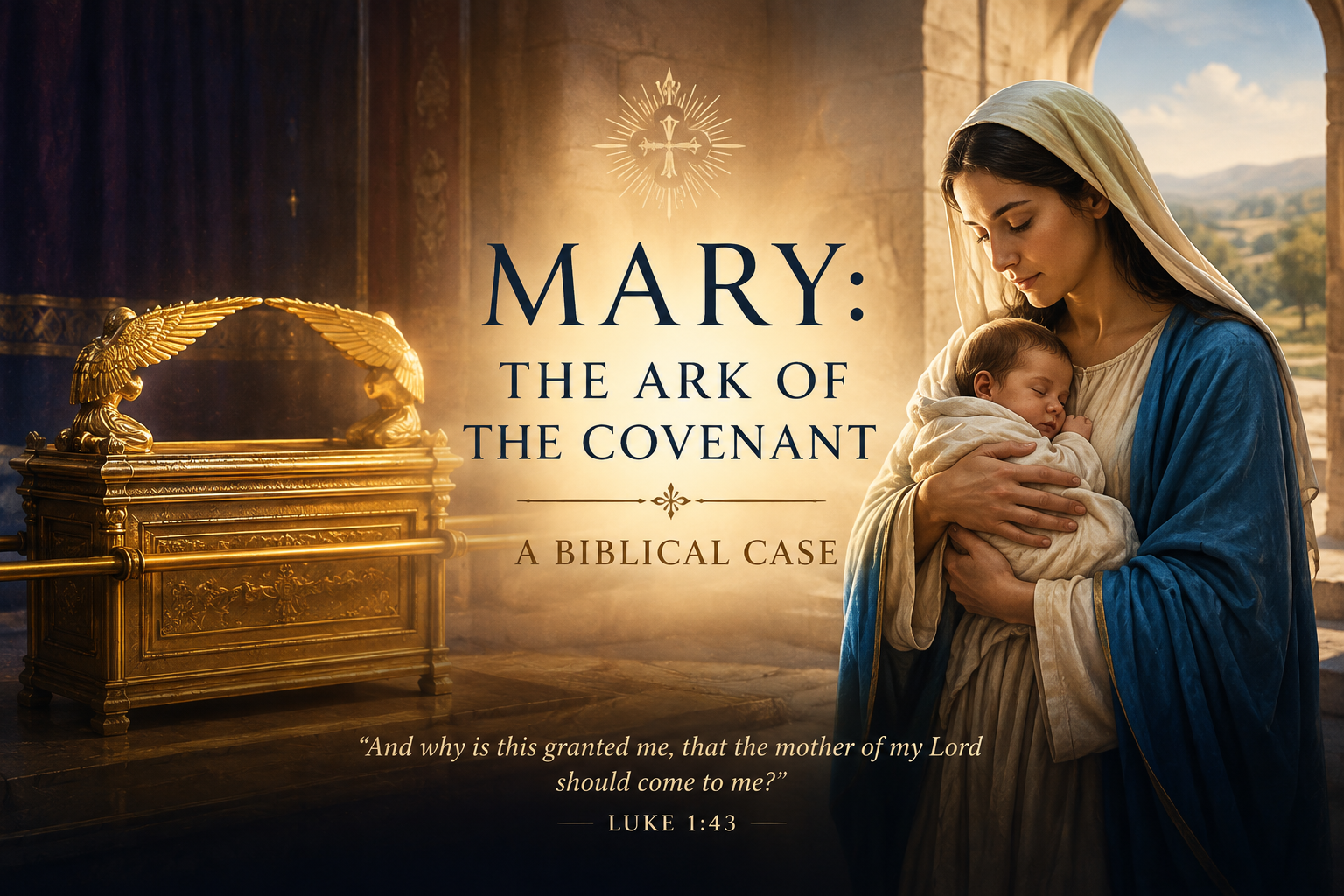
Mary: The Ark of the Covenant – A Biblical Case
Introduction
One of the most beautiful biblical typologies in Scripture is the relationship between Mary and the Ark of the Covenant. Far from being a later Catholic invention, this connection is woven throughout both the Old and New Testaments.
The Ark of the Covenant was the holiest object in Israel because it was the dwelling place of God’s presence among His people. St. Luke deliberately presents Mary as the New Ark, revealing that she carried not the written Word of God engraved on stone, but the eternal Word made flesh—Jesus Christ (John 1:14).
The following biblical parallels reveal that Mary is presented not merely as a faithful servant of God, but as the New Ark of the Covenant, prepared by God’s grace to bear God Himself in the flesh.
What Was the Ark of the Covenant – and Why Does It Matter?
To understand why St. Luke presents Mary as the New Ark of the Covenant, we must first understand what the Ark represented under the Old Covenant. The Ark was not merely a sacred chest or religious symbol—it was the dwelling place of God’s presence among His people and the holiest object in all of Israel.
God gave Moses precise instructions for its construction:
“They shall make an ark of acacia wood…” (Exodus 25:10)
The Ark was overlaid with pure gold inside and out (Exodus 25:11), and God declared:
“There I will meet with you… from above the mercy seat.” (Exodus 25:22)
When the Tabernacle was completed, “the glory of the LORD filled the tabernacle” (Exodus 40:34–35), demonstrating that the Ark was set apart as the place where God’s presence dwelt among His people.
Inside the Ark were three sacred objects, each of which pointed forward to the coming Messiah:
- The stone tablets of the Ten Commandments (Hebrews 9:4)
- The golden urn of manna (Hebrews 9:4)
- Aaron’s rod that budded (Hebrews 9:4)
The New Testament reveals that these were not random objects. They foreshadowed Jesus Christ and prepared Israel for His coming.
Jesus Fulfils Everything Inside the Ark
| Old Testament The Ark carried symbols | Fulfilled in Christ Mary carried the reality |
|---|---|
| Stone Tablets | Jesus is the Word made flesh (John 1:14) |
| Golden Urn of Manna | Jesus is the Bread of Life (John 6:35) |
| Aaron’s Rod that Budded (Hebrews 9:4) | Jesus is the Eternal High Priest (Hebrews 4:14–16; Hebrews 7:23–28) |
.
The contents point to Christ
The contents of the Ark were shadows of the Messiah. The Ark carried the symbols of God’s covenant. Mary carried their fulfillment—Jesus Christ, the Word made flesh, the true Bread from Heaven, and the Eternal High Priest.
The Old Testament repeatedly emphasizes that God’s dwelling place was holy…
The Old Testament repeatedly emphasizes that God’s dwelling place was holy. The Tabernacle and the Ark were set apart for God’s presence (Exodus 25:8; Exodus 40:34–35). Only the high priest could enter the Most Holy Place, and only once a year, bringing sacrificial blood to make atonement (Leviticus 16:2, 11–19; Hebrews 9:6–7). If God required such holiness for the place where His presence dwelt under the Old Covenant, how much more fitting would it be for the woman chosen to bear God Himself in the flesh to be prepared by His grace? Mary was not merely carrying a symbol of God’s presence, but Jesus Christ Himself—the incarnate Son of God. The holiness of the Ark pointed forward to the even greater holiness of the New Ark, the one chosen to bear the Holy One of Israel.
David and Elizabeth: The Ark Arrives
| The Ark of the Covenant | The Virgin Mary |
|---|---|
| David asks: “How can the Ark of the LORD come to me?” (2 Samuel 6:9) | Elizabeth asks: “And why is this granted to me, that the mother of my Lord should come to me?” (Luke 1:43) |
| David leaped before the Ark as it was brought in with shouting. (2 Samuel 6:15–16) | John leaped in Elizabeth’s womb at the sound of Mary’s voice, and Elizabeth cried out with a loud shout. (Luke 1:41–42) |
| The Ark remained in the hill country, in the house of Obed-Edom, three months. (2 Samuel 6:11) | Mary remained in the hill country, in Elizabeth’s house, three months. (Luke 1:56) |
David’s words and actions surrounding the Ark of the Covenant are deliberately echoed in Luke’s account of Mary’s visitation to Elizabeth. David asks, “How can the Ark of the LORD come to me?” while Elizabeth asks, “Why is this granted to me, that the mother of my Lord should come to me?” David leaps before the Ark with joyful shouting; John the Baptist leaps in Elizabeth’s womb, and Elizabeth cries out with a loud voice. Finally, just as the Ark remained in the hill country for three months, Mary remained with Elizabeth for three months. These striking parallels are too numerous to be dismissed as coincidence. Luke intentionally presents Mary as the New Ark of the Covenant, carrying not the written Law or sacred vessels, but Jesus Christ, the incarnate Son of God.
The Overshadowing
| The Tabernacle Old Covenant: God’s presence dwelt in the Ark | The Virgin Mary New Covenant: God Himself dwelt in the womb of the Virgin Mary |
| Then the cloud covered the tent of meeting, and the glory of the LORD filled the tabernacle “overshadows“(episkiazō) (Exodus 40:34) | The Holy Spirit will come upon you, and the power of the Most High will “overshadow“(episkiazō) you. (Luke 1:35) |
The glory of God overshadowed the Ark because it was the place where God dwelt among His people. In the New Covenant, the Holy Spirit overshadowed Mary because she became the living Ark, bearing Jesus Christ, God incarnate, in her womb.
The Greek Old Testament (the Septuagint, or LXX) uses the word episkiazō (“to overshadow”) in Exodus 40:34–35. Luke deliberately uses the same Greek word in Luke 1:35 when describing the Holy Spirit overshadowing Mary. This is a strong indication that Mary is being presented as the new Ark and dwelling place of God’s presence.
If the Ark of the Old Covenant was made of the purest materials because it carried the presence of God, how much more fitting was it that the woman chosen to bear God Himself should be prepared by His grace? Luke is deliberately presenting Mary as the New Ark of the Covenant, fulfilling what the Old Testament foreshadowed.
Why This Matters
The Ark of the Covenant was made holy because it was the dwelling place of God’s presence among His people. If God commanded such reverence for the Ark that carried His presence under the Old Covenant, how much more fitting would it be for the woman chosen to bear God Himself in the flesh to be prepared by His grace?
Mary did not carry the stone tablets, manna, or Aaron’s rod. She carried Jesus Christ—the eternal Word made flesh (John 1:14), the true Bread from Heaven (John 6:35), and the Eternal High Priest (Hebrews 4:14–16).
Catholics therefore honour Mary not because she replaces Christ, but because every privilege she received came from Him and points back to Him. As Mary herself prophesied:
“From now on all generations will call me blessed.” (Luke 1:48)
Everything about Mary leads us to Jesus.
Common Protestant Objection
“The Bible never calls Mary the Ark.”
The Bible also never explicitly says, “Jesus is the New Moses,” yet the New Testament presents Him that way through clear parallels (Matthew 2–5). Likewise, St. Paul calls Christ the “last Adam” (1 Corinthians 15:45), building on a pattern rather than a repeated title.
Biblical typology works through divinely inspired patterns. The New Testament constantly reveals how people, places, and events in the Old Testament foreshadow their fulfilment in Christ. Jesus Himself taught His disciples to read the Scriptures this way (Luke 24:27).
St. Luke expected his readers—especially Jewish Christians familiar with the Old Testament—to recognize these deliberate echoes. The repeated parallels between the Ark of the Covenant and Mary are too numerous and too specific to be accidental. Rather than stating, “Mary is the Ark,” Luke presents her as the New Ark through biblical typology.
Conclusion
The New Testament presents Mary as the New Ark of the Covenant.
The Ark of the Old Covenant carried the Word of God written on stone, the manna from heaven, and Aaron’s priestly rod. Mary carried their fulfilment—Jesus Christ Himself, the eternal Word made flesh, the true Bread from Heaven, and our Eternal High Priest.
The Ark was made holy because it bore God’s presence. If God commanded such reverence for the Old Covenant Ark, which carried only symbols, how much more fitting is it that the woman chosen to bear God Himself would be prepared by His grace and set apart for that unique mission?
The many parallels between the Ark of the Covenant and Mary are not isolated coincidences but a consistent biblical pattern. From the Annunciation to the Visitation, St. Luke deliberately echoes the language and events surrounding the Ark, inviting his readers to recognize Mary as the New Ark of the Covenant.
Catholics honour Mary not because she replaces Christ, but because she carried Him into the world. Every privilege she received points to Jesus Christ, and every true Marian doctrine ultimately magnifies Him.
As Mary herself proclaimed:
“My soul magnifies the Lord, and my spirit rejoices in God my Saviour.” (Luke 1:46–47)
Further Reading
- Exodus 25–40 — The construction of the Ark of the Covenant and the Tabernacle.
- 2 Samuel 6 — David brings the Ark to Jerusalem.
- Luke 1:26–56 — The Annunciation and the Visitation.
- John 2:1–11 — Mary at the Wedding at Cana.
- John 19:25–27 — Mary at the Cross.
- Revelation 11:19–12:17 — The Ark of the Covenant and the Woman clothed with the sun.
- Hebrews 9:1–5 — The contents of the Ark.
- 1 Kings 8:1–11 — The Ark enters the Temple and God’s glory fills it.