Mary, the New Eve — How Christ Reverses the Fall
One of the most striking patterns in Scripture is the way the New Testament deliberately reverses the events of Genesis.
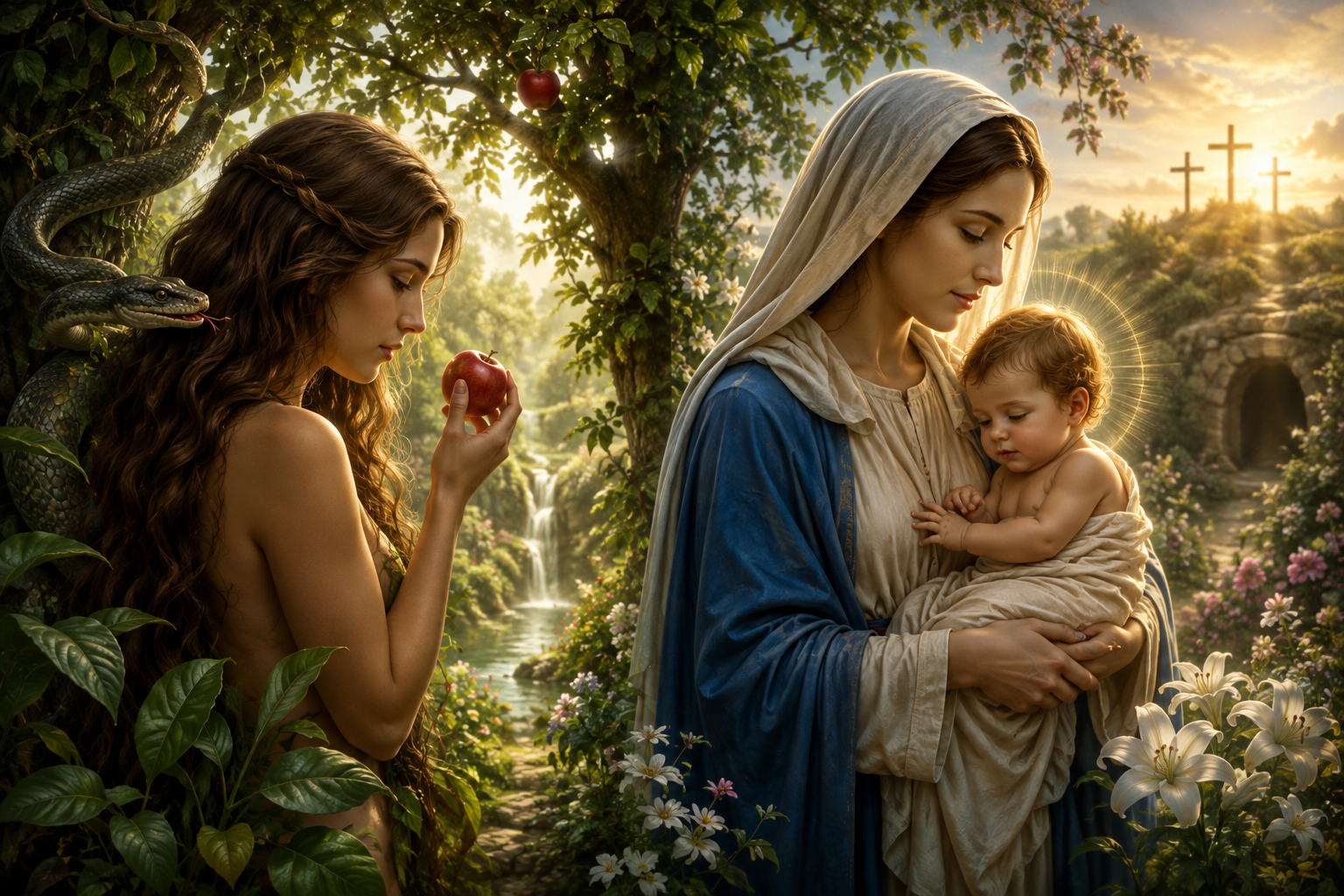
The Fall begins with Adam, Eve, a garden, a tree, a serpent, and death.
The Gospel answers with Christ, Mary, another garden, another tree, the defeat of the serpent, and the restoration of life.
This is not simply a collection of similarities. The New Testament repeatedly uses the same language and images found in Genesis, showing that Jesus is the New Adam and Mary is the New Eve.
Two Women, Two Messages
In Genesis, Eve is approached by the serpent.
She listens to the words of a fallen spiritual creature, believes him, and disobeys God.
Through that disobedience, sin and death enter the world.
In Luke’s Gospel, another woman appears.
Mary is approached by Gabriel, a holy angel sent by God.
Gabriel announces that she will conceive the Son of God.
Mary responds:
“Behold, I am the handmaid of the Lord; let it be to me according to your word.”
— Luke 1:38
Eve hears the message of the serpent and responds with disobedience.
Mary hears the message of Gabriel and responds with faith and obedience.
The contrast is extraordinary.
Through the first virgin came disobedience and death.
Through the second virgin came the One who brings life.
This comparison is ancient. Early Christians such as St. Justin Martyr and St. Irenaeus explicitly contrasted Eve’s disobedience with Mary’s obedience.
The Fruit of the Tree and the Fruit of Mary’s Womb
Genesis centres on forbidden fruit.
Eve takes fruit from the forbidden tree, eats it, and gives it to Adam.
The result is death.
Then notice the language used when Mary visits Elizabeth.
Filled with the Holy Spirit, Elizabeth cries out:
“Blessed are you among women, and blessed is the fruit of your womb.”
— Luke 1:42
Jesus is the fruit of Mary’s womb.
And where does that fruit ultimately go?
To a tree.
The New Testament repeatedly describes the Cross as a tree.
“The God of our fathers raised Jesus whom you killed by hanging him on a tree.”
— Acts 5:30
Again:
“They put him to death by hanging him on a tree.”
— Acts 10:39
And again:
“They took him down from the tree and laid him in a tomb.”
— Acts 13:29
Why repeatedly call the Cross a tree?
Because the story of salvation is answering Genesis.
Humanity took forbidden fruit from a tree and received death.
Now the fruit of Mary’s womb hangs upon a tree and gives life.
The instrument associated with death becomes the instrument through which death itself is defeated.
The Garden Lost — and the Garden Restored
The Fall takes place in a garden.
Adam is placed in Eden to cultivate and keep it.
After the Fall, Adam and Eve are driven from the garden, and access to the Tree of Life is blocked.
Genesis tells us:
“He drove out the man; and at the east of the garden of Eden he placed the cherubim… to guard the way to the tree of life.”
— Genesis 3:24
Now look at John’s account of Christ’s death and resurrection.
John specifically tells us:
“At the place where Jesus was crucified, there was a garden, and in the garden a new tomb.”
— John 19:41
Death entered the world in a garden.
Christ defeats death in a garden.
And when Mary Magdalene encounters the risen Christ, she initially thinks He is:
“the gardener.”
— John 20:15
That detail is remarkable.
Adam was the gardener of Eden.
Now the risen Christ — whom St. Paul calls the Last Adam — stands in another garden and is mistaken for a gardener.
The symbolism is difficult to miss.
The first Adam failed in the garden.
The Last Adam triumphs in the garden.
The Woman in the Garden
There is another deliberate Genesis echo.
Jesus says to Mary Magdalene:
“Woman, why are you weeping?”
— John 20:15
A woman stands in a garden.
That immediately recalls Genesis.
In the first garden, the woman reaches for the tree associated with death.
In the resurrection garden, women are the first to encounter the risen Christ.
Matthew tells us:
“They came up and took hold of his feet and worshiped him.”
— Matthew 28:9
The woman who first reached toward the forbidden tree is answered by women who now reach toward the risen Christ.
Humanity had been barred from the Tree of Life.
Now, because of Christ, the way to life has been opened again.
The Seed of the Woman
The connection becomes even stronger in Genesis 3:15.
After the Fall, God says to the serpent:
“I will put enmity between you and the woman, and between your seed and her seed; he shall bruise your head, and you shall bruise his heel.”
This is often called the Protoevangelium — the first announcement of the Gospel.
Notice the elements:
The serpent.
The woman.
Her seed.
The conflict.
The crushing of the serpent.
Now go to Calvary.
John tells us that Mary is standing beside the Cross.
Jesus looks at His mother and says:
“Woman, behold your son.”
— John 19:26
Why does Jesus call His mother Woman?
It is not disrespect.
John is bringing the reader back to Genesis.
Here again is the Woman.
And beside her is the promised Seed.
Christ is the Seed of the Woman who destroys the serpent.
The Skull and the Crushing of the Serpent
Genesis says the serpent’s head will be crushed.
Where is Jesus crucified?
Matthew tells us:
“They came to a place called Golgotha, which means Place of a Skull.”
— Matthew 27:33
John gives the same detail:
“He went out, bearing his own cross, to the place called the Place of the Skull.”
— John 19:17
At the Place of the Skull, the Seed of the Woman defeats Satan.
The serpent appears to strike Christ by bringing about His death.
But the Cross itself becomes the weapon by which Satan is defeated.
Hebrews explains:
“Through death he might destroy him who has the power of death, that is, the devil.”
— Hebrews 2:14
What appears to be Satan’s victory becomes his defeat.
The heel is struck.
The head is crushed.
Eve and Mary
The parallels can now be seen clearly.
Eve is called woman.
Mary is called Woman.
Eve encounters a fallen angelic being.
Mary encounters the angel Gabriel.
Eve believes the serpent.
Mary believes God.
Eve’s response leads to death.
Mary’s obedience brings forth Christ, who is Life.
Eve is associated with fruit from a forbidden tree.
Mary gives birth to the fruit of her womb, who hangs upon the Cross.
Eve stands at the beginning of the old creation.
Mary stands at the beginning of the new creation.
This is why the earliest Christians recognized Mary as the New Eve.
Mother of All the Living
After the Fall, Adam gives his wife the name Eve:
“The man called his wife’s name Eve, because she was the mother of all living.”
— Genesis 3:20
Yet Eve had just participated in bringing death into the world.
The title therefore points beyond her.
Who is truly Life?
Jesus says:
“I am the resurrection and the life.”
— John 11:25
And:
“I am the way, and the truth, and the life.”
— John 14:6
Mary is the mother of Jesus Christ — the One who is Life itself.
Eve becomes the mother of humanity according to the flesh.
Mary becomes the mother of the One through whom humanity receives eternal life.
At the Cross Jesus then says:
“Woman, behold your son.”
And to the beloved disciple:
“Behold your mother.”
— John 19:26–27
The Woman of Genesis now stands at the foot of the Cross as the New Adam establishes the new creation.
Flesh of My Flesh — Reversed
There is one final reversal.
When Eve is created from Adam, Adam declares:
“This at last is bone of my bones and flesh of my flesh.”
— Genesis 2:23
The first woman receives her flesh from the first Adam.
But in the Incarnation, the direction is reversed.
The Last Adam receives His human flesh from a woman.
Jesus took His human nature from Mary.
The first woman came from man.
The New Adam came from woman.
St. Paul writes:
“God sent forth his Son, born of woman.”
— Galatians 4:4
The reversal is complete.
The New Creation
The story that begins in Genesis is not abandoned.
It is fulfilled.
The first Adam fails.
The Last Adam obeys.
The first woman listens to the serpent.
The New Eve listens to God.
The forbidden tree brings death.
The Cross brings life.
The garden is closed.
The resurrection garden is opened.
The serpent strikes.
Christ crushes him.
Everything lost through the first Adam is restored through Christ.
And just as Eve stood beside Adam at the beginning of the old creation, Mary stands beside Christ in the decisive moments of the new.
That is why the title New Eve is not a later invention imposed upon Scripture.
It arises naturally from the biblical pattern itself.
Adam points to Christ.
Eve points to Mary.
The tree of death points to the Cross.
The lost garden points to the resurrection garden.
And the Fall points forward to the great reversal accomplished by Jesus Christ.
The New Eve Begins Where the First Eve Began
There is another important part of the Adam and Eve parallel that is often overlooked.
When God created the first Adam and Eve, neither was created in a state of sin.
Sin entered their lives through their own disobedience.
The New Testament then presents Jesus as the New Adam or Last Adam:
“The first man Adam became a living being; the last Adam became a life-giving spirit.”
— 1 Corinthians 15:45
Christ does not begin His earthly life under the dominion of sin. He is conceived by the Holy Spirit and is completely holy.
Gabriel tells Mary:
“The Holy Spirit will come upon you, and the power of the Most High will overshadow you; therefore the child to be born will be called holy, the Son of God.”
— Luke 1:35
Now consider the New Eve.
If the first Eve entered God’s creation without sin, would it be fitting for the woman chosen to reverse Eve’s disobedience to begin in a lesser state than Eve herself?
The parallel is striking:
The first Adam — created without sin.
The first Eve — created without sin.
The New Adam — conceived without sin.
The New Eve — preserved from original sin.
This does not mean Mary is equal to Christ.
There is an enormous difference.
Jesus is sinless by His own divine nature. Mary is sinless only by the grace of God and because of the saving work of Christ.
Catholic teaching does not claim that Mary did not need a Saviour. Mary herself declares:
“My spirit rejoices in God my Savior.”
— Luke 1:47
Mary was saved by Christ in the most complete way: not by being rescued from original sin after falling into it, but by being preserved from it through the grace of Christ.
This is what the Catholic Church means by the Immaculate Conception.
And within the New Eve pattern, it makes profound sense.
The first Eve begins immaculate and through disobedience participates in the Fall.
The New Eve begins immaculate and through obedience cooperates with God’s plan for the coming of the Redeemer.
Eve begins without sin and says no to God.
Mary is preserved from sin and says yes to God.
“Behold, I am the handmaid of the Lord; let it be to me according to your word.”
— Luke 1:38
The New Eve does not merely resemble the old Eve.
She reverses her.