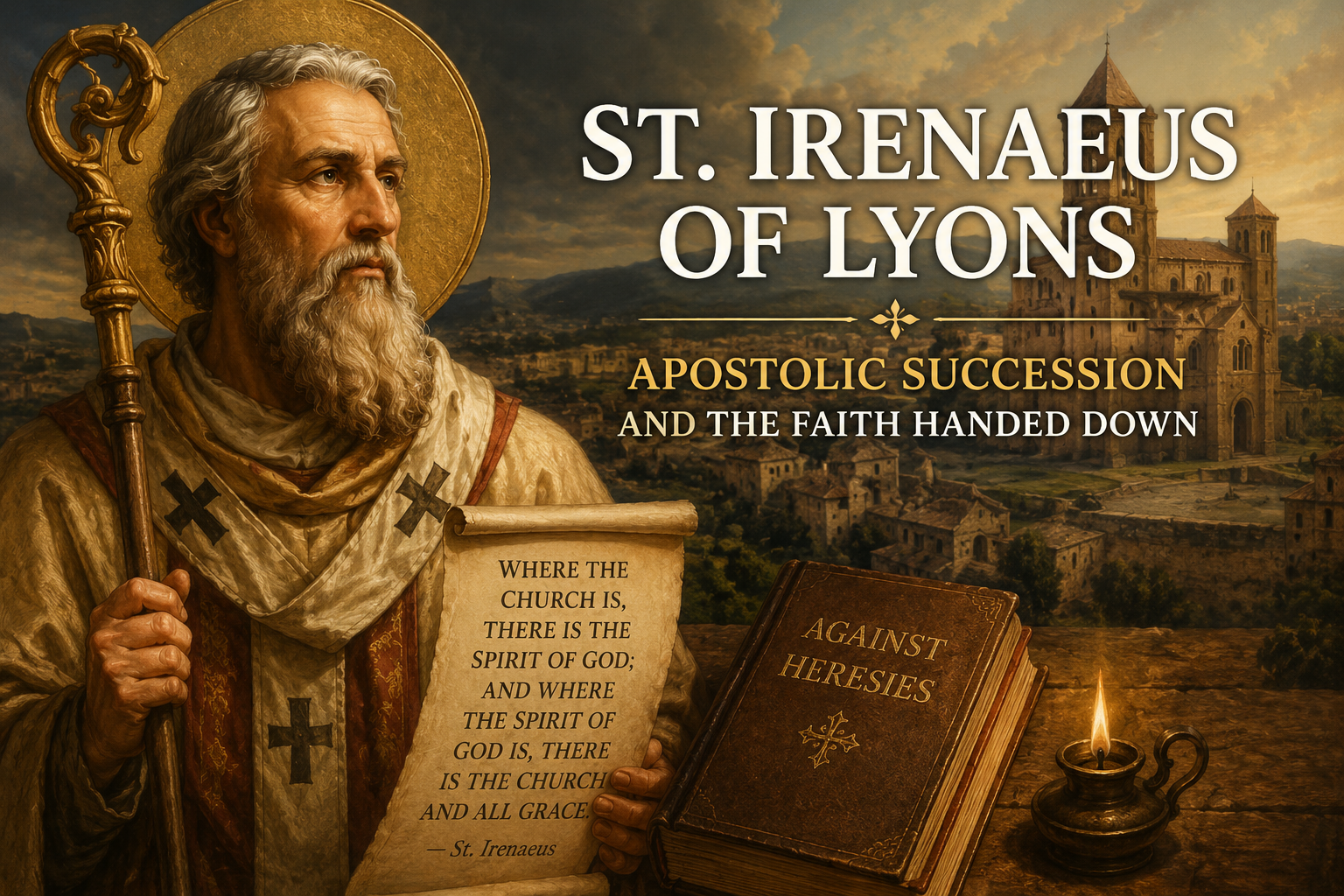
St. Irenaeus of Lyons — Apostolic Succession and the Faith Handed Down
How did the earliest Christians know which interpretation of Christianity was true?
By the end of the second century, many groups claimed to possess the real teaching of Jesus.
Some claimed to have secret knowledge.
Others produced alternative interpretations of Scripture.
Some even claimed that the visible Church had misunderstood the faith handed down by Christ.
That raises an important question:
How could an ordinary Christian know who was right?
One of the greatest early Church Fathers gave a remarkably clear answer.
His name was:
St. Irenaeus of Lyons
Writing around AD 180, Irenaeus argued that the true Christian faith could be identified because it had been publicly handed down from:
Christ
to:
the Apostles
and then through:
the bishops who succeeded them.
For Irenaeus, Christianity was not a secret teaching rediscovered by isolated individuals.
It was a faith:
received
preserved
taught publicly
and:
handed down within the Church.
This makes Irenaeus one of the most important witnesses in the entire early Church for understanding:
Apostolic Tradition and Apostolic Succession.
Who Was St. Irenaeus?
Irenaeus was born in the first half of the second century, probably somewhere in Asia Minor.
As a young man, he knew:
St. Polycarp of Smyrna
That connection is enormously important.
Polycarp belonged to an earlier generation of Christianity and was remembered as a disciple of the Apostle John.
So consider the historical chain:
Jesus Christ
↓
The Apostle John
↓
Polycarp
↓
Irenaeus
We are extraordinarily close to the Apostolic age.
Irenaeus later travelled west and became Bishop of:
Lyons
in modern France.
His most famous work is usually known as:
Against Heresies
In it, he confronted one of the greatest threats facing early Christianity:
Gnosticism
The Gnostic Problem
The Gnostics were not one single organised denomination.
There were different groups with different beliefs.
But many shared a common idea:
They possessed secret spiritual knowledge unavailable to ordinary Christians.
According to these teachers, the public teaching of the Church was not enough.
The real truth had supposedly been passed secretly to a select few.
That sounds remarkably familiar.
Throughout Christian history, people have repeatedly appeared claiming:
“The Church has misunderstood Christianity.”
or:
“Everyone got it wrong until we rediscovered the real meaning.”
Irenaeus faced essentially the same claim in the second century.
And his response was devastatingly simple.
Where did your teaching come from?
Go Back to the Apostles
Irenaeus argued that if someone wanted to know authentic Christianity, he should look at the churches founded by the Apostles.
Those churches could identify the succession of their bishops.
Their doctrine had been taught publicly.
Their faith could be traced backwards.
This was the opposite of the Gnostic system.
The Gnostics claimed:
secret knowledge
Irenaeus pointed to:
public teaching
The Gnostics claimed:
hidden traditions
Irenaeus pointed to:
churches founded by the Apostles
The Gnostics produced new teachers.
Irenaeus pointed to:
Apostolic succession.
What Is Apostolic Succession?
Apostolic succession means that the Apostles did not simply preach the Gospel and then disappear leaving Christianity without visible leadership.
They appointed men to continue their ministry.
Those men appointed successors.
And the teaching entrusted to the Apostles continued to be guarded within the Church.
We can already see the beginnings of this in Scripture.
St. Paul tells Timothy:
“What you have heard from me before many witnesses entrust to faithful men who will be able to teach others also.”
— 2 Timothy 2:2
Notice the generations contained in that one verse.
Paul
teaches:
Timothy
who is to entrust the teaching to:
faithful men
who will then teach:
others.
That is transmission.
The faith is handed on.
Irenaeus shows us this principle operating in the Church of the second century.
The Church Could Name Its Bishops
Irenaeus does not speak about apostolic succession as an abstract theory.
He says that Christians could actually examine the succession of bishops in churches founded by the Apostles.
That is important.
The argument is historical.
If someone suddenly appears claiming to possess the true Christian faith, ask:
Can your teaching be traced back?
For Irenaeus, authentic Christianity possesses continuity.
The Apostles taught the faith.
Their successors preserved that faith.
And the churches continued publicly teaching it.
Christianity Was Not Based on Secret Interpretation
This tells us something extremely important about the early Church.
Irenaeus does not tell Christians:
“Take the Scriptures, interpret them independently, and decide which teacher is correct.”
Scripture is absolutely central to his arguments.
Irenaeus uses Scripture constantly.
But Scripture exists within the Apostolic Church that received it, preserved it and proclaimed it.
The question is not:
Scripture or Church?
For Irenaeus, the two belong together.
The same Apostolic Church that preserves the teaching of the Apostles also possesses the Scriptures handed down from them.
Scripture and Tradition Belong Together
This becomes particularly significant when discussing:
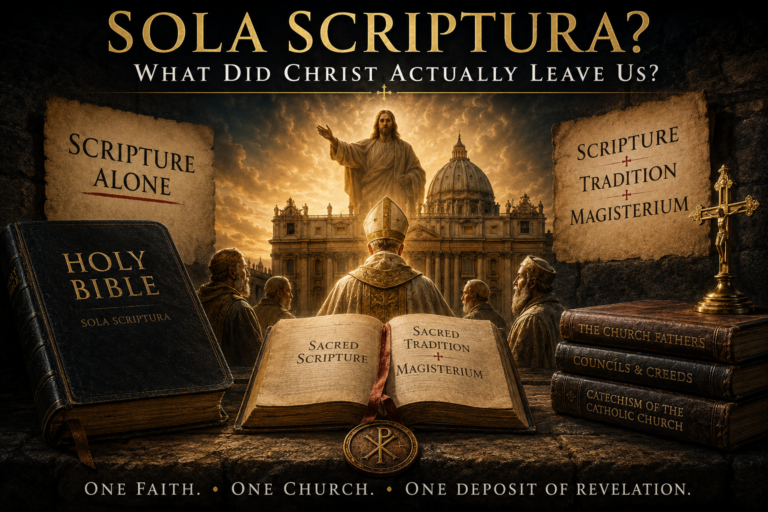
Sola Scriptura
Irenaeus lived long before the Protestant Reformation.
He was fighting heresy hundreds of years before anyone had heard of Luther or Calvin.
And when he explains how Christianity is preserved, he repeatedly appeals to:
the Scriptures
the tradition received from the Apostles
and:
the succession of bishops.
These are not competing authorities for Irenaeus.
They form part of the same Apostolic inheritance.
The faith written in Scripture is the faith proclaimed in the Church.
What If the Apostles Had Left No Scriptures?
Irenaeus makes an extraordinary argument.
He asks, in effect:
What would Christians have done if the Apostles had not left written Scriptures?
His answer is revealing.
Christians would still have been obliged to follow:
the tradition handed down to those entrusted with the churches.
That does not diminish Scripture.
Quite the opposite.
It tells us how Irenaeus understood Christianity itself.
The faith existed before every New Testament book had been collected into one bound Bible.
The Gospel was:
preached,
lived,
worshipped,
and:
handed down.
The Church did not emerge from a completed New Testament.
The New Testament emerged within the Apostolic Church.
Then Irenaeus Points to Rome
Irenaeus could have listed the succession of every Apostolic church.
Instead, he says that this would take too long.
So he selects one especially important example:
The Church of Rome
He describes Rome as a Church founded and organised by the glorious Apostles:
Peter and Paul.
He then gives a succession of bishops leading from the Apostolic period down to his own day.
This is extraordinary historical evidence.
By around AD 180, a Christian writer can appeal to the succession of bishops in Rome as evidence of continuity with the Apostles.
Why Rome?
Irenaeus speaks about Rome in unusually strong language.
One traditional translation says that because of Rome’s pre-eminent authority, every Church should agree with it.
The precise translation and force of this passage have been debated, so Catholics should not pretend that one sentence by itself proves every later detail of papal authority.
But neither should we ignore what Irenaeus is doing.
He deliberately selects:
Rome
as his outstanding example of a Church whose public Apostolic succession can be used against heresy.
And he connects that Church with:
Peter and Paul.
That is extremely significant.
Whatever precise conclusions someone draws about later papal jurisdiction, Rome clearly already occupied an exceptional place in Irenaeus’ understanding of the universal Church.
The Succession at Rome
Irenaeus even provides a list of the bishops who succeeded the Apostles in Rome.
He speaks of:
Linus
then:
Anacletus
then:
Clement
and continues through the succession down to the bishop of his own time.
Why does he bother doing this?
Because succession matters.
He is saying:
We can trace this Church backwards.
Its bishops did not suddenly appear.
Its faith did not emerge yesterday.
There is continuity between:
the present Church
and:
the Apostolic Church.
St. Clement Was Already Close to the Apostles
When discussing the Roman succession, Irenaeus mentions Clement.
He says Clement had seen the blessed Apostles and had been acquainted with them.
That makes the historical chain remarkable.
Again, we are not looking at Christianity after many centuries of separation.
We are looking at men who stand extremely close to the Apostles themselves.
This is one of the reasons the Church Fathers matter so much.
They reduce the historical distance.
What Did Irenaeus Believe About the Eucharist?
Irenaeus is also an extremely important witness to early Christian belief in:
The Eucharist
Some Gnostics had difficulty with the physical world.
They viewed matter negatively and denied important aspects of the Incarnation and bodily resurrection.
Irenaeus responds partly by pointing directly to the Eucharist.
He speaks of the bread receiving the invocation of God and no longer being regarded merely as ordinary bread, but as:
the Eucharist
consisting of an earthly reality and a heavenly reality.
Why is that important?
Because Irenaeus uses the Eucharist to defend the resurrection of the body.
His reasoning depends upon the Eucharist being much more than a purely symbolic mental reminder.
Our bodies receive the Eucharist.
And those bodies, nourished by God’s gift, are destined for resurrection.
The Eucharist and the Body of Christ
Irenaeus also connects the bread and wine directly with:
the Body and Blood of Christ.
This fits perfectly with the witnesses we have already examined.
The sequence is becoming very difficult to dismiss.
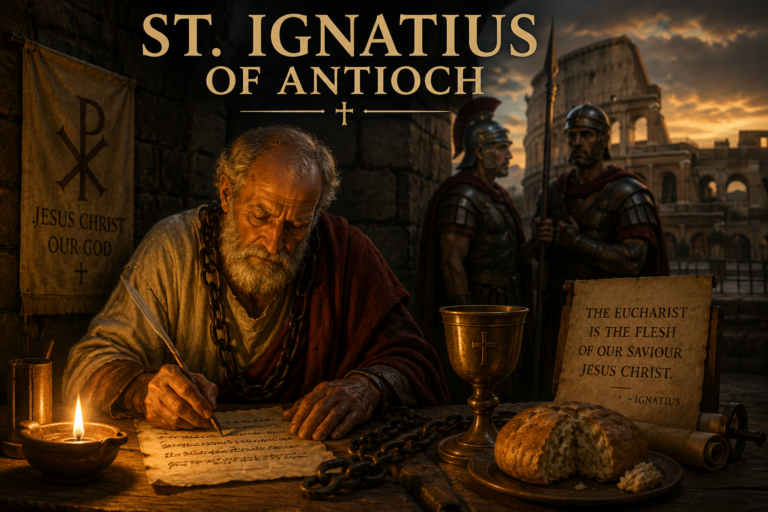
Ignatius of Antioch
near the beginning of the second century speaks of the Eucharist as the flesh of Jesus Christ.
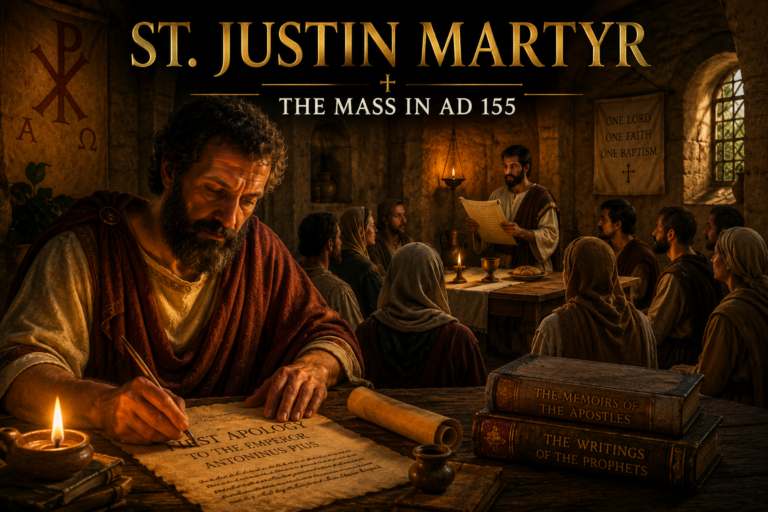
Justin Martyr
around AD 155 tells us Christians do not receive the Eucharist as ordinary bread and drink.
And now:
Irenaeus
around AD 180 uses the Eucharist itself as part of his argument for the reality of Christ’s Incarnation and the resurrection of our bodies.
Three early witnesses.
Different circumstances.
The same deeply sacramental Christianity.
The Eucharist Also Shows That Creation Is Good
This mattered greatly against Gnosticism.
Some Gnostic systems treated the material world as something inferior or evil.
Christianity teaches something very different.
God created the material world.
And:
“God saw everything that he had made, and behold, it was very good.”
— Genesis 1:31
The eternal Son then genuinely became flesh.
And Christ takes material things:
bread
and:
wine
and makes them part of the sacramental life of His Church.
For Irenaeus, Christianity does not teach escape from God’s creation.
It teaches its:
redemption.
Irenaeus and Mary — The New Eve
Irenaeus also gives us one of the earliest and most important witnesses to a doctrine we have already encountered in our Mariology section:
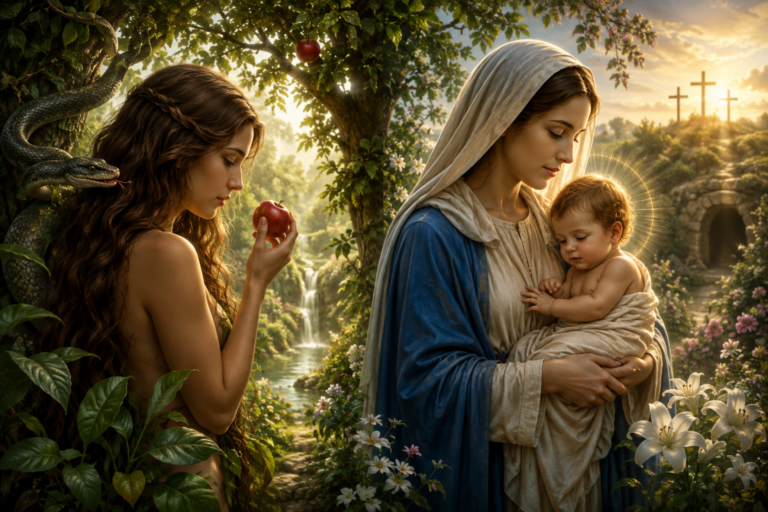
Mary as the New Eve
He compares the disobedience of Eve with the obedience of Mary.
Eve, while still a virgin, disobeys.
Mary, also a virgin, responds to God in faith and obedience.
The knot created by Eve’s disobedience is undone through Mary’s obedience.
The parallel is:
Eve → Mary
just as St. Paul gives us:
Adam → Christ
This is extremely important.
The New Eve understanding of Mary was not created in the Middle Ages.
We find it explicitly developed by:
Irenaeus in the second century.
Mary Does Not Replace Christ
Irenaeus’ New Eve theology also helps prevent a common misunderstanding.
Mary is not presented as a rival to Jesus.
The entire comparison depends upon:
Christ being the New Adam.
Jesus is the Redeemer.
Jesus conquers death.
Jesus is the source of salvation.
Mary’s role exists entirely because of her relationship to Him.
Her obedience stands in contrast to Eve’s disobedience because through Mary’s faithful consent:
the Saviour enters the world.
This is an early Christian way of reading the Bible typologically.
And it is deeply Catholic.
The Rule of Faith
Another important idea in Irenaeus is often called:
The Rule of Faith
This refers to the basic Apostolic faith confessed throughout the Church.
God is the Creator.
Jesus Christ is His Son.
Christ truly became man.
He suffered.
He rose from the dead.
He will return.
The Holy Spirit works within God’s plan of salvation.
This basic faith existed across widely separated Christian communities.
Irenaeus points to the remarkable unity of Christian belief throughout the world.
Christians may live in different countries.
They may speak different languages.
But the Apostolic faith remains:
one.
One Church Across the World
For Irenaeus, geographic distance does not create different Christianities.
The churches throughout the world confess the same faith.
That is the meaning of:
Catholicity
The Church is:
universal.
It is spread throughout the nations.
Yet it possesses one Apostolic faith.
This fits beautifully with what Ignatius of Antioch had already called:
The Catholic Church
decades earlier.
Ignatius gives us the name.
Irenaeus shows us the principle in action.
Why Heresy Could Be Identified
This is how Irenaeus believes false teaching can be recognised.
Ask:
Does this teaching come from the Apostles?
Is it found in the churches founded by the Apostles?
Is it consistent with the faith publicly taught throughout the Church?
Can its teachers demonstrate continuity with the Apostolic succession?
The Gnostics could not do this.
Their teachings appeared later.
Their alleged secret knowledge could not be demonstrated through the public succession of the Church.
Irenaeus therefore turns history itself into an apologetic argument.
That Argument Still Matters Today
Imagine someone appearing today and saying:
“Christianity became corrupted immediately after the Apostles.”
There is a question we should ask:
Where is the evidence?
Because when we examine the earliest surviving Christian documents, we find continuity.
The Didache shows:
Baptism
Eucharistic worship
Sunday gathering
bishops and deacons.
Ignatius gives us:
bishop
presbyter
deacon
the Eucharist as Christ’s flesh
and:
the Catholic Church.
Justin gives us:
Scripture readings
the homily
prayers
bread and wine
the Eucharistic thanksgiving
and:
Sunday worship resembling the structure of the Mass.
And Irenaeus now gives us:
Apostolic Tradition
Apostolic Succession
the succession of bishops
the special importance of Rome
the Eucharist
and:
Mary as the New Eve.
These witnesses reinforce one another.
Christianity Was Handed Down
One of the most important ideas in Irenaeus can be expressed with one word:
Received
The Church did not invent the Gospel.
The bishops did not create Christianity.
The Church:
received it.
The Apostles received the Gospel from Christ.
They preached it.
They entrusted it to the churches.
The next generation received it.
And they handed it on.
This is the meaning of:
Tradition
The Latin word traditio simply refers to something:
handed on
or:
delivered.
And Scripture itself uses exactly this idea.
Paul tells the Thessalonians:
“Stand firm and hold to the traditions which you were taught by us, either by word of mouth or by letter.”
— 2 Thessalonians 2:15
Written.
And oral.
Both coming from the Apostles.
Irenaeus shows us what that looked like in the generations immediately following them.
Did the Early Church Believe in Sola Scriptura?
If by Sola Scriptura we mean that Scripture is inspired and uniquely God’s written Word, Irenaeus would strongly defend Scripture.
He quotes it constantly.
But if Sola Scriptura means that the individual Christian possesses Scripture as the sole binding authority apart from Apostolic Tradition and the teaching authority of the Church, Irenaeus gives us a very different picture.
His defence of Christianity depends upon:
Scripture
Tradition
Apostolic succession
and:
the Church.
For Irenaeus, these belong together.
Why St. Irenaeus Matters
Irenaeus matters because he answers one of the most important questions in Christian history:
How did Christians know what authentic Christianity was?
His answer was not:
“Whichever interpretation seems most convincing to you.”
His answer was historical.
Look to the faith:
handed down from the Apostles.
Look to the churches:
founded by the Apostles.
Look to the bishops:
who succeeded the Apostles.
Look to the teaching:
confessed throughout the universal Church.
Christian truth was not secret.
It was public.
It was visible.
And it had continuity.
A Chain Reaching Back to Christ
This is what makes Irenaeus such a powerful witness.
He does not stand hundreds upon hundreds of years removed from Christianity’s beginnings.
His own life reaches backwards through men who remembered the Apostolic generation.
Think again about that chain:
Christ
↓
The Apostles
↓
Polycarp
↓
Irenaeus
And Irenaeus tells us that the Christian faith is preserved through precisely this kind of transmission.
Not through secret revelation.
Not through rediscovery centuries later.
But through:
Apostolic Tradition
and:
Apostolic Succession.
What Kind of Church Does Irenaeus Describe?
When we read Irenaeus, a clear picture emerges.
He describes a Church that is:
visible
universal
Apostolic
sacramental
governed by bishops
rooted in Scripture
guided by Apostolic Tradition
and:
historically continuous with the Apostles.
He points to Rome.
He points to episcopal succession.
He points to the Eucharist.
He points to the universal faith.
He even gives us one of the earliest great explanations of:
Mary as the New Eve.
Once again, the closer we move toward the age of the Apostles, the harder it becomes to argue that Catholic features appeared only many centuries later.
The evidence points in the opposite direction.
The roots are already there.
And St. Irenaeus tells us exactly why.
Because the Church did not create a new faith.