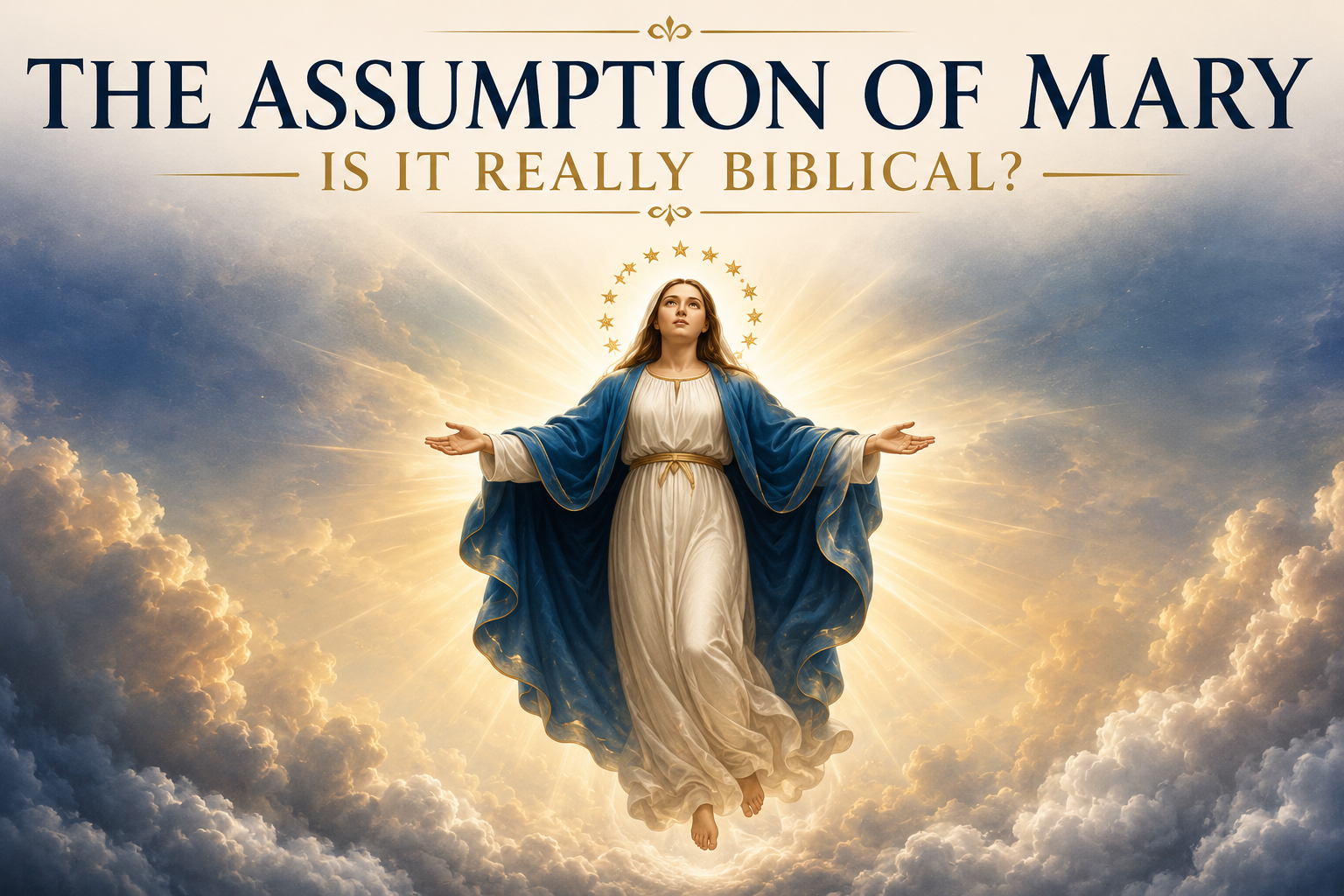
The Assumption of Mary — Is It Really Biblical?
One of the most common objections made against Catholic teaching on Mary is simple:
“Where does the Bible say that Mary was assumed into Heaven?”
There is no verse that simply says:
“And Mary was taken body and soul into Heaven.”
But that does not mean the Assumption is disconnected from Scripture.
Catholic teaching does not rest upon isolated proof-texts. Scripture reveals God’s plan through prophecy, fulfilment, patterns and biblical typology. And when Mary is viewed within the whole story of salvation — from Genesis to Revelation — something remarkable emerges.
The Bible begins with a Woman, her Seed, and a serpent.
The Bible ends with a Woman, her Son, and a dragon.
Between those two scenes stands the Ark of the Covenant — first on earth, and finally seen in Heaven.
And immediately after John sees the heavenly Ark, he sees a Woman clothed with the sun.
That is where the biblical case for the Assumption begins.
—
What Does the Catholic Church Actually Teach?
The Church teaches that:
«“The Immaculate Virgin… when the course of her earthly life was finished, was taken up body and soul into heavenly glory.”»
This is the doctrine of the Assumption of Mary.
Notice something important.
The Church says that Mary was taken up.
Jesus ascended into Heaven by His own divine power.
Mary was assumed into Heaven by the power of God.
Mary is not divine. She did not raise herself. Everything she possesses comes from the grace and power of her Son.
The Assumption therefore glorifies Christ, not Mary independently of Christ.
—
The First Prophecy: The Woman and the Serpent
Immediately after the Fall, God speaks to the serpent:
«“I will put enmity between you and the woman, and between your seed and her seed.”
— Genesis 3:15»
This passage is often called the Protoevangelium — the “First Gospel” — because it is the first announcement of the coming victory over Satan.
Notice the unusual language.
God does not merely speak about a future man.
He specifically places before us:
The serpent.
The Woman.
The serpent’s seed.
The Woman’s Seed.
The ultimate Seed is Christ.
But who is the Woman?
At the immediate level Eve stands before the serpent. Yet the prophecy reaches far beyond Eve because the final victory comes through Jesus Christ, born of a woman.
This connection was recognised extremely early in Christianity.
Around AD 180, St Irenaeus contrasted Eve’s disobedience with Mary’s obedience, teaching that what the virgin Eve bound through unbelief, the Virgin Mary helped undo through faith.
Irenaeus also directly connected Genesis 3:15 with Christ being born “from the Virgin” to conquer the serpent.
This is not medieval Catholic imagination.
The Mary–Eve parallel appears within Christianity centuries before the Council of Nicaea.
And Genesis 3 will become extremely important when we reach Revelation 12.
—
Isaiah Also Foretells the Virgin
Centuries before Christ, Isaiah prophesied:
«“Behold, a virgin shall conceive, and bear a son, and shall call his name Emmanuel.”
— Isaiah 7:14»
This obviously centres upon Christ — Emmanuel, God with us.
But a prophecy about a virgin conceiving the Messiah necessarily also points toward the Virgin herself.
St Justin Martyr was already arguing from Isaiah’s virgin prophecy in the second century, long before later Marian controversies arose.
Mary therefore does not suddenly appear without preparation in the Gospel of Luke.
She belongs to a plan God had been revealing throughout the Old Testament.
—
Mary as the New Ark of the Covenant
This brings us to one of the most important biblical keys to understanding Mary.
In the Old Covenant, the Ark of the Covenant was the holiest object in Israel.
The Ark contained signs of God’s covenant presence.
It contained:
– the tablets of the Law — the Word of God
– manna — the bread from Heaven
– the priestly rod of Aaron
Then Mary carried within her womb:
– Jesus, the Word made flesh
– Jesus, the true Bread from Heaven
– Jesus, the eternal High Priest
The old Ark carried symbols.
Mary carried the reality.
The parallels become even more striking when Luke’s account of Mary’s visitation is compared with David bringing the Ark into the hill country in 2 Samuel 6.
David asks:
“How can the ark of the Lord come to me?”
Elizabeth asks:
“And how does this happen to me, that the mother of my Lord should come to me?”
David leaps before the Ark.
John the Baptist leaps in Elizabeth’s womb before Mary.
The Ark remained in the house of Obed-edom for three months.
Mary remained with Elizabeth for about three months.
Luke is presenting Mary using the imagery of the Ark.
And once that connection is recognised, Revelation becomes extraordinary.
—
The Ark Appears in Heaven
Near the end of Revelation 11, John writes:
«“Then God’s temple in heaven was opened, and the ark of his covenant was seen within his temple.”
— Revelation 11:19»
Think about what John has just said.
The Ark is seen in Heaven.
And what does John see immediately afterward?
«“And a great sign appeared in heaven: a woman clothed with the sun, with the moon under her feet, and on her head a crown of twelve stars.”
— Revelation 12:1»
The chapter numbers were added many centuries after Revelation was written.
For John, these scenes flow directly into one another:
The heavenly Temple opens.
The Ark appears.
Then the Woman appears in Heaven.
If Mary has already been presented in Luke as the New Ark, this sequence is difficult simply to dismiss.
—
Who Is the Woman of Revelation 12?
The Woman has several levels of meaning.
She represents Israel, from whom the Messiah came.
She represents the Church, whose children are persecuted by Satan.
But she also has an unmistakable Marian dimension.
Why?
Because she gives birth to:
«“a male child, one who is to rule all the nations with a rod of iron.”
— Revelation 12:5»
That language comes from Psalm 2 and identifies the child as the Messiah — Jesus Christ.
Who gave birth to Jesus?
Mary.
Therefore it is unnecessary to choose between Mary, Israel and the Church as though only one interpretation can exist.
Mary is the daughter of Israel.
Mary gives birth to Christ.
And Mary becomes an image of the Church.
Even some Reformation-era interpreters acknowledged a Marian dimension to the Woman precisely because Christ is her Son.
But notice where John sees her:
“A great sign appeared in heaven.”
The Woman is depicted in heavenly glory:
clothed with the sun,
the moon beneath her feet,
and crowned with twelve stars.
This is not an insignificant woman disappearing from salvation history after Acts.
This is the Mother of the Messiah shown within the final cosmic battle between Christ and Satan.
—
Genesis and Revelation Complete the Picture
Now place Genesis 3 beside Revelation 12.
Genesis 3
A Woman
Her Seed
A serpent
War between their offspring
Revelation 12
A Woman
Her Son
A dragon — explicitly identified as the ancient serpent
War against the Woman and her offspring
Revelation actually identifies the dragon as:
«“that ancient serpent, who is called the Devil and Satan.”»
The language deliberately takes us back to Genesis.
The Woman promised in the opening chapters of Scripture reappears in the final book of Scripture.
The battle announced in Genesis reaches its climax in Revelation.
The first Eve stood before the serpent and was defeated.
The New Eve stands within the victory of her Son over the ancient serpent.
Christ is always the source of that victory.
Mary participates in it because she belongs completely to Christ.
—
“Arise, O Lord… You and the Ark”
Another remarkable Old Testament passage appears in Psalm 132:
«“Arise, O Lord, and go to your resting place, you and the ark of your might.”
— Psalm 132:8»
In its original historical context, the Psalm concerns God’s dwelling and the Ark.
But Christians have long seen a deeper typological significance.
If Christ is the fulfilment of God’s presence among His people, and Mary is the New Ark who bore Him, the image of the Lord arising with His Ark becomes especially significant when contemplating Mary’s glorification.
Pope Pius XII specifically noted the traditional Christian application of this verse to the Assumption in Munificentissimus Deus.
Again, this is typology, not an attempt to pretend the Psalm originally contained the name “Mary.”
The Old Testament type finds a greater fulfilment in the New.
The old Ark was holy because of what it contained.
How much more extraordinary is the woman who carried God Himself made flesh?
—
Can God Take Someone Bodily Into Heaven?
Sometimes the Assumption is rejected as though bodily translation into Heaven would itself contradict Scripture.
But Scripture already gives examples.
Enoch
Genesis tells us:
«“Enoch walked with God; and he was not, for God took him.”
— Genesis 5:24»
Hebrews explains:
«“By faith Enoch was taken up so that he should not see death.”
— Hebrews 11:5»
Elijah
Elijah is taken from the earth in a whirlwind:
«“And Elijah went up by a whirlwind into heaven.”
— 2 Kings 2:11»
So the objection cannot be:
“God would never take a human person bodily from this world.”
Scripture already establishes that He can.
The real question is whether God granted a unique bodily glorification to the woman chosen to become the Mother of His incarnate Son.
Catholics believe He did.
—
Did Mary Die Before the Assumption?
The Church has deliberately not defined this question.
The dogmatic definition says:
«“Having completed the course of her earthly life…”»
It does not state whether Mary first died and was then raised, or whether God assumed her without death.
The ancient Eastern tradition usually speaks of Mary’s Dormition, or “falling asleep,” and therefore commonly holds that she died before being bodily glorified.
But a Catholic is not required by the dogmatic definition to settle that question.
What Catholics must believe is that Mary was taken body and soul into heavenly glory.
—
What About the Early Church?
Historical honesty matters here.
We should not claim that we possess a document from AD 100 describing Mary’s Assumption.
We do not.
The New Testament does not record how Mary’s earthly life ended, and the earliest surviving Christian writers give us very little information about it.
Around AD 377, St Epiphanius explicitly acknowledged the uncertainty surrounding Mary’s earthly end. He noted that Scripture does not tell us whether she died and refused to claim certainty about the manner of her departure.
That should be admitted openly.
But notice what this does not prove.
It does not prove that Mary’s body corrupted in a grave.
It does not prove that the Assumption never happened.
It proves that the details of Mary’s final earthly moments were not preserved clearly in our earliest surviving written sources.
Over the following centuries, traditions concerning Mary’s Dormition and bodily glorification become increasingly explicit, and eventually the feast becomes established throughout Christian worship.
The doctrine therefore should not be presented as though Catholics discovered a forgotten sentence in the New Testament.
The Catholic claim is broader:
Scripture provides the theological pattern.
Apostolic Tradition preserves the faith of the Church.
The Church, guided by the Holy Spirit, eventually defines explicitly what had come to be universally confessed.
That is precisely why Catholic Christianity cannot be reduced to Scripture alone.
—
The Assumption and the Resurrection
The Assumption is also about something far greater than Marian devotion.
It tells us what Christ intends ultimately to accomplish for us.
Christian salvation is not simply the rescue of an invisible soul.
We confess:
“I believe in the resurrection of the body.”
Christ rose bodily.
At the end of time, those who belong to Him will also be raised bodily.
Mary’s Assumption is therefore an anticipation of the destiny promised to the Church.
The Catechism calls it:
«“a singular participation in her Son’s Resurrection and an anticipation of the resurrection of other Christians.”»
Mary does not replace Christ.
Mary shows us what Christ’s victory looks like when completely fulfilled in a human creature.
—
From the Woman in Genesis to the Woman in Revelation
Now step back and look at the whole biblical story.
Genesis
A Woman and her Seed are placed in opposition to the serpent.
Isaiah
A Virgin will conceive and bear Emmanuel.
The Gospel
The Virgin conceives by the Holy Spirit and gives birth to Jesus Christ, God with us.
Luke
Mary is presented using the imagery of the Ark of the Covenant.
Revelation
The Ark appears in Heaven.
Immediately John sees:
A Woman in Heaven,
clothed with the sun,
crowned with twelve stars,
who gives birth to the Messiah.
Then the ancient serpent attacks her and her offspring.
That is the Bible’s Marian landscape.
Not a goddess.
Not a rival to Christ.
Not someone worshipped alongside God.
But the Woman chosen by God, whose entire dignity comes from the Son she carried.
—
So Is the Assumption Biblical?
If by “biblical” someone means:
“Is there one verse explicitly narrating Mary’s Assumption?”
Then the answer is no.
The Catholic Church has never needed to pretend otherwise.
But if the question is:
“Does the Assumption fit the biblical revelation concerning Mary, the New Eve, the Ark, the Woman of Genesis and the Woman seen in heavenly glory in Revelation?”
Then the answer is profoundly yes.
The Assumption does not appear out of nowhere.
It fits a pattern running from the first pages of Scripture to the last.
The Bible begins with:
the Woman,
her Seed,
and the serpent.
And it ends with:
the Woman,
her victorious Son,
and the ancient serpent defeated.
At the centre of everything is Jesus Christ.
Mary’s Assumption is ultimately another testimony to His victory.
Christ conquered sin.
Christ conquered Satan.
Christ conquered death.
And in the woman who gave Him His human flesh, the Church sees the first extraordinary anticipation of what Christ ultimately promises to all those who belong to Him:
the resurrection of the body and life everlasting.